Davos Pivots to AI ROI, Agentic AI Enters Production, Hardware-Software Divergence Grows
Davos 2026 shifts from AI hype to ROI demands. Agentic AI operations move into production with focus on observability. The stock market divergence between AI hardware winners and software losers widens.
1. Davos Pivots from AI Hype to ROI Demands
Fortune reported that at Davos 2026, "AI hype gives way to focus on ROI" as executives and investors demand concrete returns on the hundreds of billions being invested in AI infrastructure. The shift signals that the AI industry's honeymoon period is ending — now it must deliver measurable business value.
Source: Fortune
The ROI pivot is healthy and overdue. For enterprises that have been running AI pilots without clear success metrics, the pressure to demonstrate value is intensifying. SEN-X recommends establishing ROI frameworks before launching AI initiatives — not after. Define what success looks like in measurable terms: cost reduction, revenue impact, speed improvement, or error reduction.
2. Agentic AI Operations Move Into Production
Help Net Security reported that agentic AI operations are moving into production as organizations focus on observability, human oversight, and control of autonomous systems. The shift from pilot to production represents a maturity milestone for AI agents in enterprise environments.
Source: Help Net Security
Agentic AI in production means organizations are trusting AI systems to take actions autonomously — not just provide recommendations. The focus on observability and human oversight is critical: you need to know what your AI agents are doing, why, and with what confidence level. This is exactly the governance framework SEN-X builds into every agentic AI deployment.
3. AI Stock Rally Creates Hardware-Software Divergence
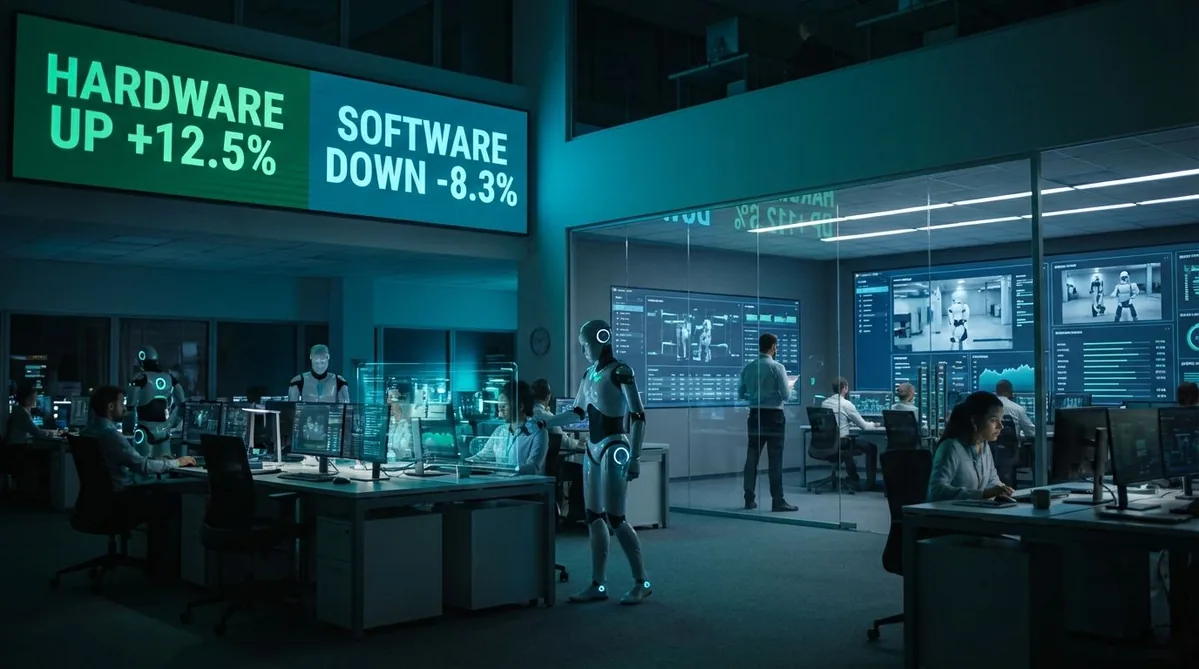
Investopedia published an analysis showing that "AI-driven growth is lifting hardware stocks while fear of AI disruption hammers software." The divergence creates a two-track market where AI enablers (chips, cloud, infrastructure) benefit while AI-disrupted sectors (SaaS, services) suffer.
Source: Investopedia
The hardware-software divergence is the stock market's prediction about AI's structural impact: infrastructure providers win, legacy software gets disrupted. For enterprises, this means investing in AI infrastructure (compute, data, security) while critically evaluating your software stack for AI replacement opportunities.
4. Industrial AI Trust Requires Transparency and Governance
Leon Lauritsen, CEO of Aras, explained in DirectIndustry Magazine that organizational trust in AI at scale depends on strong data governance, transparency, and context — not just model capability. The insight is particularly relevant for manufacturing and industrial AI deployments where errors can have physical consequences.
Source: DirectIndustry
Trust is the bottleneck for industrial AI adoption. Unlike consumer AI where errors are inconvenient, manufacturing AI errors can be dangerous and expensive. Lauritsen's emphasis on data governance and transparency aligns with SEN-X's approach: build trust through explainability, auditability, and human-in-the-loop design — especially for safety-critical applications.
🔍 Why It Matters for Business
The transition from AI hype to AI accountability is the defining theme of late January 2026. ROI demands, production agentic AI, market divergence, and industrial trust all point to an AI industry entering its next phase: proving value.
Enterprises that can demonstrate measurable AI value, maintain transparency, and build trust will lead their industries. Those still running unfocused experiments will fall behind.
Need help navigating AI for your business?
Our team turns these developments into actionable strategy — from architecture to deployment.
Contact SEN-X →