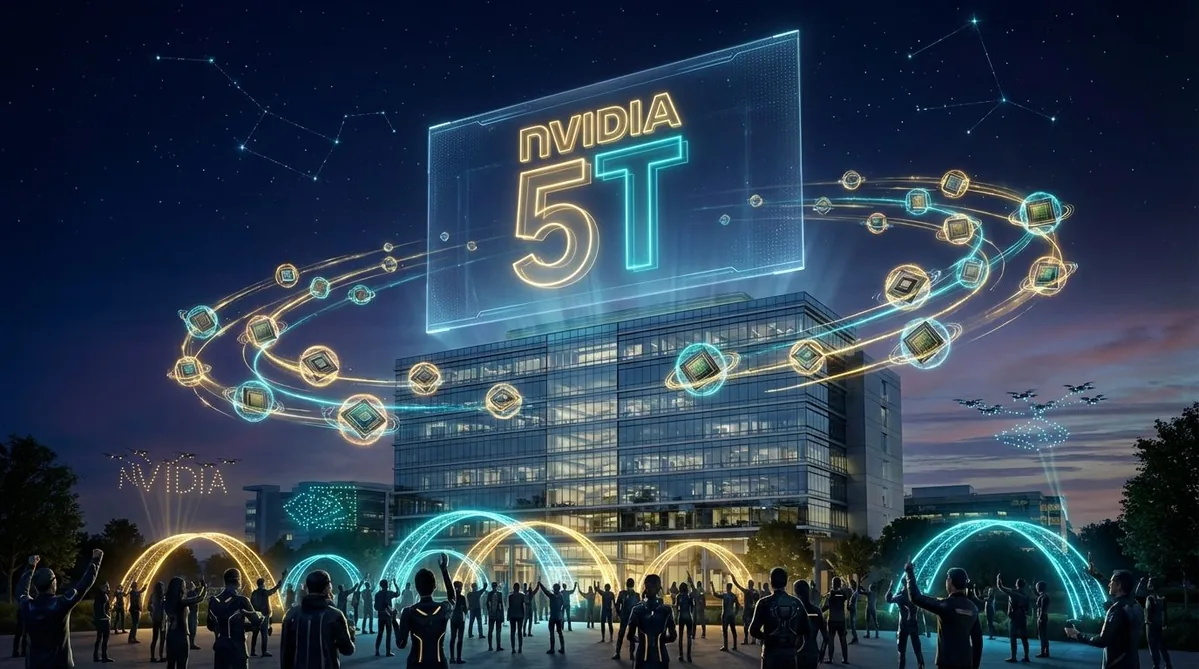
NVIDIA Becomes First $5T Company, Chip Industry Hits $1T Revenue, Dassault Partnership
NVIDIA makes history as the first company to reach $5 trillion market cap. The semiconductor industry crosses $1 trillion in annual revenue. Jensen Huang and Dassault announce an industrial AI partnership.
1. NVIDIA Becomes First Company to Reach $5 Trillion Market Cap
NVIDIA made history on February 7 by briefly surpassing $5 trillion in market valuation — becoming the first company ever to reach that milestone. CNN reported that the surge was driven by overwhelming demand for Blackwell and next-generation Rubin GPU platforms, combined with Big Tech's $650 billion AI spending plans for 2026.
The previous day, NVIDIA shares had surged 7.8% — adding roughly $325 billion in value in the fourth-largest one-day market cap gain for any stock ever.
Source: CNN
$5 trillion is not a stock market number — it's an infrastructure thesis validated. NVIDIA's valuation reflects the market's belief that AI compute is as foundational to the 21st century economy as electricity was to the 20th. For enterprises, this means the AI infrastructure arms race is well-funded and will continue accelerating. Plan your AI strategy on the assumption that compute will get cheaper and more available, not scarcer.
2. Semiconductor Industry Crosses $1 Trillion Revenue Milestone
Bloomberg reported that the semiconductor industry will reach $1 trillion in revenue in 2026 for the first time ever, fueled by AI and the proliferation of chips across every sector of the economy. Total industry sales were $791.7 billion in 2025 and are forecast to surge another 26% in 2026, according to the Semiconductor Industry Association.
Source: Bloomberg
A trillion-dollar chip industry means semiconductors are now as economically significant as entire national GDPs. For manufacturing and distribution companies, the chip supply chain is increasingly relevant to your operations — whether you're building AI-enabled products, running smart factories, or optimizing logistics with edge computing.
3. NVIDIA and Dassault Systèmes Announce Industrial AI Partnership
Jensen Huang and Dassault Systèmes CEO Pascal Daloz announced a partnership at 3DEXPERIENCE World to build a shared industrial AI architecture, merging virtual twins with physics-based AI to redefine design, engineering, and manufacturing. The collaboration aims to make digital twins AI-native.
Source: NVIDIA Blog
The NVIDIA-Dassault partnership signals that industrial AI is entering its production phase. AI-powered digital twins that incorporate real physics simulation will transform manufacturing, construction, and product development. Companies in these sectors should be evaluating how AI-enhanced simulation can reduce prototyping costs and accelerate time-to-market.
4. NVIDIA Authorized to Sell AI Chips to China
Bloomberg reported that the US government authorized NVIDIA to sell its workhorse AI chip — the H200 — to China, a move Jensen Huang had lobbied for aggressively. The decision reopens a massive market for NVIDIA but carries significant geopolitical risks around technology transfer.
Source: Bloomberg
US chip exports to China create a complex competitive dynamic. While NVIDIA benefits commercially, the move could accelerate China's AI capabilities. For enterprises with global operations, the AI technology export landscape is a regulatory risk factor that needs monitoring. Your AI strategy shouldn't assume permanent technology asymmetries between US and Chinese capabilities.
🔍 Why It Matters for Business
February 7, 2026 was a milestone day for the AI economy: NVIDIA's $5T valuation and the chip industry's $1T revenue mark the arrival of AI as a fundamental economic force. The Dassault partnership shows this isn't just about software — it's about reimagining physical industries through AI.
Every business leader should internalize this: AI infrastructure investment is accelerating, not peaking. Build your strategy accordingly.
Need help navigating AI for your business?
Our team turns these developments into actionable strategy — from architecture to deployment.
Contact SEN-X →