Altman and Amodei Won't Hold Hands, Musk Wants Data Centers in Space, 6.1M Workers Face AI Reckoning
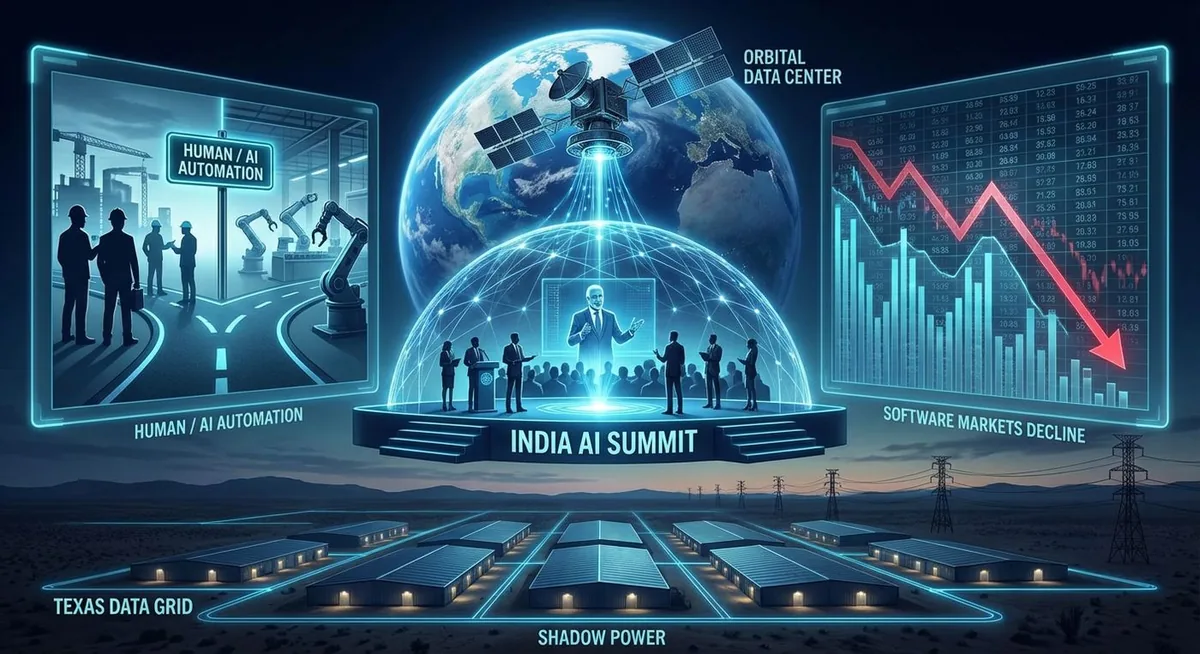
The India AI Summit produces its most viral moment as OpenAI and Anthropic's CEOs refuse to link hands during a Modi-orchestrated unity photo. Elon Musk files plans for a million-satellite data center network while Silicon Valley quietly builds a shadow power grid across America. Brookings identifies 6.1 million workers trapped in AI's kill zone. The SaaSpocalypse claims another $300 billion. Global AI spending is forecast to hit $2.5 trillion this year. And The Guardian launches a major series on AI's human toll. Here's your Thursday briefing.
1. Altman and Amodei Refuse to Hold Hands at India AI Summit — Rivalry Goes Viral
The India AI Impact Summit in New Delhi produced many headlines on Thursday, but none spread faster than a single photograph: OpenAI CEO Sam Altman and Anthropic CEO Dario Amodei standing side by side on stage with Prime Minister Narendra Modi, conspicuously refusing to hold each other's hands during what was supposed to be a show of global AI unity.
Modi had orchestrated the moment — lifting the hands of Altman and Google CEO Sundar Pichai before an applauding crowd, with all 13 tech leaders on stage following suit. All except the two men standing next to each other. Altman and Amodei raised their fists independently rather than clasping hands, creating an image that Bloomberg, Reuters, the AP, TechCrunch, and CNBC all ran as their lead story. Siddharth Bhatia, cofounder of AI startup Puch AI, captured the internet's mood on X: "When AGI? The day Dario and Sam hold hands." Andreessen Horowitz partner Justine Moore shared the photo with the caption: "When you're forced to do a group project with your opp."
The personal animosity has corporate roots. Amodei co-founded Anthropic in 2021 after leaving OpenAI over disagreements about safety practices — a departure that has become the defining schism in the AI industry. The rivalry has intensified dramatically in 2026: Anthropic ran Super Bowl ads mocking OpenAI's plan to introduce advertising in ChatGPT, which Altman called "clearly dishonest." Anthropic's chief customer officer, Paul Smith, responded by telling CNBC the company was focused on "growing its business rather than making flashy headlines" — a veiled shot at OpenAI's increasingly consumer-media-company trajectory.
The summit itself was substantive. French President Emmanuel Macron attended, declaring that "AI has become a major field of strategic competition." Switzerland announced it will host the 2027 AI Summit in Geneva. And Altman used his keynote to predict that AI costs will "fall dramatically," telling PTI: "If costs come down dramatically, I think that helps the Global South the most."
"When you're forced to do a group project with your opp." — Justine Moore, a16z investing partner, on the Altman-Amodei photo
Source: CNBC, TechCrunch, Reuters, Bloomberg
The handshake refusal is entertaining theater, but the strategic implications are real. OpenAI and Anthropic are diverging not just in personality but in business model: OpenAI is moving toward an ad-supported consumer platform (think AI-native Google), while Anthropic is positioning as the enterprise-grade, safety-first alternative. For enterprise buyers evaluating AI platforms, this matters. You're not just choosing a model — you're choosing an ecosystem philosophy. Companies that need strict data privacy and no ad-driven incentives to monetize user interactions should be leaning Anthropic. Companies building consumer-facing AI products may find OpenAI's broader ecosystem more aligned. The "rivalry" isn't just personal drama — it's a fork in the road for the entire AI industry.
2. Musk Files for Million-Satellite Data Center Network as Silicon Valley Builds a "Shadow Power Grid"
Two intertwined stories emerged on Thursday that together paint a stark picture of AI's insatiable appetite for energy — and the increasingly radical solutions being pursued to feed it.
First, Fortune reported that SpaceX has filed plans with the FCC for what amounts to a million-satellite data center network in orbit. Elon Musk has said he plans to merge his AI startup xAI with SpaceX to pursue orbital data centers, and at an all-hands meeting last week told xAI employees the company would "ultimately need a factory on the moon to build AI satellites — along with a massive catapult to launch them into space." At Davos in January, Musk predicted: "The lowest-cost place to put AI will be in space, and that will be true within two years, maybe three at the latest."
Musk isn't entirely alone in this thinking. Alphabet CEO Sundar Pichai has said Google is exploring "moonshot" data center concepts for later this decade. Former Google CEO Eric Schmidt has warned the industry is "running out of electricity." And Jeff Bezos has discussed orbital data centers as a natural extension of Blue Origin's space ventures.
But experts are deeply skeptical. Fortune quoted analysts saying that running AI data centers in orbit would require "ginormous" solar arrays that don't yet exist, and that constraints around power generation, heat dissipation, launch logistics, and cost make space a "poor substitute for earth-based data centers anytime soon." The consensus: meaningful orbital computing is decades away, not years.
Meanwhile, back on Earth, the Washington Post revealed that Silicon Valley is building what amounts to a "shadow power grid" — private power plants attached directly to data centers, bypassing the public electrical grid entirely. The flagship example: the GW Ranch project on 8,000 acres of West Texas, where dozens of airplane-hangar-sized data center warehouses will consume more power than all of Chicago, powered by on-site natural gas and solar plants. The approach lets tech companies avoid the years-long queue for grid connections but raises serious concerns about carbon emissions and environmental impact.
"The lowest-cost place to put AI will be in space, and that will be true within two years, maybe three at the latest." — Elon Musk, Davos 2026
Source: Fortune, The Washington Post
Ignore the space data center headlines — they're a distraction from the real story, which is the shadow power grid. Tech companies building their own private energy infrastructure is a signal that the existing electrical grid cannot keep pace with AI compute demand, and that the industry has decided it's faster to build around the problem than wait for regulators and utilities to solve it. For enterprise leaders, this has two immediate implications: (1) energy costs for AI compute will be volatile and regionally dependent — choose your data center partners based on their energy strategy, not just their GPU count; (2) ESG reporting is about to get much more complicated, because your AI workloads may be running on private natural gas plants that don't appear in standard grid-emissions calculations. The companies consuming more power than Chicago deserve scrutiny, not applause.
3. Brookings: 6.1 Million Workers Are Highly Exposed to AI With No Escape Route
A new study from the Brookings Institution published Thursday quantifies what many have feared but few have measured precisely: 6.1 million American workers occupy jobs that are both highly exposed to AI automation and offer low ability to transition to new employment. They are, in the study's framework, trapped — in AI's kill zone with no clear exit.
Researchers led by senior fellow Sam Manning mapped occupations along two axes: AI exposure (how vulnerable the job is to automation) and adaptability (how easily workers in that role can find alternative employment). The results reveal a deeply unequal landscape. Software developers, for instance, face high AI exposure but have high adaptability — they can pivot. Customer service representatives get the worst of both worlds: high exposure and low adaptability. Dentists face little AI threat and could adapt easily. Janitors and roofers are safe from AI but would struggle to switch careers if needed.
The demographic findings are particularly stark. "These workers tend to be concentrated in clerical and administrative roles, and about 86% are women," the researchers wrote. The 6.1 million figure is comparable in scale to the 7.3 million Americans currently unemployed, effectively suggesting AI could create a shadow unemployment crisis concentrated among women in administrative work.
The study arrives alongside a separate Investopedia analysis confirming that interpreters and translators are the single most AI-vulnerable occupation, and a Fortune report that a Federal Reserve governor acknowledged an AI "doomsday" scenario where many workers become "essentially unemployable" is "totally possible." The Fed governor's comments came as job creation has been "near zero" over the previous year while inflation remains elevated at 3%.
"The combination of employment size, potentially elevated automation impacts, and precarious worker traits highlights occupations where policymakers may benefit from greater visibility into AI's workforce effects." — Brookings Institution researchers
Source: Investopedia, Fortune, Indeed Hiring Lab
The 86% women statistic should be a fire alarm for every enterprise HR department. If your AI deployment strategy is automating clerical and administrative roles without a parallel reskilling program, you're not just creating a workforce problem — you're creating a gender equity crisis that will attract regulatory, legal, and reputational risk. The Brookings framework (exposure × adaptability) is also a useful tool for enterprise workforce planning: map your own roles on that matrix, identify the high-exposure/low-adaptability clusters, and begin building transition pathways now — before the automation arrives. The Fed governor's "totally possible" doomsday comment is notable because central bankers almost never use language that stark. When the Fed is worried, enterprises should be acting.
4. The SaaSpocalypse Deepens: $300B Wiped in a Single Week as Software Stocks Enter Free Fall
The software sector's AI-driven sell-off continued to dominate financial markets this week, with nearly $300 billion in market value evaporating from software stocks in a single week of trading. The carnage now stretches across the industry's biggest names: Palantir is down 22% year-to-date, while Adobe, Salesforce, and ServiceNow have all shed 25-30% since January 1.
Business Insider compiled reactions from industry leaders, and the commentary is remarkably candid. Zoho founder Sridhar Vembu argued that SaaS was "ripe for consolidation" long before AI arrived: "An industry that spends vastly more on sales and marketing than on engineering and product development was always vulnerable. The venture capital bubble and then the stock market bubble funded a fundamentally flawed, unsustainable model for too long."
The trigger, according to CNN, was Anthropic's release of industry-specific AI tools tailored for legal and financial analysis — demonstrating that AI can now replicate functions that SaaS companies charge thousands of dollars per seat to provide. When a $20/month AI subscription can do what a $50,000/year enterprise software license does, the math stops working for incumbents. Financial Content documented that the meltdown reached "fever pitch" on February 3 — now known on trading floors as "Black Tuesday for Software" — and described a "massive sector rotation into value and industrials" as investors flee software for companies building the physical backbone of the AI age.
The Motley Fool offered a more measured view, noting that many software companies are still growing subscription revenue at 20%+ rates, and that the sell-off has compressed valuations to levels not seen in years — potentially creating buying opportunities for long-term investors willing to bet that software companies can adapt by embedding AI into their existing platforms rather than being replaced by it.
"An industry that spends vastly more on sales and marketing than on engineering and product development was always vulnerable." — Sridhar Vembu, founder of Zoho
Source: Business Insider, The Motley Fool, CNN
Vembu's quote is the most important sentence written about the SaaSpocalypse. The SaaS model was always more of a distribution and sales motion than a technology moat — and AI is exposing that reality. For enterprise buyers, this creates a rare window: negotiate aggressively on your software renewals. Your SaaS vendors know their stocks are cratering and their customers are evaluating AI alternatives. Use that leverage now, while the fear is fresh. For enterprises building on SaaS platforms: stress-test your dependency. If your critical workflow runs on a SaaS tool that's lost 30% of its market cap, understand the scenario where that vendor pivots, gets acquired, or shuts down. The SaaSpocalypse isn't just a stock market event — it's a signal that the enterprise software landscape is about to restructure dramatically.
5. AI Spending Forecast to Hit $2.5 Trillion in 2026 — Dwarfing History's Mega Projects
Al Jazeera published a striking visualization on Thursday comparing global AI spending forecasts to history's largest scientific and infrastructure projects — and the numbers are staggering. AI spending is projected to reach $2.5 trillion in 2026, a figure that dwarfs the Manhattan Project, the Apollo program, the International Space Station, and even the entire US interstate highway system when adjusted for inflation.
The breakdown reveals where the money is flowing. Reuters reported that the Magnificent Seven tech companies alone will spend approximately $630 billion on AI capital expenditure this year. Meta's AI capex plan for 2026 stands at $135 billion, with clear hardware commitments to Nvidia. Grand View Research projects that artificial intelligence spending across hardware, software, and services will increase at 30% annually through 2033.
Some investors are pivoting. Reuters noted a growing trend of US investors rotating from AI software stocks (hit by the SaaSpocalypse) into AI infrastructure plays — companies building data centers, manufacturing chips, and providing energy to the compute buildout. The logic: even if the software layer is uncertain, the physical infrastructure is being built regardless, and those investments represent decades of locked-in demand.
Republic World added global context, noting that AI investment is increasingly flowing into the Global South, with digital infrastructure and healthcare applications leading the way in emerging markets — a trend reinforced by the India AI Summit's massive investment pledges from Reliance, Adani, and Google this week.
AI spending in 2026 is forecast to reach $2.5 trillion globally — surpassing the largest scientific and infrastructure projects in human history.
Source: Al Jazeera, Reuters, Republic World
Two-and-a-half trillion dollars is not an investment — it's a civilizational bet. The comparison to the Apollo program and Manhattan Project isn't just a visualization gimmick; it reflects the reality that AI infrastructure is being built at a scale and speed that has no historical precedent. For enterprise leaders, the strategic question isn't whether AI is real (the $2.5 trillion answers that) — it's whether the return on that investment will materialize fast enough to justify it. The pivot from software to infrastructure stocks is a leading indicator: smart money believes the physical layer (chips, data centers, energy) is the safe bet, while the application layer (what software runs on top) is still uncertain. Position your enterprise accordingly — invest in infrastructure relationships and partnerships, and keep your application layer flexible enough to swap providers as the landscape shakes out.
6. The Guardian Launches "Reworked" — A Major Series on AI's Human Toll
The Guardian launched "Reworked" on Thursday, a major ongoing reporting series that centers "the human stakes as AI disrupts our workplaces, in ways both thrilling and alarming." The inaugural piece argues that while AI has workers spooked, experts see the technology creating an opening for a resurgence in worker power — potentially fueling a new labor movement.
The piece paints a visceral picture of the current moment. "In 2026, it's a scary time to work for a living," it begins, before exploring how AI anxiety intersects with worsening affordability, geopolitical instability, and decades of declining union power. Sarita Gupta, a labor expert quoted in the piece, frames AI disruption as an opportunity: "I'm hopeful about the opportunity for technology to lift up some of the issues that have been under way in our economy for decades… in terms of how workers are treated and how we are distributing the rewards of productivity."
But Gupta also identifies the structural barrier: "Over time, unions have lost collective bargaining power, and a lot of that is due to the lack of laws that we need and enforcement of laws." The implication is that AI could be the catalyst for a worker power resurgence — but only if the legal and organizational infrastructure exists to channel worker anxiety into collective action.
The series launch coincides with a constellation of related stories: the Brookings 6.1 million trapped workers study, the Fed governor's "doomsday" warning, Indeed's labor market update showing AI job listings growing amid broader hiring weakness, and the SaaSpocalypse's destruction of software sector market cap. Together, they paint a picture of a labor market in the early stages of a fundamental restructuring — one that will define economic policy debates for the rest of the decade.
"I'm hopeful about the opportunity for technology to lift up some of the issues that have been under way in our economy for decades… in terms of how workers are treated and how we are distributing the rewards of productivity." — Sarita Gupta, labor expert, in The Guardian
Source: The Guardian
The Guardian's "Reworked" series is going to be one of the most important ongoing journalism projects in AI this year, and enterprise leaders should follow it closely — not because it's hostile to business, but because it will shape the public narrative around AI and employment. That narrative directly affects your regulatory environment, your talent pipeline, and your brand. Companies that are proactive about workforce transition — visible reskilling programs, transparent AI deployment policies, genuine profit-sharing from AI productivity gains — will be the ones cited as positive examples. Companies that quietly automate and lay off will become cautionary tales. The PR and regulatory risk of getting this wrong is now measurable in billions. Treat your AI workforce strategy as a communications and compliance priority, not just an operations decision.
7. Infosys Partners with Anthropic to Build Enterprise AI Agents for Regulated Industries
Infosys and Anthropic announced a strategic collaboration this week to develop and deploy "enterprise-grade" AI agents across telecommunications, financial services, manufacturing, and software development. Under the partnership, Infosys will integrate Anthropic's Claude models into its Topaz AI platform to build agentic systems capable of autonomously handling complex enterprise workflows.
The collaboration will begin in telecommunications with a dedicated Anthropic Center of Excellence to build and deploy AI agents tailored to industry-specific operations. The choice of telecom as the starting point is strategic — the sector has massive volumes of repetitive customer interactions, complex regulatory requirements, and established IT infrastructure that can support agentic deployment.
TechCrunch framed the partnership against the backdrop of the SaaSpocalypse, noting that "AI jitters rattle IT stocks" even as Infosys bets heavily on AI-native service delivery. VentureBeat added context from earlier in the week, reporting that Anthropic's new Claude Sonnet 4.6 — released on February 17 — delivers "near-Opus AI performance for coding, computer use, and agents at Sonnet pricing ($3/$15 per million tokens)," making enterprise-scale agentic deployment dramatically more affordable. The model's 1-million-token context window, twice the size of previous Sonnet models, enables agents to process entire codebases, regulatory documents, or customer interaction histories in a single pass.
The Infosys partnership represents a new template for enterprise AI adoption: instead of buying AI models directly, companies engage a systems integrator (Infosys) that has built specialized agents on top of a foundation model provider (Anthropic). It's the enterprise AI equivalent of the old ERP model — you don't build SAP yourself; you hire Accenture to customize it for your industry.
"The collaboration will begin in telecommunications with a dedicated Anthropic Center of Excellence to build and deploy AI agents tailored to industry-specific operations." — Infosys press release
Source: TechCrunch, Infosys, VentureBeat
This is the enterprise AI deployment model we've been predicting: foundation model provider + systems integrator + industry-specific agent. It's the same three-layer architecture that dominated enterprise software for decades (Oracle/SAP + Accenture/Deloitte + industry vertical). What's different is the speed and cost. At $3/$15 per million tokens with a 1M context window, Sonnet 4.6 makes it economically viable to deploy AI agents that can process an entire quarter's worth of customer interactions or an entire regulatory filing in one shot. For enterprises in regulated industries — telecom, finance, manufacturing — this partnership is a signal that "enterprise-grade agentic AI" is no longer vaporware. It's being productized right now, with named customers and specific use cases. If your enterprise hasn't started its own agent strategy, the Infosys-Anthropic template is a useful blueprint for how the market is structuring these deployments.
🔍 Why It Matters for Business
Today's stories converge on a theme that's becoming impossible to ignore: the AI economy is splitting into winners and losers at every level — companies, workers, countries, and even the physical infrastructure that powers it all.
The Altman-Amodei rivalry is a proxy for the industry's fundamental strategic fork: consumer platform vs. enterprise safety. Silicon Valley's shadow power grid reveals an infrastructure crisis hiding in plain sight. Brookings shows us exactly who gets hurt — 6.1 million workers, 86% women, with nowhere to go. The SaaSpocalypse is repricing an entire software industry. And $2.5 trillion in spending says none of this is slowing down.
For enterprise leaders, the mandate is clear: this is not a quarter for strategy memos and pilot programs. The decisions being made right now — on AI platform selection, workforce transition, energy procurement, and vendor negotiation — will determine competitive position for the next five years. The Infosys-Anthropic partnership shows how the deployment model is crystallizing. The Guardian's "Reworked" series signals the public accountability that's coming. And the $2.5 trillion in global spending means the resources are flowing whether you're ready or not. Get in position or get left behind.
Need help navigating AI for your business?
Our team turns these developments into actionable strategy — from architecture to deployment.
Contact SEN-X →