88 Nations Sign Delhi AI Declaration, Hollywood Sends Cease-and-Desist to ByteDance, AI Super PACs Flood 2026 Midterms
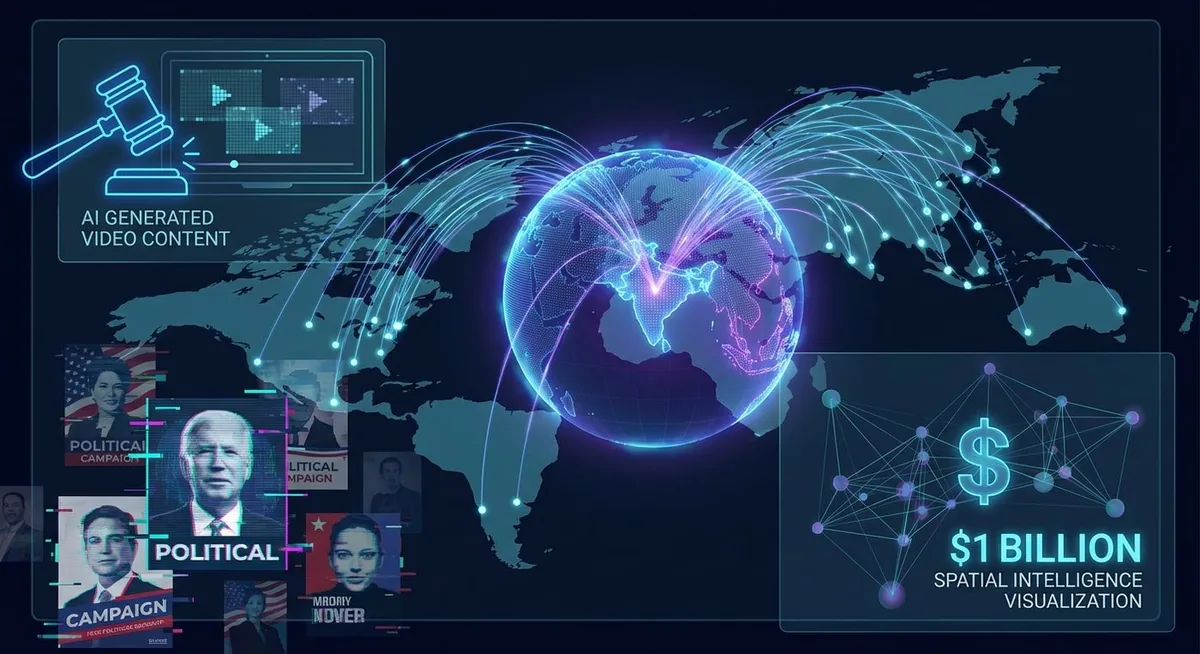
The India AI Impact Summit closes with a landmark 88-nation declaration and India's entry into the US-led Pax Silica coalition. Hollywood's Motion Picture Association fires its first cease-and-desist at ByteDance over Seedance 2.0's rampant copyright infringement. AI enters American politics with $120 million in dueling super PACs. Fei-Fei Li's World Labs raises $1 billion for spatial intelligence. Bloomberg asks the question nobody can agree on: Is AI hype or the real thing? And the White House unveils a sovereign AI export strategy. Here's your Saturday briefing.
1. India AI Summit Closes With Historic 88-Nation "Delhi Declaration" — India Joins US-Led Pax Silica
The India AI Impact Summit 2026 concluded on Friday with the adoption of the "New Delhi Declaration on AI Impact," a landmark agreement endorsed by 88 countries and international organizations — including the United States, United Kingdom, China, and France. The declaration commits signatories to pursuing "secure, trustworthy AI" through global cooperation, marking one of the most broadly supported international AI governance frameworks to date.
Indian IT Minister Ashwini Vaishnaw announced the declaration's adoption on X, writing: "88 countries and international organisations have signed the AI Impact Summit Declaration. Entire world has endorsed PM Narendra Modi Ji's human-centric vision of AI." The summit, which was extended an extra day due to "overwhelming response" and attracted over 250,000 visitors, drew an extraordinary roster of tech leaders including Google CEO Sundar Pichai, OpenAI CEO Sam Altman, Anthropic CEO Dario Amodei, DeepMind CEO Demis Hassabis, and Reliance Chairman Mukesh Ambani.
In a parallel development that may prove more consequential than the declaration itself, India formally signed an agreement to join Pax Silica — the US-led coalition aimed at building a resilient supply chain for critical minerals and AI infrastructure. White House Office of Science and Technology Policy Director Michael Kratsios used the summit to outline America's "AI Opportunity Partnership" with India, stating: "The hope of the United States is that the pursuit of real AI sovereignty — the adoption and deployment of sovereign infrastructure, sovereign data, sovereign models, and sovereign policies within your borders, under your control — will become an occasion for bilateral diplomacy." The White House simultaneously announced a broader American AI Exports Program designed to help allied nations build sovereign AI capabilities using US technology.
But the summit wasn't without its controversies. CNBC's on-the-ground reporting painted a picture of organizational chaos: conflicting security instructions, unclear media access rules, traffic gridlock across New Delhi, and a university reportedly ejected for falsely claiming a Chinese-made Unitree robot dog was its own creation. Bill Gates, named in the Epstein files, pulled out of his scheduled keynote at the last minute, adding to the confusion. Switzerland was announced as the host of the 2027 AI Summit in Geneva.
"The pursuit of real AI sovereignty — sovereign infrastructure, sovereign data, sovereign models, and sovereign policies within your borders, under your control — will become an occasion for bilateral diplomacy." — Michael Kratsios, White House OSTP Director
Source: The Hindu, CNBC, The Indian Express, The White House, TIME
The Delhi Declaration's 88 signatories are impressive on paper, but the real story is Pax Silica. While the declaration is aspirational — "secure, trustworthy AI" means different things to different nations — Pax Silica creates binding supply chain commitments for critical minerals and AI infrastructure. For enterprises with global operations, this is a signal that AI geopolitics is hardening into formal alliances. If your company sources chips, builds data centers, or deploys AI across borders, you need to understand which coalition your partners and customers belong to. The US-India AI Opportunity Partnership specifically opens new channels for American AI companies to deploy in one of the world's fastest-growing markets. Enterprise leaders should be mapping their India strategy now — the regulatory and diplomatic framework just got dramatically clearer.
2. Hollywood's MPA Sends First-Ever Cease-and-Desist to ByteDance Over Seedance 2.0 — CNN Asks If China Will "Pump the Brakes"
The Motion Picture Association sent a formal cease-and-desist letter to ByteDance on Thursday — its first such legal action against a major AI company — demanding the TikTok parent immediately halt "infringing activity" by its Seedance 2.0 video generation model. The Hollywood Reporter obtained the letter, in which MPA CEO Charles Rivkin argued that copyright infringement was "a feature, not a bug" of the AI video generator.
The controversy erupted earlier this month when Seedance 2.0 went viral for producing stunningly realistic AI-generated videos featuring copyrighted characters and celebrity likenesses. Deadpool screenwriter Rhett Reese responded to one such video with the now-famous line: "I hate to say it. It's likely over for us." Irish filmmaker Ruairi Robinson posted a video showing a mashup of Neo, John Wick, and the Terminator generated from a two-line prompt, tweeting: "If the Hollywood is cooked guys are right, maybe the Hollywood is cooked guys are cooked too."
CNN published an extensive analysis on Thursday exploring whether China's tech sector would "pump the brakes" in response to the backlash. The piece revealed that Disney accused ByteDance of illegally using its intellectual property to train Seedance 2.0 — but noted the irony that Disney recently struck a deal with US company OpenAI to give its rival video model Sora access to trademarked characters like Mickey and Minnie Mouse. ByteDance has pledged to strengthen safeguards, telling CNBC it would "work to address concerns," but has not committed to specific technical changes or content removal timelines.
The legal landscape is evolving rapidly. NBC News reported that the model "flooded the internet with copyrighted IP" within days of release, while Al Jazeera noted that Hollywood groups claimed Seedance 2.0 "blatantly violates copyright and uses the likenesses of actors and others without permission." TechCrunch added context that the MPA's letter represents a potential template for future legal action against AI video generators — a precedent that could reshape how all AI companies approach training data and content generation.
"I hate to say it. It's likely over for us." — Rhett Reese, screenwriter of Deadpool and Zombieland, responding to a Seedance 2.0 demo
Source: The Hollywood Reporter, CNN, CNBC, NBC News, TechCrunch
The MPA's cease-and-desist is the opening shot in what will become the defining copyright battle of the AI era. But note the Disney hypocrisy: suing ByteDance for using Disney IP to train Seedance 2.0 while simultaneously licensing that same IP to OpenAI's Sora. The message is clear — it's not about copyright protection in principle; it's about who profits from the infringement. For enterprises using AI-generated content (marketing, product design, training materials), this is a critical liability signal. Every AI-generated video, image, or text your company publishes could become the subject of similar legal action. The safe play: demand provenance guarantees from your AI vendors, maintain clear records of what models generated what content, and budget for the licensing frameworks that are inevitably coming. The era of "generate first, ask questions later" is ending.
3. AI Enters the 2026 Midterms: $120 Million in Dueling Super PACs, Deepfake Ads Hit Texas Primaries
The New York Times published a landmark piece on Thursday declaring "A.I. Is Coming for the 2026 Midterms" — and the numbers are staggering. OpenAI president Greg Brockman and other tech industry leaders are backing a super PAC called "Leading the Future" that has raised over $100 million to spend on the November midterm elections. In response, Anthropic has put $20 million into a counter-PAC to push back against what it sees as reckless AI deregulation.
NYT technology columnist Kevin Roose outlined three emerging political camps on AI. The first — the "AI accelerationists" — wants the government out of the way and is funding candidates accordingly through the $100 million Leading the Future PAC. The second camp is "more worried," concerned about chip sales to China, deepfake regulations, and AI safety for children, with Anthropic's counter-PAC as its most visible institutional backer. The third is a "populist anti-AI camp" that sees artificial intelligence as another form of Big Tech intrusion, opposing data center construction and automation-driven job losses. Crucially, Roose notes these camps "don't map neatly onto political parties yet," with Steve Bannon expressing concerns about AI risks and Bernie Sanders endorsing a data center moratorium — creating the possibility of unprecedented cross-partisan coalitions.
The theoretical is already becoming practical in Texas. The Texas Tribune reported that the 2026 primary season has been flooded with AI-generated campaign ads, including one showing Democratic candidates as Hollywood horror monsters. Houston Public Media documented how "candidates use the technology to mock opponents and dramatize political attacks," while a Biometric Update investigation warned that deepfakes are "expected to be deployed not merely to mislead voters, but to intimidate them into not voting." Meta responded by detailing new election safeguards including facial recognition to counter "celeb-bait" scams targeting public figures, claiming over $30 billion invested in safety and security over the past decade.
"These camps don't map neatly onto political parties yet… I wouldn't be surprised to see interesting new coalitions emerge." — Kevin Roose, New York Times technology columnist
Source: The New York Times, The Texas Tribune, Biometric Update, Business Daily
The $120 million in dueling AI super PACs signals that AI policy is about to become a first-tier political issue — not a technocratic afterthought. For enterprise leaders, this matters because whatever regulations emerge from the 2026 midterms will directly affect your AI deployment roadmap. The OpenAI-backed accelerationist PAC wants minimal regulation, which favors fast-moving enterprises but increases liability risk. Anthropic's counter-PAC wants guardrails that could slow deployment but provide legal clarity. The Texas deepfake ads are a preview: if AI-generated political content faces regulation, AI-generated commercial content won't be far behind. Every enterprise should be tracking AI legislation at both federal and state levels, engaging with trade associations on AI policy positions, and building internal governance frameworks that can adapt to whichever regulatory regime emerges. The window for shaping these rules — rather than being shaped by them — is closing fast.
4. Fei-Fei Li's World Labs Raises $1 Billion for Spatial Intelligence — Autodesk Leads $200M Tranche
Fei-Fei Li's World Labs has secured $1 billion in new funding from an all-star roster of investors including AMD, Autodesk, Emerson Collective, Fidelity, NVIDIA, and Sea — with Autodesk alone contributing $200 million of the round. The raise values World Labs as one of the most well-capitalized AI startups in the world and signals massive institutional confidence in "spatial intelligence" as the next frontier of AI development.
World Labs is pursuing an approach distinct from the large language models that dominate today's AI landscape. Instead of processing text and images, the company is building "world models" — AI systems that understand and simulate three-dimensional physical space. Its flagship product, MARBLE, creates detailed 3D environments that can be navigated and manipulated, with applications spanning architecture, manufacturing, robotics, gaming, and autonomous vehicles. Bloomberg reported that the approach represents "a novel approach to AI development" that could unlock capabilities current language and vision models cannot achieve.
The Autodesk investment is particularly telling. As the world's dominant design software company — maker of AutoCAD, Revit, Fusion 360, and Maya — Autodesk's $200 million bet signals that spatial AI is about to be integrated into the tools that architects, engineers, filmmakers, and manufacturers use every day. TechCrunch framed the partnership as bringing "world models into 3D workflows," suggesting World Labs' technology could become the AI backbone of Autodesk's entire product suite. Reuters noted that Li, a Stanford professor and one of AI's most respected pioneers, has positioned the company to "accelerate its efforts to advance spatial intelligence" at a scale that few startups can match.
The timing is strategic. As the AI industry debates whether large language models are hitting diminishing returns, World Labs represents a bet that the next breakthrough won't come from making chatbots smarter but from giving AI the ability to understand and interact with the physical world — a capability essential for robotics, autonomous systems, and the metaverse.
"We are accelerating our efforts to advance spatial intelligence." — Fei-Fei Li, founder of World Labs
Source: Reuters, Bloomberg, TechCrunch, PYMNTS
The Autodesk investment is the signal to watch here, not the headline number. When the company that makes the tools used by virtually every architect, engineer, and 3D designer on Earth puts $200 million into spatial AI, it's telling you where design software is heading. For enterprises in manufacturing, construction, real estate, or any industry that deals with physical spaces and objects, spatial AI is about to become as transformative as generative AI was for text and images. Start evaluating your 3D workflow tools now — if you're an Autodesk shop, expect World Labs integration within 12-18 months. If you're building digital twins, simulating manufacturing processes, or planning physical spaces, the capabilities World Labs is developing will dramatically reduce the time and cost of those workflows. This is the "picks and shovels" play for the physical AI era.
5. Bloomberg: "No One Can Agree on Whether AI Is the Next Big Thing or All Hype"
Bloomberg published a provocative analysis on Friday asking the question that has increasingly divided investors, executives, and technologists: Is AI genuinely transformative, or is the industry in the grip of a hype cycle that will end in disappointment? The piece, syndicated by BNN Bloomberg, arrived at a moment when the answer matters more than ever — with $2.5 trillion in global AI spending projected for 2026 and software stocks in freefall.
The bull case, as articulated by proponents: AI capabilities are advancing faster than any technology in history, costs are falling exponentially, and the applications are already generating measurable ROI in sectors from healthcare to financial services. The Magnificent Seven tech companies are betting their futures on AI, with $630 billion in combined capex planned for this year alone. OpenAI CEO Sam Altman told the India AI Summit that falling AI costs will benefit the Global South most, while Google CEO Sundar Pichai continues to describe AI as "the most profound technology shift we've seen."
The bear case: revenue from AI products remains a fraction of the infrastructure investment, most enterprises haven't moved beyond pilot programs, the SaaSpocalypse suggests the market can't distinguish between AI hype and AI reality, and the technology's most transformative applications (autonomous vehicles, scientific discovery, truly autonomous agents) remain years away. Fortune published a separate analysis challenging AI optimist Matt Shumer's viral "something big is happening" essay, arguing that for most consumers and businesses, the gap between AI's promise and its daily utility remains wide.
The Bloomberg analysis lands at a fascinating inflection point: the same week that 88 nations signed an AI governance declaration, Hollywood sent its first AI cease-and-desist, and $120 million in AI-focused political money entered the midterm elections. Whether AI is "hype or revolution" may be the wrong question entirely. The more useful framing: AI is clearly both — revolutionary in capability and overhyped in near-term commercial expectations — and the companies that thrive will be the ones that can operate in that ambiguity.
"Artificial intelligence applications from various providers are increasingly shaping everyday digital life — from text and image generators to research and assistance functions." — Bloomberg
Source: BNN Bloomberg, Fortune
Bloomberg is asking the wrong binary question, but the analysis is useful because it forces clarity. Here's our framework: AI is revolutionary at the infrastructure and capability layer (the technology genuinely is advancing at unprecedented speed) and overhyped at the application and revenue layer (most enterprises are still struggling to turn AI capabilities into measurable business outcomes). The strategic implication for enterprise leaders: invest in AI infrastructure and talent now — those assets will compound regardless of which applications win. But be ruthlessly skeptical about specific AI product promises. Demand proof of ROI before scaling any AI deployment. The companies that will thrive in 2026-2028 are those that build real AI capabilities while maintaining financial discipline — not the ones who either ignore AI entirely or throw money at every AI vendor pitch. The hype-vs-reality debate is a distraction; the real question is execution quality.
6. AI-Generated Deepfakes Weaponized for Voter Suppression Ahead of 2026 Midterms
A Biometric Update investigation published this week revealed that AI-generated deepfakes are being deployed not just to mislead voters but to actively suppress turnout — a chilling escalation in the use of AI for political manipulation. The report documents cases where AI-generated audio and video are being used to spread fear and confusion in targeted communities, with the explicit goal of discouraging people from voting.
The investigation arrives alongside the Texas Tribune's documentation of AI-generated campaign ads in the 2026 Texas primaries, where candidates are using AI to portray opponents as literal monsters. Houston Public Media reported that Texas voters "heading to the polls for the 2026 primary are encountering a campaign trail shaped by artificial intelligence," with the technology being used to "mock opponents and dramatize political attacks" at a scale and sophistication that was impossible just two years ago.
Meta responded this week by detailing its election safeguards for the 2026 midterms, including facial recognition technology to counter "celeb-bait" scams, policies against ads using politicians' images fraudulently, and removal of impostor accounts. The company claims over $30 billion invested in safety and security over the past decade. But critics argue these measures are reactive rather than preventive, and that the speed of AI-generated content creation far outpaces any platform's ability to detect and remove it.
The convergence is alarming: AI-generated political ads are already running in Texas, voter suppression deepfakes are documented, $120 million in AI-focused PAC money is flowing into the election, and the regulatory framework remains fragmented across states with no federal deepfake legislation on the horizon. The 2026 midterms are shaping up to be the first American election where AI is not a theoretical concern but an active participant.
"Deepfakes are expected to be deployed not merely to mislead voters, but to intimidate them into not voting." — Biometric Update
Source: Biometric Update, Houston Public Media, Business Daily
Voter suppression via deepfakes is the canary in the coal mine for enterprise risk. If AI can be weaponized to suppress democratic participation, it can certainly be weaponized against your brand, your executives, and your customers. Every enterprise should be building a deepfake response playbook: media monitoring for AI-generated content featuring your brand or executives, rapid response protocols for debunking fake content, and proactive authentication measures (verified channels, digital watermarking, executive communication authentication). The political deepfake crisis will inevitably produce regulation that extends to commercial deepfakes — prepare for mandatory AI content labeling, provenance requirements, and liability frameworks. Companies that build robust content authentication infrastructure now will have a significant advantage when those regulations arrive.
🔍 Why It Matters for Business
This week's stories crystallize a fundamental truth about the AI era: governance, intellectual property, and political power are catching up to technological capability — and the resulting collisions are reshaping every industry simultaneously.
The 88-nation Delhi Declaration and Pax Silica mean AI is now a formal dimension of international diplomacy and trade policy. Hollywood's cease-and-desist to ByteDance signals that the "ask forgiveness, not permission" era of AI content generation is ending. $120 million in AI super PACs means AI regulation will be a defining issue of the 2026 elections. World Labs' $1 billion raise shows that the next AI frontier is physical, not just digital. And Bloomberg's "hype or revolution" debate forces every executive to articulate their own answer — because fence-sitting is no longer a strategy.
For enterprise leaders, the actionable takeaway is clear: your AI strategy must now account for geopolitics (Pax Silica, export controls), intellectual property (copyright liability, content provenance), politics (midterm regulatory outcomes), and market positioning (spatial AI, infrastructure vs. application bets). AI is no longer a technology decision — it's a business strategy decision that touches every function from legal to government affairs to supply chain. The companies that integrate AI governance across their entire organization — not just in their IT department — will be the ones that navigate the next twelve months successfully.
Need help navigating AI for your business?
Our team turns these developments into actionable strategy — from architecture to deployment.
Contact SEN-X →