Sanders Demands AI Data Center Moratorium, Nvidia Pours $30B Into OpenAI, Google Ships Gemini 3.1 Pro
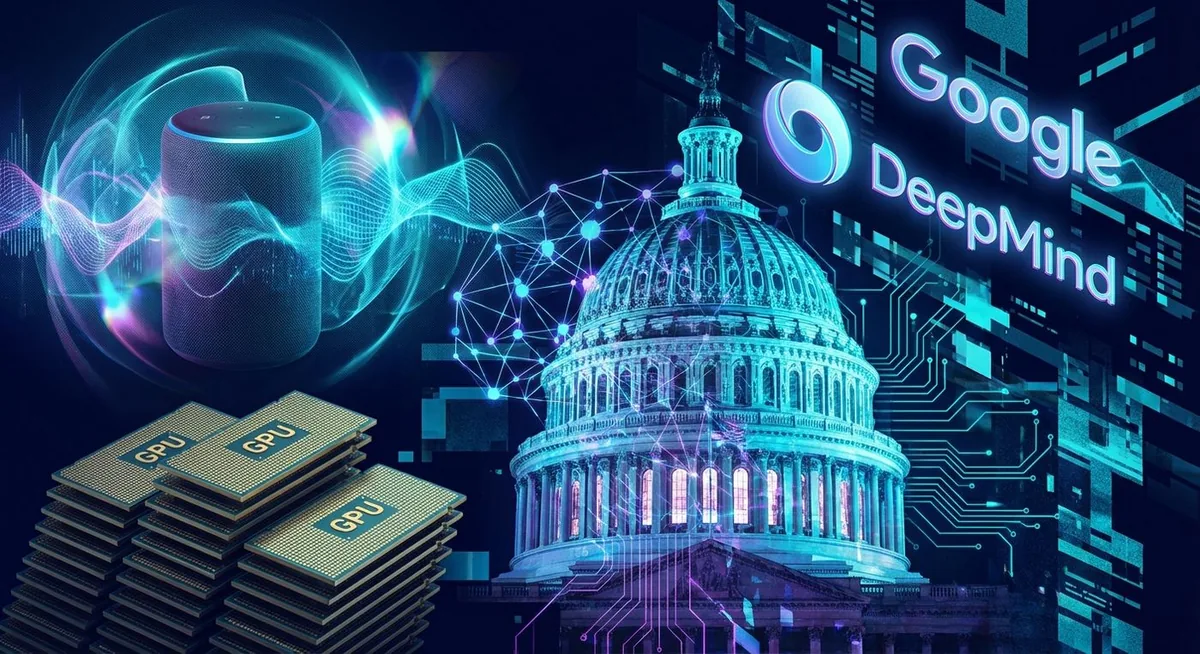
Senator Bernie Sanders takes the stage at Stanford to demand a nationwide freeze on AI data center construction. Nvidia closes in on a staggering $30 billion investment in OpenAI — the largest single AI investment ever. OpenAI reveals it's building smart speakers, glasses, and a smart lamp. Google launches Gemini 3.1 Pro with a 77.1% ARC-AGI-2 score and 1M-token context window. Anthropic and Infosys partner to build enterprise AI agents for regulated industries. And the AI hype-vs-reality debate reaches a boiling point as software stocks crater. Here's your Sunday briefing.
1. Bernie Sanders Demands Nationwide AI Data Center Moratorium at Stanford Town Hall
Senator Bernie Sanders brought the AI debate to Silicon Valley's doorstep on Saturday, delivering a fiery speech at Stanford University calling for an immediate nationwide moratorium on the construction of new AI data centers. Speaking alongside Representative Ro Khanna at a packed town hall, Sanders warned that the United States "has no clue about the speed and scale of the coming AI revolution" and demanded that policymakers "slow this thing down" before it's too late.
The Guardian reported that Sanders framed the moratorium not as anti-technology but as a necessary pause for democratic governance to catch up with corporate ambition. "We need to slow down the revolution and protect workers while policymakers catch up," Sanders told the crowd, invoking what he called an approaching "tsunami" of job displacement, energy consumption, and concentrated corporate power. The senator pointed to the staggering electricity demands of AI data centers — which are already straining power grids across the country — and the fact that communities from North Carolina to rural Oregon are bearing the environmental burden of Silicon Valley's compute arms race.
Khanna offered more specific policy proposals, outlining seven principles for preventing what he called an "AI-induced dystopia." These ranged from halting data center construction in overburdened communities to enacting regulations ensuring AI augments union workers rather than replaces them. The SF Standard reported that while Sanders' speech was "light on practical solutions," the combined message resonated powerfully with an audience increasingly worried about AI's unchecked growth. Canton, North Carolina has already approved a one-year moratorium on new data center construction — a local action Sanders held up as a model for national policy.
The timing was deliberate. Sanders spoke just days after the India AI Summit, where world leaders celebrated $200 billion in AI investment pledges and tech CEOs positioned AI as humanity's greatest opportunity. The contrast could not have been sharper: while Sam Altman and Sundar Pichai were taking victory laps in New Delhi, Sanders was 8,000 miles away arguing that the same companies need to be reined in before their ambitions consume the planet's resources and workers' livelihoods.
"We need to slow down the revolution and protect workers while policymakers catch up. The United States has no clue about the speed and scale of what's coming." — Senator Bernie Sanders, Stanford University town hall
Source: The Guardian, The Almanac, SF Standard
A data center moratorium won't happen at the federal level — the bipartisan consensus on AI infrastructure is too strong — but Sanders is creating political cover for state and local governments to impose their own restrictions. For enterprises planning data center expansions or cloud migration, this is a tangible risk: permitting delays, community opposition, and potential state-level moratoriums could add 12-18 months to your infrastructure timeline. The smart move is to diversify your compute strategy now. Don't bet everything on a single region or provider. Explore edge computing, distributed architectures, and international options. If you're building a new data center, engage early with local communities and address energy concerns proactively — the political winds are shifting, and the companies that get ahead of community opposition will have a significant advantage over those caught flat-footed.
2. Nvidia Finalizes $30 Billion Investment in OpenAI — The Largest Single AI Bet in History
Nvidia is close to finalizing a $30 billion investment in OpenAI's mega funding round, according to Reuters and CNBC — a deal that would represent the single largest investment in an AI company ever made and fundamentally reshape the relationship between the world's dominant AI chipmaker and its most prominent customer. The investment is part of OpenAI's broader fundraising push that could value the company at over $300 billion.
The strategic logic is circular and powerful: OpenAI will use much of the $30 billion to purchase Nvidia's chips, which power the training and deployment of its AI models. In effect, Nvidia is investing in its own largest customer, ensuring demand for its GPU products while gaining an equity stake in the company most likely to define the AI application layer. CNBC reported that the investment structure differs from what was contemplated during OpenAI's September 2025 funding round, but Nvidia could still invest in subsequent rounds that align with the original framework.
The Guardian's analysis highlighted a question hanging over the deal: Broadcom CEO Hock Tan told investors in December that his company "did not expect much in 2026" from its own OpenAI investment, raising questions about whether the AI startup's revenue can justify these astronomical valuations. OpenAI's annualized revenue is reportedly approaching $10 billion — impressive for a company that barely existed five years ago, but a fraction of the capital being poured into it. The investment also raises antitrust concerns: if Nvidia both supplies the chips and owns a significant stake in its largest buyer, competitors like AMD and Intel face an even steeper uphill battle in the AI accelerator market.
Reddit's r/artificial community pointed to an even more eye-popping figure: Nvidia may ultimately invest up to $100 billion in OpenAI "as each gigawatt is deployed," suggesting the $30 billion is just the opening salvo of a much deeper partnership. For the broader AI ecosystem, this deal signals that the era of neutral chipmakers selling to the highest bidder may be ending — replaced by vertically integrated partnerships where hardware and software companies are financially intertwined.
"OpenAI is set to use much of the fresh capital to purchase Nvidia's chips, which power the training and deployment of its artificial intelligence models." — Reuters
Source: Reuters, CNBC, The Guardian
This isn't just an investment — it's the formalization of a vertical monopoly. When your chip supplier is also your largest shareholder, the incentives for competing AI companies to seek alternative hardware become existential. For enterprises, the immediate implication is supply chain risk: if you're building on OpenAI's models and Nvidia's chips, you're betting on a single integrated stack. That's convenient today and potentially catastrophic if the relationship sours, regulators intervene, or a better alternative emerges. Diversify your AI infrastructure across multiple model providers and chip architectures. The AMD MI400 series and Intel's Gaudi line deserve serious evaluation, not because they're better today, but because vendor lock-in to the Nvidia-OpenAI axis is becoming a strategic liability. Watch for antitrust scrutiny — the FTC will not ignore a $30 billion circular investment indefinitely.
3. OpenAI Reveals Plans for AI Smart Speaker, Smart Glasses, and a Smart Lamp
OpenAI is building a lineup of AI-powered hardware devices, according to The Information, with plans to release a smart speaker as its first consumer hardware product by 2027. The company has more than 200 people working on hardware development, and the device portfolio reportedly includes smart glasses, a smart lamp, and the flagship smart speaker — which will be priced between $200 and $300 and feature a built-in camera.
Engadget reported that the smart speaker represents OpenAI's bid to move beyond software and establish a physical presence in users' homes and daily lives. The device would compete directly with Amazon's Alexa, Google Home, and Apple's HomePod — but with the conversational intelligence of ChatGPT baked in from the ground up rather than bolted on as an afterthought. 9to5Google noted the timing is particularly interesting given that Google is simultaneously rebooting its own Home Speaker with enhanced AI capabilities, setting up a hardware battle for the AI-powered home.
The smart glasses would put OpenAI in competition with Meta's Ray-Ban AI glasses, which have been a surprise hit, while the smart lamp suggests OpenAI is exploring ambient computing — devices that passively observe and respond to their environment without requiring explicit user interaction. The Hindu reported that the hardware push signals a strategic shift: OpenAI appears to believe that controlling the device layer is essential to its long-term competitive position, rather than remaining dependent on Apple, Google, and Samsung to distribute its AI through their hardware.
The announcement comes as OpenAI's valuation soars past $300 billion and its annualized revenue approaches $10 billion. But hardware is a notoriously difficult business with razor-thin margins, complex supply chains, and high customer expectations. Google, Amazon, and Meta have all learned expensive lessons about AI hardware — and OpenAI will need to demonstrate that its software advantage translates into a compelling enough hardware experience to justify entering one of tech's most competitive arenas.
"The smart speaker — the first device OpenAI will release — is likely to be priced between $200 and $300." — The Information, via 9to5Google
Source: Reuters, Engadget, 9to5Google, The Hindu
OpenAI building hardware is the clearest signal yet that the company views itself as a full-stack technology platform, not just a model provider. For enterprise leaders, the strategic implication is about ecosystem lock-in: if OpenAI controls devices, models, and APIs, it becomes exponentially harder to switch providers. The smart speaker with a camera is particularly significant — it suggests OpenAI is building toward always-on, multimodal AI that sees, hears, and understands context in physical spaces. Companies building products for smart home, retail, hospitality, or office environments should start evaluating how an OpenAI hardware ecosystem could either complement or compete with their offerings. But don't panic yet — hardware takes years to get right, and OpenAI's 2027 timeline gives the market time to adapt.
4. Google Launches Gemini 3.1 Pro — 77.1% ARC-AGI-2, 1M-Token Context, Deep Think Integration
Google DeepMind released Gemini 3.1 Pro on February 19, marking a significant upgrade to its core AI intelligence. The model achieves a 77.1% score on the ARC-AGI-2 benchmark — a test specifically designed to measure AI reasoning and generalization — and ships with a million-token context window, multimodal reasoning across text, images, audio, video, and code, and integration with Google's "Deep Think" extended reasoning tool.
Ars Technica reported that while the benchmarks show "mostly modest improvements" in standard tests, the model's integration with Deep Think represents a qualitative leap in how Google's AI handles complex, multi-step problems. The 3.1 Pro model is the "core intelligence" behind Deep Think's recent improvements, meaning the reasoning capabilities compound when the two systems work together. Google Cloud's announcement emphasized that 3.1 Pro is immediately available on Vertex AI, Gemini Enterprise, and the Gemini CLI — positioning it for both consumer and enterprise adoption.
GitHub's integration is particularly noteworthy: Gemini 3.1 Pro is now available in public preview within GitHub Copilot, where early testing shows it "excels on effective and efficient edit-then-test loops with high tool precision, achieving strong resolution success with fewer tool calls per benchmark." This positions Google's model as a serious contender in the AI coding assistant space, directly challenging Anthropic's Claude (which powers Cursor) and OpenAI's models in GitHub Copilot's existing lineup.
The model is rolling out to Google AI Pro and Ultra subscribers through the Gemini app and NotebookLM, with API access through Google AI Studio and Vertex AI. For developers, the million-token context window is the headline feature — enabling analysis of entire codebases, lengthy legal documents, or hours of video in a single prompt. Case Western Reserve University's technology team noted that the release also coincides with Google's launch of Lyria 3, its latest music generation model, suggesting Google is pushing hard across multiple AI modalities simultaneously.
"In early testing, this model excels on effective and efficient edit-then-test loops with high tool precision, achieving strong resolution success with fewer tool calls per benchmark." — GitHub Changelog
Source: Google Blog, Ars Technica, GitHub, Google Cloud
The real story isn't the benchmark scores — it's the distribution. Google is embedding Gemini 3.1 Pro into GitHub Copilot, NotebookLM, Vertex AI, and the Gemini CLI simultaneously, making it the most broadly available frontier model on day one of release. For enterprises evaluating AI model providers, this changes the calculus: Google's model quality is now competitive with Claude and GPT-5 on most tasks, and its distribution advantage through Google Cloud, Workspace, and developer tools is unmatched. The million-token context window is immediately practical for document-heavy industries like legal, financial services, and healthcare. If you've been defaulting to OpenAI or Anthropic, now is the time to run serious head-to-head evaluations with Gemini 3.1 Pro on your actual workloads. The three-horse race just got tighter.
5. Anthropic and Infosys Partner to Build Enterprise AI Agents for Regulated Industries
Anthropic and IT services giant Infosys announced a collaboration on February 16 to develop and deploy enterprise-grade AI agents tailored to regulated industries — including financial services, telecommunications, manufacturing, and software development. The partnership will begin with a dedicated Anthropic Center of Excellence within Infosys, building AI agents designed to handle complex, multi-step tasks like claims processing, compliance reporting, and risk assessment.
TechCrunch framed the partnership as Anthropic's route into "heavily regulated enterprise sectors where deploying AI systems at scale requires industry expertise and governance capabilities" — expertise that Infosys, with its deep relationships with Fortune 500 companies and decades of enterprise consulting experience, can provide. Bloomberg confirmed that the partners will develop "custom AI agents tailored for specific industries and business functions," suggesting a level of vertical specialization that goes beyond Anthropic's general-purpose Claude model.
The financial services applications are particularly detailed: AI agents will help firms "detect and assess risk faster, automate compliance reporting, and deliver more personalized customer interactions — such as tailoring financial advice based on a client's full account history and market conditions," according to Infosys's press release. CIO Dive reported that the agents will handle multi-step tasks autonomously, a significant step beyond the current paradigm of AI as a question-answering tool.
The timing is loaded with context. Anthropic's recent release of industry-specific Claude plugins — particularly for legal work — sent software stocks into a tailspin earlier this month, with Thomson Reuters plummeting 16% and LegalZoom suffering similar declines. The Infosys partnership extends that strategy into financial services, telecom, and manufacturing, signaling that Anthropic is systematically building vertical AI capabilities that directly compete with incumbent enterprise software providers. PitchBook's analysis asked whether Anthropic's tools represent "the death knell for AI legaltech" — and concluded "not quite," but acknowledged that the threat to specialized SaaS companies is real and growing.
"The collaboration will begin in telecommunications with a dedicated Anthropic Center of Excellence to build and deploy AI agents tailored to industry-specific operations." — Infosys press release
Source: TechCrunch, Bloomberg, CIO Dive, Infosys
This is the template for how AI model companies will eat enterprise software. Anthropic provides the intelligence layer; Infosys provides the industry expertise, regulatory knowledge, and enterprise relationships. The result is vertical AI agents that can do what previously required expensive SaaS platforms plus human operators. If your company relies on specialized enterprise software for compliance, risk management, or customer service, you need to honestly evaluate whether an AI agent could replace 60-80% of that functionality within 18 months. The companies most at risk are mid-tier SaaS providers with narrow feature sets — they're being squeezed between the AI model providers (who can replicate their features) and the IT consultancies (who own the customer relationships). For enterprises buying these tools, the leverage just shifted dramatically in your favor: you now have credible AI alternatives to negotiate against incumbent software contracts.
6. The Great AI Debate: Hype or Revolution? Software Stocks Crash as Markets Pick Sides
The existential question dominating Wall Street and Silicon Valley reached a fever pitch this week: Is artificial intelligence the most transformative technology since the internet, or is the industry trapped in a hype bubble that will leave investors holding the bag? Bloomberg's Friday analysis — "No One Can Agree on Whether AI Is the Next Big Thing or All Hype" — crystallized a debate that has moved from conference rooms to trading floors, with hundreds of billions of dollars riding on the answer.
The bear case gained ammunition when Anthropic's industry-specific Claude tools triggered what some are calling the "SaaSpocalypse" — a sharp selloff in enterprise software stocks. Thomson Reuters fell 16% after Anthropic released its legal plugin, while financial software companies dropped in sympathy after a new Opus model tailored for financial research hit the market. Bloomberg reported that Anthropic's "quiet release of a tool to automate certain legal work helped spark a market meltdown" that "particularly hit software companies that investors fear may eventually be rendered obsolete." The message from markets was stark: if AI can replace specialized SaaS products, what exactly are software companies worth?
Fortune pushed back with a direct challenge to AI optimist Matt Shumer's viral "something big is happening" essay, arguing that for most consumers and businesses, the gap between AI's promise and its daily utility remains uncomfortably wide. US stock futures did rise as the week closed, with AI concerns receding slightly — but the volatility itself tells the story. Markets are oscillating between euphoria (Nvidia's $30B OpenAI bet) and panic (software stock crashes) because the honest answer is that nobody knows how quickly AI will transform specific industries or which companies will be winners and losers.
The CP24/Bloomberg analysis noted that this uncertainty itself is historically unusual. With previous technology shifts — the internet, mobile, cloud — the trajectory became clear within a few years. With AI, we're simultaneously seeing breakthrough capabilities (Gemini 3.1 Pro's reasoning, autonomous agents) and widespread failure to convert those capabilities into reliable business value. The parallel with the dot-com era is imperfect but instructive: the technology was real, the transformation was real, but the timing and the winners were impossible to predict in 1999. We may be in 1999 for AI — and that means both enormous opportunity and enormous risk.
"Software stocks plummeted in early February after AI company Anthropic released a tool tailoring its AI helper specifically for individual industries, like legal and financial analysis." — Bloomberg, via CP24
Source: CP24/Bloomberg, Bloomberg, Fortune
Stop trying to answer "hype or revolution" — the question is a trap. The useful question for enterprise leaders is: "What can AI reliably do for my business today, and what is the cost of waiting vs. the cost of moving too fast?" The SaaSpocalypse is real but selective — AI is disrupting narrow, automatable software functions while leaving complex, relationship-dependent businesses largely intact. The practical framework: audit every software tool in your stack and categorize each as "AI-replaceable within 12 months," "AI-augmentable," or "AI-resistant." Renegotiate contracts for the first category, experiment with AI copilots for the second, and maintain the third. The companies that thrive won't be the ones who called the hype-vs-reality debate correctly — they'll be the ones who executed methodically while everyone else argued about it.
🔍 Why It Matters for Business
This week's stories form a picture of an industry at maximum tension — with capital, regulation, and technology all pulling in different directions simultaneously. Nvidia's $30 billion bet and Google's Gemini 3.1 Pro launch show the supply side accelerating at breakneck speed, while Sanders' moratorium push and the software stock crash show the demand side and civil society struggling to keep up.
The Anthropic-Infosys partnership is the bridge between these two worlds: a model company and a consultancy joining forces to bring AI into the most conservative, regulated corners of enterprise technology. OpenAI's hardware ambitions extend the stakes from software to physical devices. And the hype-vs-reality debate forces every executive to stake a position with real money behind it.
For enterprise leaders, the actionable synthesis is this: build AI capabilities aggressively, but build them defensibly. Diversify across model providers (Google just made that easier). Diversify across chip architectures (the Nvidia-OpenAI axis is a concentration risk). Prepare for regulatory friction (Sanders won't pass a national moratorium, but local governments will slow your data center plans). And above all, focus on measurable business outcomes — not AI hype cycles. The companies that win in 2026 will be the ones that turned AI from a strategy slide into an income statement line item.
Need help navigating AI for your business?
Our team turns these developments into actionable strategy — from architecture to deployment.
Contact SEN-X →