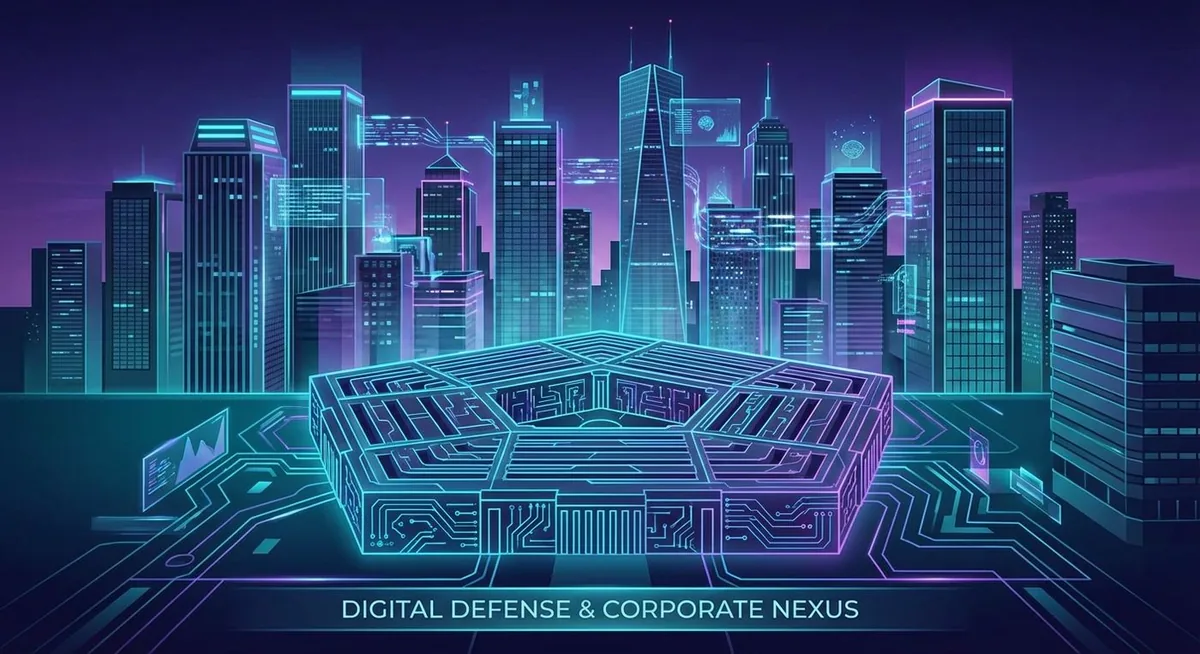
Pentagon Gives Anthropic Friday Ultimatum, AMD-Meta $60B Chip Deal, Citrini 'Doomsday' Report Rattles Wall Street
Defense Secretary Hegseth threatens to invoke the Defense Production Act if Anthropic won't grant full military access to Claude. AMD and Meta announce a massive $60 billion AI chip partnership. A little-known research firm's dystopian AI scenario sparks a market selloff. Anthropic expands Cowork with 10 new enterprise plugins. Google pledges water-free data centers. Markets rebound.
1. Pentagon Gives Anthropic Until Friday to Drop AI Safety Guardrails
In the most dramatic confrontation yet between the U.S. government and an AI company, Defense Secretary Pete Hegseth summoned Anthropic CEO Dario Amodei to the Pentagon on Tuesday morning and delivered an ultimatum: sign a document granting the military full, unrestricted access to Claude by end of day Friday — or face severe consequences.
According to Axios, Hegseth warned that if Anthropic refuses, the Pentagon will either declare the company a "supply chain risk" — effectively blacklisting it from all government contracts — or invoke the Defense Production Act to compel the company to tailor its model to military specifications. The New York Times reported that the tone of the meeting was "civil" but that Hegseth's demands were non-negotiable.
"Anthropic CEO Dario Amodei met with Secretary Hegseth at the Pentagon this morning. During the conversation, Dario expressed appreciation for the Department's work and thanked the Secretary for his service." — Anthropic statement via CNN
The standoff comes as Anthropic has long positioned itself as the most safety-conscious of the leading AI labs. The company joined the military's GenAI.mil secure platform but has maintained certain usage restrictions on Claude. OpenAI, by contrast, announced in early February that it would also join GenAI.mil, enabling service members to use a custom version of ChatGPT for unclassified tasks. The Washington Post and CBS News both confirmed the Friday deadline.
Source: Axios, New York Times, CNN, Washington Post, CBS News
This is a watershed moment for the entire AI industry. The potential invocation of the Defense Production Act — a wartime statute — to compel AI model access sets a precedent that every AI company, and every enterprise using AI, needs to watch closely. If the government can force one company to remove safety guardrails, it can force any company. For enterprise leaders, the immediate question is: how does your AI governance framework account for government mandates that may conflict with your responsible AI policies? The answer to the Anthropic standoff will shape the regulatory landscape for years.
2. AMD and Meta Announce $60 Billion AI Chip Partnership
In a deal that reshapes the AI hardware landscape, AMD and Meta announced a massive strategic partnership on Tuesday worth up to $60 billion over five years. Under the agreement, Meta will purchase AMD's MI540 series GPUs and latest-generation CPUs to power its next generation of AI infrastructure, representing a 6-gigawatt computing commitment.
The deal follows the same "chips-for-stock" playbook AMD used with OpenAI: Meta will acquire a 10% stake in AMD as part of the arrangement, according to The Guardian. TechCrunch reported that the total deal value could reach $100 billion when including Meta's broader infrastructure commitments, noting that CPUs are "increasingly becoming a core pillar of the AI inference compute stack because they're efficient, easier to scale, and don't tie companies solely to Nvidia."
"AMD and Meta today announced a 6-gigawatt agreement to power Meta's next generation of AI infrastructure across multiple generations of AMD Instinct GPUs." — AMD Press Release
AMD shares surged on the news, helping drive a broader market rebound on Tuesday. The deal signals Meta's commitment to diversifying its chip supply away from sole reliance on Nvidia, while giving AMD its second major hyperscaler win after OpenAI.
Source: Reuters, New York Times, TechCrunch, AMD
The Nvidia monopoly narrative is cracking. When Meta — one of the world's largest AI infrastructure buyers — commits $60B to AMD, it validates an entire alternative ecosystem. For enterprises planning AI infrastructure, this means real negotiating leverage is emerging. Don't lock yourself into single-vendor GPU contracts. The "chips-for-stock" deal structure also signals a new era of vertical integration between hyperscalers and chipmakers that will reshape pricing dynamics across the industry.
3. Citrini Research's AI 'Doomsday' Report Spooks Wall Street
A little-known research firm called Citrini Research rattled global markets this week with a dystopian Substack post that went viral across trading floors and social media. The report — which its 33-year-old founder described as "a scenario, not a prediction" — outlined a hypothetical 2028 timeline in which autonomous AI agents trigger mass white-collar layoffs, a collapse in consumer spending, a mortgage crisis, and ultimately a deep recession.
The Guardian called it "a feedback loop with no brake," describing the scenario in which AI-driven job displacement creates a self-reinforcing economic spiral. Business Insider reported that the report contributed to Monday's sharp selloff, with the Dow sinking 1.7% (over 820 points) and the S&P 500 falling 1%.
Bloomberg profiled the founder, noting he was "shocked" that his thought experiment moved markets. The New York Times reported that while many analysts and economists questioned the report's conclusions, its viral spread exposed the deep anxiety simmering beneath the AI investment boom.
Source: The Guardian, Bloomberg, Business Insider, New York Times
The fact that a Substack post from a small research firm can move billions in market capitalization tells you everything about the current psychological state of AI investing. The market is simultaneously all-in on AI and terrified of what it means. For business leaders, the Citrini scenario — however exaggerated — highlights a real strategic risk: if AI displaces workers faster than the economy can absorb them, consumer demand collapses, and that hurts everyone. The smartest play is investing in AI augmentation (making workers more productive) rather than pure replacement. Companies that get the transition right will thrive; those that slash headcount blindly may find their customers have disappeared too.
4. Anthropic Expands Cowork with 10 New Enterprise Plugins
In a busy day for Anthropic — separate from the Pentagon drama — the company unveiled 10 new plugins and connectors for its Claude Cowork platform, dramatically expanding its enterprise footprint. The announcement, covered by Reuters, CNBC, and TechCrunch, comes just weeks after earlier Cowork plugins for legal and financial analysis sparked a massive sell-off in SaaS stocks.
The new plugins include connectors for Google Workspace, Slack, DocuSign, FactSet, and S&P Global, along with native Excel and PowerPoint embedding. Business Insider reported that Anthropic framed the expansion as bringing the Claude Code revolution to "all knowledge work," with stock plugins designed for finance, legal, HR, engineering, and design departments.
"In 2025, Claude Code transformed how software gets built. In 2026, we're bringing that transformation to all knowledge work." — Anthropic, via Business Insider
TechCrunch noted that each plugin includes "basic skills common across different companies," though Anthropic expects organizations to customize them for their unique workflows. The announcement positions Cowork as a direct competitor to Microsoft's Copilot ecosystem.
Source: Reuters, TechCrunch, CNBC, Business Insider
Anthropic is executing a masterful land-and-expand strategy. By shipping department-specific plugins with standardized connectors (Google Workspace, Slack, DocuSign), they're making it trivially easy for enterprises to adopt Cowork without ripping out existing tools. The FactSet and S&P Global integrations are particularly telling — these are the data sources that drive Wall Street research, which means AI-assisted analysis is about to become table stakes for investment firms. For enterprise IT leaders, the message is clear: evaluate Cowork alongside Microsoft Copilot now. The window for setting your organization's AI productivity platform is closing fast.
5. Google Announces Water-Free AI Data Centers in Texas
As the AI industry faces mounting scrutiny over its environmental footprint, Google announced on Tuesday that its new data center in Wilbarger County, Texas will use "advanced air-cooling technology" to eliminate operational water consumption entirely — a first for a major hyperscaler facility.
Engadget reported that water use at the facility will be limited to "critical campus operations" like kitchens, rather than cooling. The announcement comes in partnership with AES as part of a "power-first" initiative, per KAUZ News.
The timing is significant. Just days earlier, OpenAI CEO Sam Altman dismissed data center water concerns as "fake" at the India AI Summit, drawing sharp criticism. CNBC reported Altman compared AI energy use to that of humans. Meanwhile, Bloomberg warned that AI data center water use remains "too much of an afterthought," and India Today reported that Google's own facilities consume billions of gallons of fresh water to keep servers cool.
Source: Engadget, New Atlas, CNBC
Google's air-cooled data center is a smart competitive move that also happens to be the right thing to do. As AI infrastructure scales to consume multiple percent of global energy and water resources, sustainability is becoming a real procurement criterion for enterprise customers. Companies increasingly need to justify their AI carbon and water footprints to ESG-conscious boards and regulators. When choosing cloud providers for AI workloads, ask about their cooling technology and water usage at the specific regions you'll deploy to. It matters more than you think.
6. Markets Rebound After Monday's AI-Driven Selloff
After Monday's sharp decline driven by AI disruption fears, U.S. markets staged a solid rebound on Tuesday. Bloomberg reported the S&P 500 gained 0.8% to close at 6,890, the Nasdaq jumped 1.1%, and the Dow rose 0.8%. CNBC noted that sentiment was buoyed by both the AMD-Meta deal and improved consumer confidence data.
Anthropic's Cowork expansion announcement also helped stabilize sentiment, with Bloomberg noting that the S&P 500 rose "as AI startup Anthropic said it was expanding the reach of its Claude chatbot to build partnerships in the software and services sectors." The rebound came despite a new global 10% U.S. tariff taking effect Tuesday.
Investopedia highlighted that AMD was a standout performer, surging on the Meta deal. Citi reiterated a buy rating on Nvidia, noting the stock "is likely to outperform in the second half of 2026" as hyperscaler AI capex continues accelerating.
Source: Bloomberg, CNBC, Investopedia
The Monday-Tuesday whipsaw — selloff on AI doom fears, rebound on AI expansion news — perfectly captures the market's split personality on artificial intelligence. Investors are simultaneously pricing in AI as both an existential threat and an unprecedented opportunity. For enterprise budget planners, this volatility actually works in your favor: it creates windows to negotiate better terms with AI vendors who need to show growth metrics to nervous investors. Use the fear cycles strategically.
🔍 Why It Matters for Business
Tuesday's headlines painted a picture of an AI industry at an inflection point. The Pentagon's ultimatum to Anthropic tests whether AI safety principles can survive contact with government power. The AMD-Meta deal proves the chip market is diversifying beyond Nvidia. Citrini's viral report reveals deep economic anxiety beneath the AI hype. And Anthropic's Cowork expansion shows enterprise AI is moving from pilot to production at breakneck speed.
For business leaders, the throughline is clear: AI is no longer a technology story — it's a geopolitical, economic, and infrastructure story. Your AI strategy needs to account for all three dimensions.
Need help navigating AI for your business?
Our team turns these developments into actionable strategy — from architecture to deployment.
Contact SEN-X →