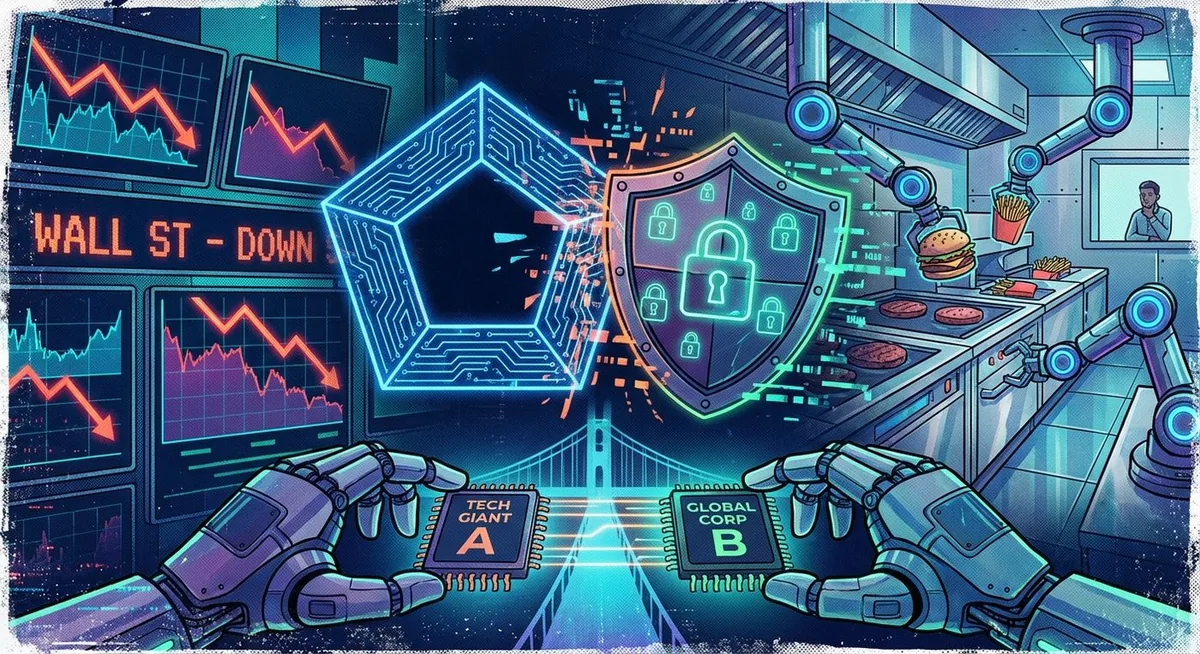
Anthropic Defies Pentagon, Block Cuts Half Its Workforce for AI, Meta Rents Google TPUs, Nano Banana 2 Launches, Burger King Deploys 'Patty'
Anthropic CEO Dario Amodei draws a line in the sand, refusing Pentagon demands for unrestricted military AI access. Jack Dorsey's Block slashes over 4,000 jobs — nearly half its workforce — betting that AI replaces them. Meta signs a multi-billion dollar deal to rent Google's TPUs for next-gen model training. Google launches Nano Banana 2, making pro-quality image generation the default across Gemini. Nvidia stock drops 5% despite smashing earnings records. Burger King straps OpenAI-powered headsets onto 500 locations' worth of employees. CoreWeave slides 10% after revealing $30 billion in planned 2026 capex.
1. Anthropic CEO Amodei Rejects Pentagon Demands: 'We Cannot in Good Conscience Accede'
The most consequential showdown in the brief history of the AI industry reached its climax Thursday evening when Anthropic CEO Dario Amodei issued a public statement rejecting the Department of Defense's demands for unrestricted access to Claude for military applications. The statement — covered simultaneously by CNBC, the New York Times, the Washington Post, and Bloomberg — came just one day before the Pentagon's Friday ultimatum deadline, during which Defense Secretary Pete Hegseth had threatened to invoke the Defense Production Act to compel compliance.
Amodei's words were unequivocal: "We cannot in good conscience accede to their request," he said, specifically noting that Anthropic could not permit its technology to be applied to "domestic mass surveillance or fully autonomous weapons." The statement added: "It is the department's prerogative to select contractors most aligned with their vision." The implication was clear — Anthropic would rather lose the contract entirely than compromise its red lines.
"We cannot in good conscience accede to their request. It is the department's prerogative to select contractors most aligned with their vision." — Dario Amodei, Anthropic CEO, via CNBC
Bloomberg's deep-dive reported that a senior defense official had posed hypothetical scenarios to Amodei during negotiations, testing where exactly Anthropic would draw the line. The Washington Post noted that Anthropic had already offered concessions — including allowing Claude to be used for missile defense applications — but that the Pentagon's latest demands went further, seeking blanket authorization for "all lawful use cases" without Anthropic maintaining any veto power over specific applications.
The standoff has become a defining moment for the AI industry. Just one day earlier, Anthropic had quietly loosened its Responsible Scaling Policy — the foundational safety document that differentiated it from competitors. Now, with the Pentagon rejection, Anthropic is sending a contradictory but strategically coherent message: it will bend on commercial safety commitments to compete with OpenAI, but it will not break on military red lines.
Source: CNBC, New York Times, Washington Post, Bloomberg
This is the most important AI governance story of 2026 so far. Anthropic just established that there is a line that at least one major AI lab won't cross — even under threat of the Defense Production Act. For enterprise buyers, this has immediate implications: if your organization handles government contracts or defense-adjacent work, you need to map your AI vendor relationships against the emerging military-access landscape. Anthropic's refusal creates a bifurcation in the market — labs willing to serve defense without guardrails (likely OpenAI, possibly xAI) versus those maintaining restrictions. Your procurement strategy needs to account for this split, because the regulatory and reputational consequences of choosing the wrong side will compound over time.
2. Block Slashes Nearly Half Its Workforce — 4,000+ Jobs — in Explicit AI Bet
Jack Dorsey's Block (formerly Square) announced Thursday that it is laying off more than 4,000 employees — approximately 40-45% of its entire workforce — in what the company explicitly described as a bet on artificial intelligence replacing human labor. The stock surged as much as 24% in after-hours trading on the news, as reported by CNBC, Reuters, Bloomberg, and CNN.
What makes Block's cuts different from the typical Silicon Valley layoff cycle is the candor. Dorsey didn't frame this as "restructuring" or "refocusing" — he said outright that AI efficiencies made this many humans unnecessary. VentureBeat noted that Block had grown from 3,835 employees in 2019 to over 10,000 before the cuts, and that Dorsey's message implied most companies would eventually do the same.
"Today we shared a difficult decision with our team." — Jack Dorsey, Block co-founder, via CNBC
CNN's analysis placed the Block layoffs in the broader context of pandemic-era over-hiring: Block, like Meta before it, had roughly tripled its headcount during the boom years. But the AI framing is new territory. Previous mass layoffs at tech companies cited "macroeconomic conditions" or "strategic realignment." Block is the first major public company to cut nearly half its workforce and explicitly say "AI made these roles redundant." Wall Street's enthusiastic response — a 24% stock surge — sends a chilling signal about what investors want to see from other companies.
Source: CNBC, Reuters, Bloomberg, VentureBeat, CNN
Block just gave every CEO in America permission to say the quiet part out loud: AI is replacing jobs, and Wall Street will reward you for it. The 24% stock surge is the most dangerous data point in this story — it creates an incentive structure where announcing AI-driven layoffs becomes a share price catalyst. For business leaders, the question is no longer whether AI will reduce headcount but how fast and how transparently you communicate it. For HR leaders and workforce planners, this is the inflection point that the Citrini doomsday report was warning about — except it's happening at one company at a time rather than all at once. Start scenario-planning for 20-40% role displacement over the next 24 months, and build reskilling programs now, not when the layoff announcements are drafted.
3. Meta Signs Multi-Billion Dollar Deal to Rent Google's TPUs
In a move that reshapes the AI chip landscape, Meta Platforms has signed a multi-billion dollar agreement to rent Google's Tensor Processing Units (TPUs) for developing next-generation AI models, according to a report from Reuters, citing The Information. The deal is remarkable because it represents Meta — one of the world's largest AI infrastructure builders — turning to a direct competitor for computing power.
The timing is strategic. Meta has already signed deals with both Nvidia (for current and future GPU generations) and AMD (a $60 billion partnership announced earlier this week for custom MI450 GPUs and Venice CPUs arriving in late 2026). By adding Google's TPUs to the mix, Meta is effectively building a three-vendor AI compute strategy that reduces dependency on any single supplier while maximizing access to the best available hardware for different workloads.
Reuters noted that Google has been aggressively positioning its TPUs as a viable alternative to Nvidia's market-leading GPUs since late 2025. Landing Meta as a customer is a massive validation of that strategy. For Google, it's also a revenue diversification play — turning its custom silicon from an internal competitive advantage into an external profit center.
Source: Reuters, CoinCentral, CyberNews
Meta's three-vendor chip strategy (Nvidia + AMD + Google TPUs) is a masterclass in supply chain risk management that every enterprise should study. In 2025, many companies learned the hard way that single-vendor AI compute dependencies create both pricing leverage problems and availability bottlenecks. Meta's approach — signing massive deals with all three leading chip providers simultaneously — ensures it can train different model architectures on the best-suited hardware while maintaining negotiating leverage. If you're planning significant AI compute procurement, take note: the era of "just buy Nvidia" is over. Multi-vendor strategies are now table stakes for serious AI infrastructure.
4. Google Launches Nano Banana 2: Pro-Quality Image Generation Goes Default Across Gemini
Google DeepMind launched Nano Banana 2 on Thursday — a new image generation model that combines the advanced capabilities of Nano Banana Pro with the speed of Gemini Flash. The model, technically designated Gemini 3.1 Flash Image, will become the default image generator across the entire Gemini app ecosystem, as reported by Google's official blog, TechCrunch, and Ars Technica.
The original Nano Banana model went viral in August 2025, redefining what users expected from AI image generation. Nano Banana Pro followed in November with studio-quality creative control. Now Nano Banana 2 promises to deliver Pro-level results at Flash speeds — essentially removing the trade-off between quality and responsiveness that had forced users to choose between the two tiers.
Ars Technica noted that Nano Banana 2 also incorporates "more advanced world knowledge pulled from the Internet," improving the model's ability to generate contextually accurate images. Google is simultaneously making the model available to developers via the Gemini API in Google AI Studio, positioning it as a platform play rather than just a consumer feature. The developer blog post emphasized "great price performance" — a clear signal that Google is pricing aggressively to win market share from OpenAI's DALL-E and Midjourney.
Source: Google Blog, TechCrunch, Ars Technica, Google Developer Blog
Google making pro-quality image generation the default across Gemini — not a premium tier, not an opt-in — is the kind of move that reshapes markets. For businesses that rely on visual content (e-commerce, marketing, media), the cost of "good enough" AI-generated imagery just dropped to effectively zero for Gemini users. The developer API pricing signal matters too: Google is clearly willing to subsidize image generation to build developer ecosystem lock-in. If you're building products that incorporate image generation, evaluate Nano Banana 2 against your current provider immediately — the price-performance ratio may have just shifted dramatically in Google's favor.
5. Nvidia Stock Sinks 5.5% Despite Record-Smashing Earnings — 'The Odds Were Stacked Against Them'
In one of the most striking "sell the news" events in recent market history, Nvidia shares fell 5.5% on Thursday despite the company posting its best quarter ever. The $68.1 billion in revenue, 73% year-over-year growth, and $78 billion forward guidance that we covered yesterday — all of which beat analyst expectations — weren't enough to satisfy a market that has priced Nvidia for perfection. CNBC led with the headline "Nvidia's blowout earnings report disappoints Wall Street as stock sinks 5%."
The selloff dragged the broader market lower. Reuters reported that U.S. stocks "turned sharply lower" as "earnings from artificial intelligence vanguard Nvidia failed to impress investors, weighing down technology shares which have provided muscle to the recent rally." The S&P 500 and Nasdaq both stumbled, with Alphabet, Amazon, and Apple also losing ground in sympathy.
"The odds were stacked against them." — Adam Phillips, EP Wealth Advisors, via CNBC
Investopedia noted the irony: Morgan Stanley called it "the largest and cleanest beat in semis industry history," yet the stock fell because expectations had already been priced to near-perfection. The Motley Fool pointed out that Nvidia has become so dominant that its earnings are now a macro event — when Nvidia disappoints (even by the narrowest definition of "disappointing"), the entire tech sector feels the tremor.
Source: CNBC, Reuters, Investopedia, The Motley Fool
The "best quarter in semiconductor history draws a 5% selloff" dynamic tells you everything about where AI expectations sit in 2026. Nvidia has become the barometer for the entire AI trade — and the market is telling us that even 73% revenue growth isn't enough to justify current multiples. For CFOs and investors, this is a reminder that the AI infrastructure buildout is real and accelerating, but the stocks pricing it in are vulnerable to the "expectations treadmill." The fundamentals are extraordinary; the valuation question is separate. Don't confuse a stock price decline with a thesis invalidation — AI compute demand is still in exponential growth mode.
6. Burger King Deploys 'Patty' — An OpenAI-Powered AI That Lives in Employee Headsets
In a story that reads like a Black Mirror premise, Burger King has begun deploying an OpenAI-powered AI assistant called "Patty" directly into employee headsets at 500 U.S. locations, with plans for a nationwide rollout by the end of 2026. As reported by The Verge, BBC, NBC News, and The Guardian, Patty does far more than answer operational questions.
The AI listens to employee-customer interactions and monitors whether workers use words like "welcome," "please," and "thank you," generating "friendliness" data for managers. It also flags low inventory, removes sold-out items from digital menus in real-time, and alerts staff to equipment issues. NBC News described it as collecting data on "friendliness and simplifying workflow" — but the surveillance dimension is hard to ignore. The Guardian noted that the system is designed to "coach" employees on being more "hospitable."
Patty "detects whether employees are using specific words when interacting with customers, including 'welcome,' 'please,' and 'thank you.'" — The Guardian
The Verge framed Patty as a tool that allows employees to "ask questions while they prepare food or clean machines" — a genuinely useful capability. But the dual nature of the system — simultaneously a helpful assistant and a surveillance tool that monitors politeness metrics — raises uncomfortable questions about the future of workplace AI. People Magazine noted that Patty can also "alert managers" to various conditions, creating a constant AI-mediated layer between workers and management.
Source: The Verge, BBC, NBC News, The Guardian
Patty is the first mass-deployed example of something we've been warning about: AI that simultaneously helps and surveils workers. The operational benefits are real — inventory management, equipment alerts, hands-free information access. But monitoring whether employees say "please" and "thank you" crosses into behavioral surveillance territory that will face legal challenges in states with workplace monitoring laws. For any business deploying workplace AI, the lesson is clear: separate the productivity features from the surveillance features in your design, your communication, and your legal review. Bundling them together invites both employee backlash and regulatory scrutiny. The fact that this is happening in fast food — an industry with high turnover and low worker leverage — makes the power dynamic especially fraught.
7. CoreWeave Slides 10% After Revealing $30 Billion Capex Plan Despite Revenue Beat
CoreWeave, the AI cloud computing company that IPO'd to much fanfare, saw its stock slide 10% in after-hours trading Thursday despite beating fourth-quarter revenue estimates. The culprit: CEO Michael Intrator revealed on the earnings call that the company plans to spend at least $30 billion in capital expenditures during 2026 — more than double its 2025 outlay — while the company simultaneously posted a net loss of $284 million for the quarter. Reuters described investors as spooked by "surging capex and backlog risks."
The $30 billion figure is staggering for a company of CoreWeave's size — it implies the company will spend more on data center infrastructure in a single year than many Fortune 500 companies generate in revenue. Business Insider reported that Nvidia has been backstopping some of CoreWeave's data center lease financing, creating an unusual symbiotic relationship where Nvidia's biggest GPU customer is partly funded by Nvidia itself. Wall Street expects CoreWeave to generate $12 billion in 2026 revenue, meaning the company will need to spend roughly $2.50 in capex for every $1 of revenue — a burn rate that only makes sense if AI compute demand continues its exponential trajectory.
Source: Reuters, Business Insider, 24/7 Wall St.
CoreWeave's $30 billion capex plan is the AI infrastructure buildout distilled to its most extreme form: spend today, pray for demand tomorrow. The $2.50-in-capex-for-every-$1-of-revenue ratio only works if AI compute demand continues growing exponentially — and if it doesn't, CoreWeave becomes a cautionary tale about overbuilding for a future that didn't arrive fast enough. The Nvidia financing backstop adds a layer of systemic risk: if CoreWeave stumbles, Nvidia takes collateral damage. For enterprise buyers evaluating AI cloud providers, CoreWeave's aggressive expansion means more compute availability is coming — but monitor the company's financial health closely. A provider that's spending 2.5x its revenue on infrastructure is either building the future or racing toward insolvency.
🔍 Why It Matters for Business
Thursday's stories paint a picture of an AI industry at maximum tension across every axis. Government versus lab — Anthropic draws its red line against the Pentagon. AI versus labor — Block cuts half its workforce and gets rewarded for it. Chip vendor versus chip vendor — Meta hedges by signing with Nvidia, AMD, and Google simultaneously. Expectations versus reality — Nvidia's best quarter ever triggers a selloff. Productivity versus surveillance — Burger King's Patty helps workers and monitors them in the same breath.
The common thread: every major institution — from the Pentagon to fast food chains — is now being forced to make choices about AI that have irreversible consequences. The window for "wait and see" is closing. Businesses that haven't started their AI transformation are no longer early; they're late.
Need help navigating AI for your business?
Our team turns these developments into actionable strategy — from architecture to deployment.
Contact SEN-X →