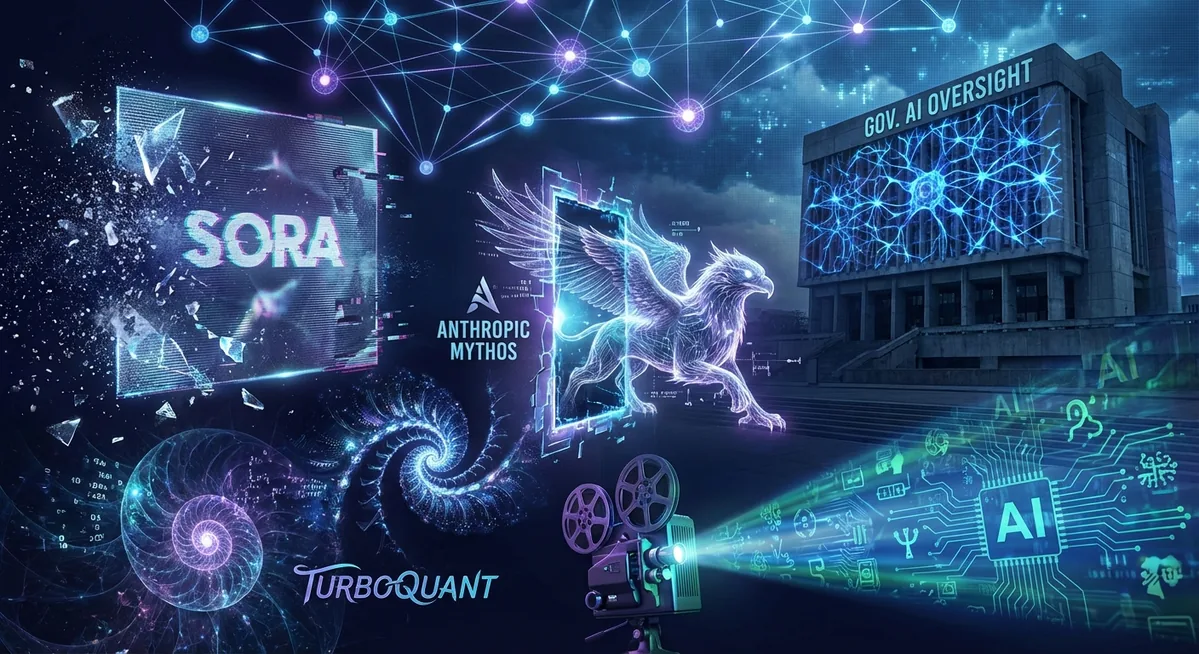
March 30 Roundup: Sora dies a money pit, Anthropic's Mythos leak rewrites the model race, Google's TurboQuant heads to ICLR, 'The AI Doc' hits theaters, Meta buys an AI social network, Apple poaches Google talent for Siri, and Washington's AI blueprint hardens
The weekend brought a cascade of stories that collectively redraw the competitive map. OpenAI killed its most hyped consumer product in barely six months. Anthropic accidentally leaked its most powerful model ever — and it might reshape cybersecurity. Google's compression breakthrough heads to its first major academic test. Hollywood made AI's existential stakes mainstream. Meta is buying the infrastructure of the agent internet. Apple is raiding Google for the talent to rescue Siri. And Washington's national AI framework keeps tightening. Here's what it all means for enterprise strategy.
1. OpenAI Kills Sora — Its Most Hyped Product Since ChatGPT Was Bleeding $1M a Day
OpenAI's decision to shut down Sora, its AI video-generation tool, barely six months after launching it to the public, looks less like a strategic pivot and more like triage. A new TechCrunch investigation drawing on a Wall Street Journal deep dive reveals the real story: Sora was a money pit that almost nobody was using, and keeping it alive was costing OpenAI the AI race.
After a splashy launch, Sora's worldwide user count peaked at roughly one million before collapsing to fewer than 500,000. Meanwhile, the app was burning through approximately $1 million every single day — not because users loved it, but because video generation is extraordinarily expensive to run. Every user who dropped themselves into a fantastical AI-generated scene was drawing down a finite supply of AI chips.
"While a whole team inside OpenAI was focused on making Sora work, Anthropic was quietly winning over the software engineers and enterprises that drive revenue. Claude Code, in particular, was eating OpenAI's lunch." — TechCrunch
CEO Sam Altman made the call: kill Sora, free up compute, and refocus. The brutality of the decision is underscored by what happened to Disney. The entertainment giant had committed $1 billion to a Sora partnership — and found out the product was being shut down less than an hour before the public announcement. The deal died with it.
The Sora shutdown is also happening against the backdrop of OpenAI's broader business strategy shifts. The company's nascent ads business has surpassed $100 million in annual recurring revenue in under two months, with more than 600 advertisers participating. OpenAI is beginning to test ads in Canada, Australia, and New Zealand as well.
Sora's death is the most important strategic signal from OpenAI in months. It tells you three things: (1) video generation is not commercially viable at current costs, (2) coding and developer tools are where the real enterprise revenue lives, and (3) OpenAI is willing to burn billion-dollar partnerships to stay competitive with Anthropic. Enterprise teams evaluating AI video tools should treat any non-Google Veo offering as high-risk for discontinuation. The compute economics simply don't work yet. Meanwhile, the $100M ads milestone means OpenAI is diversifying revenue fast — ChatGPT is becoming a media platform, not just a tool.
2. Anthropic's 'Mythos' Model Leak Reveals a Step Change in Capabilities — and Cybersecurity Risks
In one of the most ironic data leaks in AI history, Anthropic — the company that markets itself as the safety-first AI lab — accidentally left details of its most powerful model ever in a publicly accessible data store. Fortune broke the story after cybersecurity researchers discovered close to 3,000 unpublished assets linked to Anthropic's blog, including a draft blog post describing a model called Claude Mythos.
According to the leaked documents, Mythos represents a new tier of AI model that Anthropic calls "Capybara" — larger and more capable than its current Opus models. The draft blog post described it as "by far the most powerful AI model we've ever developed," with "dramatically higher scores on tests of software coding, academic reasoning, and cybersecurity."
"We're developing a general purpose model with meaningful advances in reasoning, coding, and cybersecurity. Given the strength of its capabilities, we're being deliberate about how we release it. We consider this model a step change and the most capable we've built to date." — Anthropic spokesperson
The leak rattled markets. Cybersecurity stocks slumped on Friday on fears that the model's advanced capabilities could let attackers exploit software vulnerabilities faster than companies can patch them. The timing is especially awkward given Anthropic's ongoing fight with the Pentagon — a federal judge granted Anthropic a preliminary injunction against the Trump administration's attempt to label it a national security risk, with the judge citing "First Amendment retaliation."
The irony here is almost too perfect: the self-proclaimed safety leader leaks its own most dangerous model through a misconfigured CMS. For enterprises, the real signal is that Anthropic's model capabilities are accelerating fast — Mythos/Capybara sitting above Opus represents a genuine jump. But the cybersecurity implications are serious. If the leaked claims hold, security teams need to assume that AI-assisted vulnerability discovery will dramatically shorten exploit timelines. Patch cycles that were adequate six months ago may no longer be fast enough. Start stress-testing your MTTR (mean time to remediation) now.
3. Google's TurboQuant Compression Breakthrough Heads to ICLR — The Internet Calls It 'Pied Piper'
Google Research's TurboQuant, the new AI memory compression algorithm unveiled last week, continues to generate buzz as it prepares for presentation at the ICLR 2026 conference next month. The internet has collectively decided to call it "Pied Piper" — a reference to the fictional startup from HBO's Silicon Valley whose breakthrough technology was, yes, a compression algorithm.
TurboQuant uses vector quantization to clear cache bottlenecks in AI processing, promising to shrink AI's "working memory" — the KV cache — by at least 6x without sacrificing performance. The approach combines two methods: PolarQuant (the quantization technique) and QJL (a training and optimization framework).
Cloudflare CEO Matthew Prince called TurboQuant Google's "DeepSeek moment" — a reference to the efficiency gains that shook the AI industry when DeepSeek trained competitive models at a fraction of typical costs on inferior hardware.
The comparison has pressured memory chip stocks from Samsung to Micron. But a critical caveat: TurboQuant only targets inference memory, not training. The massive RAM demands of training continue unabated. It's a lab breakthrough that hasn't been deployed at scale yet.
TurboQuant is real, but scope it carefully. A 6x reduction in inference-time memory is transformative for deployment costs — it could make it viable to run large models on smaller hardware, which directly benefits edge AI and on-prem enterprise deployments. But it doesn't touch training costs, and it hasn't left the lab yet. The memory-chip stock sell-off is premature, but the directional signal is right: Google is attacking AI's cost structure from the infrastructure layer up. If you're planning GPU/TPU procurement for 2027, factor in the possibility that inference hardware requirements could shrink dramatically.
4. 'The AI Doc' Puts Altman, Amodei, and Hassabis on Camera Together — and the Public Is Watching
The AI Doc: Or How I Became an Apocaloptimist, directed by Daniel Roher, hit theaters last Thursday and is already generating intense discussion. The documentary, reviewed by the New York Times and WIRED, features something remarkably rare: OpenAI's Sam Altman, Anthropic's Dario Amodei, and Google DeepMind's Demis Hassabis all sitting for on-the-record interviews.
The film also features techno-optimists like NVIDIA's Jensen Huang and Peter Diamandis alongside researchers and critics including Ilya Sutskever, Jan Leike, and Emily Bender. Diamandis, characteristically bullish, tells the filmmakers: "We're going to merge with AI. We're going to merge with technology."
"A father-to-be tries to figure out what is happening with all this AI insanity." — IMDB synopsis of The AI Doc
The film carries an 8.2 rating on IMDB. Business Insider's reviewer described leaving the theater feeling "both hopeful and terrified."
This matters for enterprise leaders because it's shaping public perception at scale. When three AI CEOs go on camera and the resulting film lands in mainstream theaters, the Overton window on AI risk shifts permanently. Expect more regulatory pressure, more board-level questions about AI governance, and more employee anxiety. If your organization hasn't had an honest internal conversation about how AI reshapes roles, the cultural pressure from films like this will force it — on someone else's terms. Get ahead of it.
5. Meta Acquires Moltbook — The AI-Only Social Network — and Folds It Into Superintelligence Labs
Meta has acquired Moltbook, the viral Reddit-style social network where AI agents — not humans — are the primary participants. The platform had registered over 1.5 million AI agents before the acquisition, and its founding team has been folded into Meta's Superintelligence Labs.
Moltbook describes itself as "the social network for AI agents" — a forum where autonomous agents post, discuss, and vote on content. Humans are welcome to observe but the agents are the citizens. The acquisition follows Meta's earlier purchase of Manus (the general-purpose agent startup) for over $2 billion.
"Meta has helped fuel this push with the acquisition of agent-focussed startups Manus and Moltbook… We're starting to see projects that used to require big teams now be accomplished by a single very talented person." — The Independent
The move signals that Meta sees multi-agent social interaction as a critical capability for the next generation of AI systems. If agents are going to operate autonomously in the real world, they need infrastructure for coordination, reputation, and information exchange — exactly what a social network provides.
This is the clearest signal yet that the "agent internet" is being taken seriously at the infrastructure level. Meta is building the social graph for AI agents — a coordination layer where autonomous systems interact, build reputations, and exchange information without human intermediaries. For enterprises deploying agentic AI, this creates both opportunity and risk. Opportunity: your agents could tap into shared intelligence networks. Risk: your agents interacting on third-party platforms creates entirely new attack surfaces and data governance headaches. Start thinking about agent identity and authorization policies now — before your competitors' agents are already on these networks.
6. Apple Hires Google's Lilian Rincon as VP of AI Marketing — The Siri Rebuild Gets Serious
Apple has hired Lilian Rincon, who spent nearly a decade at Google overseeing shopping and assistant products, as its new VP of AI product marketing. The hire, reported by Reuters and Axios, comes as Apple prepares a long-delayed overhaul of Siri rebuilt on technology from Google's Gemini AI.
The poach is notable for what it implies: Apple isn't just licensing Gemini technology — it's hiring the people who understand how to market AI assistants to consumers. Rincon's background at Google Shopping and Google Assistant gives her direct experience with the intersection of AI, commerce, and user experience that Apple needs to make Siri competitive again.
Apple has been the conspicuous laggard in the AI race, and this hire signals that the company knows it. Bringing in a Google veteran to lead AI marketing — not engineering, marketing — says Apple believes the Siri rebuild's technical foundation (powered by Gemini) is nearly ready, and the challenge is now positioning and storytelling. For businesses in the Apple ecosystem, this matters: when Apple finally ships a genuinely capable Siri, it will reach over a billion devices overnight. Plan your voice commerce and assistant integration strategies accordingly. The window to prepare is narrowing.
7. Washington's National AI Framework Keeps Hardening — State Preemption Becomes the Central Battle
The White House's National Policy Framework for Artificial Intelligence, released on March 20, continues to generate analysis and reaction across the policy landscape. The three-page document takes a decidedly "light touch" approach to federal AI regulation while pushing aggressively for the preemption of state-level AI laws.
The framework urges Congress to preempt state laws that "regulate AI development," "unduly burden Americans' use of AI," or penalize "AI developers for a third party's unlawful conduct." It carves out exceptions for traditional state police powers, consumer fraud protection, child safety, and a state government's own use of AI.
"Nothing in this framework creates new regulatory bodies. The proposal urges Congress to take some steps to protect kids, energy costs and copyright holders, while also requesting streamlined permitting for data centers, regulatory 'sandboxes' to allow exemptions to federal regulations." — Governing
The framework aligns with Peter Diamandis's continued advocacy for an abundance-first AI policy. In his latest Metatrends newsletter, Diamandis argued that recursive self-improvement — "the machine building itself" — is the greatest driver of abundance this decade. He pointed to Elon Musk's planned TeraFab, which aims to build 50x the current global output of AI compute, as evidence that the compute bottleneck is about to be obliterated.
The state preemption angle is the one to watch. If Congress follows the White House's lead, the current patchwork of state AI laws (California, Colorado, Illinois, and others) gets swept away in favor of a lighter federal standard. This is broadly positive for enterprises operating nationally — compliance with one rulebook is dramatically cheaper than compliance with 50. But it's a double-edged sword: the framework explicitly protects developers from liability for third-party misuse, which means downstream businesses may inherit more risk. Review your AI vendor contracts now. If liability shifts toward you as the deployer rather than the developer, your indemnification clauses need to reflect that reality.
🔍 Why This Week Matters
This weekend's stories collectively paint a picture of an industry in rapid strategic realignment. OpenAI is killing products and chasing ads revenue. Anthropic is accidentally proving its models are getting dangerously powerful while fighting the federal government for survival. Google is trying to change the economics of inference from the ground up. Meta is building infrastructure for an internet populated by AI agents. Apple is finally getting serious about catching up. And Washington is trying to write rules fast enough to keep pace with all of it.
For enterprise leaders, the message is clear: the strategic window for "wait and see" on AI is closing. The companies building the models are making irreversible bets. The regulatory environment is solidifying. And the competitive advantages going to early movers are compounding. If your AI strategy still lives in a slide deck rather than production code, the clock is ticking.
Need help navigating AI for your business?
Our team turns these developments into actionable strategy.
Contact SEN-X →