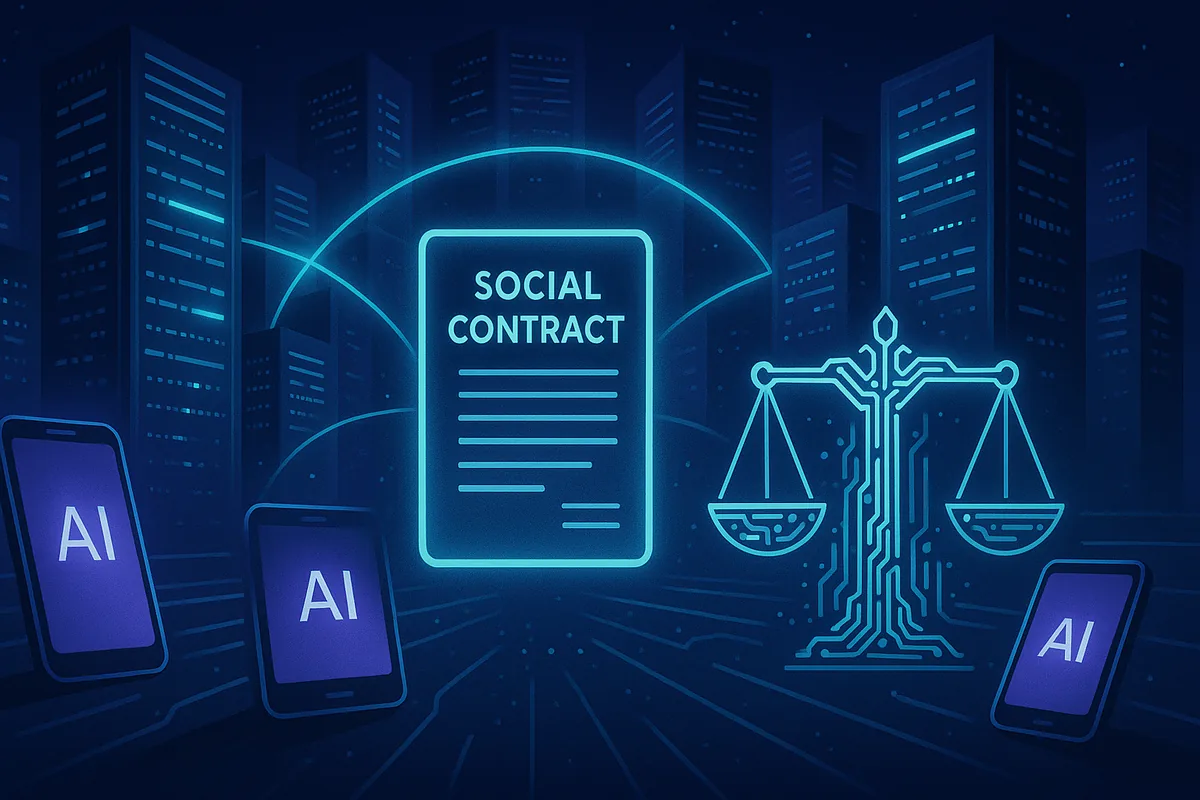
April 7 Roundup: OpenAI pitches an AI social contract, Anthropic locks in gigawatts, Google puts edge AI in your pocket, and regulation gets operational
Yesterday's AI cycle wasn't about another benchmark or another flashy demo. It was about the infrastructure, policy, and product decisions that determine who gets to build, who gets to capture value, and who bears the downside when AI moves from novelty into the plumbing of the economy. OpenAI published a strikingly political blueprint for the "intelligence age." Anthropic and Google turned raw compute into a strategic moat. Google also showed how practical AI is increasingly becoming local, ambient, and embedded rather than purely cloud-bound. At the same time, the safety and policy conversation got more operational: less abstract debate, more procurement standards, crisis interfaces, and enforcement design. Here's what mattered most.
1) OpenAI moves from product company to political economy actor
One of the most consequential stories of the day came via TechCrunch's report on OpenAI's new policy proposals. The core signal wasn't simply that OpenAI published another white paper. It's that the company is now trying to shape the social contract around AI rather than merely lobby for light-touch rules. According to the report, OpenAI is calling for ideas including public wealth funds, a shift in taxation from labor toward capital, portable benefits, support for four-day workweeks, and expanded electricity infrastructure to underpin AI buildouts.
"As AI reshapes work and production, the composition of economic activity may shift — expanding corporate profits and capital gains while potentially reducing reliance on labor income and payroll taxes," OpenAI wrote, according to TechCrunch.
This matters because OpenAI is effectively acknowledging the legitimacy of the core public concern around frontier AI: not just misuse, but distribution. The market has largely priced AI as a productivity miracle for capital owners. OpenAI is now admitting that unless value is redistributed in some credible way, the backlash risk becomes material. That doesn't make the company altruistic; it makes it realistic. If labor loses bargaining power while compute owners and model owners consolidate gains, the political system will intervene eventually.
There's another layer here. By talking about AI as a utility, OpenAI is also positioning itself for a future in which access, subsidy, and public-private coordination become strategic levers. That's not a neutral framing. It creates room for infrastructure incentives, energy support, and legitimacy for massive capital deployment. It also lets OpenAI sound more socially responsive at a moment when its scale, fundraising, and political influence are attracting more scrutiny.
Enterprises should read this as an early warning that AI strategy is now tied to tax, labor, benefits, and energy policy. If you're planning around "software budgets" alone, you're too narrow. The next phase of AI competition will be shaped by who can secure power, procurement approval, labor legitimacy, and public trust — not just model quality.
2) Anthropic, Google, and Broadcom turn compute into the real moat
Anthropic announced a major expansion of its partnership with Google and Broadcom for "multiple gigawatts of next-generation TPU capacity," with the infrastructure expected to begin coming online in 2027. CNBC's reporting added useful context: Broadcom said Anthropic would gain access to roughly 3.5 gigawatts of compute capacity drawing on Google's AI processors, while Broadcom also deepens its future chip work for Google.
"We are making our most significant compute commitment to date to keep pace with our unprecedented growth," Anthropic CFO Krishna Rao said in the company announcement.
Anthropic also disclosed that its annualized revenue run rate has surpassed $30 billion, up from roughly $9 billion at the end of 2025, and that the number of business customers spending more than $1 million annually has doubled to more than 1,000 in less than two months. That combination — demand growth plus committed future compute — tells you a lot about where the market is heading. Frontier AI is becoming less like software in the classic SaaS sense and more like an integrated industrial stack that spans chips, power, clouds, and capacity reservations years in advance.
For Google, this is equally important. Google is no longer just competing via Gemini. It is increasingly monetizing AI through vertical integration: TPU design, cloud distribution, and ecosystem lock-in. Anthropic benefits from diversification beyond Nvidia-heavy paths; Google benefits from proving that its internal hardware ecosystem can support one of the top model labs in the world. Broadcom benefits by becoming the crucial connective tissue in the custom silicon layer.
This is why compute discussions are no longer "backend details." They are strategy. If OpenAI, Anthropic, Google, Microsoft, Amazon, and Meta can each pre-buy years of future capacity, then second-tier labs and late-enterprise adopters may find themselves in a structurally worse bargaining position on cost, latency, and availability.
The AI market is hardening into a capacity hierarchy. If your company depends on frontier models for mission-critical workflows, you need contingency planning now: multi-vendor architecture, cost visibility, model portability, and a sober view of where your providers sit in the compute pecking order.
3) Google's edge AI play is quietly more important than another giant model launch
The Verge reported that Google launched AI Edge Eloquent, a free offline AI dictation app for iOS that can transcribe speech locally and automatically remove filler words such as "um." Meanwhile, Google's own March roundup emphasized a broader theme: AI that becomes ambient, contextual, and embedded across products rather than merely summoned in a chatbot window. In Google's recap of March AI updates, the company highlighted expanded Search Live, Personal Intelligence, Gemini across Workspace, upgraded Maps experiences, and new migration tools designed to help users switch to Gemini.
Google said March focused on making AI "more helpful in your daily life," with updates that help Gemini understand "your specific context — from your travel plans and work projects to your shopping preferences."
The strategic point here is subtle but huge. Google may be one of the best-positioned companies in AI not because it has the single best chatbot on every benchmark, but because it controls the surfaces where users already live: search, maps, docs, phones, browsers, email, and operating systems. Edge Eloquent is a small product in that context, but symbolically it matters. It shows Google leaning into low-friction, privacy-friendlier, local-first AI experiences that feel useful immediately.
That matters for enterprise as well. Local or edge inference can reduce latency, improve privacy posture, and make AI feel more dependable in real workflows. In industries with strong data-governance demands — healthcare, financial services, field operations, regulated customer support — the shift from "everything goes to the cloud model" toward hybrid local-plus-cloud patterns is strategically attractive.
It also reframes the platform battle. OpenAI often wins mindshare through flagship product moments. Google is increasingly playing a slower, more dangerous game: make AI native to the entire stack, then make switching cost feel irrational.
Watch the edge layer. The next enterprise AI winners won't just be the firms with the best frontier labs. They'll be the firms that can push useful intelligence into devices, workflows, and interfaces with the least friction and the strongest privacy story.
4) Safety design is shifting from policy PDF to product interface
Safety news often gets framed as a governance abstraction, but one of the more practical stories came from The Verge's report on Gemini's redesigned mental-health crisis interface. Google says the new experience makes it faster for distressed users to access help and keeps the option to reach out for professional support clearly visible throughout the conversation. The company also announced $30 million in support for global hotlines over three years.
When a conversation indicates a user is in a potential crisis related to suicide or self-harm, Gemini already launches a "Help is available" module; the redesign streamlines this into a "one-touch" interface, according to The Verge.
This is important not because it solves AI harm, but because it reflects where the industry is being forced to mature: interface design, escalation paths, persistence of safety affordances, and evidence of engagement with clinical experts. Those things sound mundane compared with AGI rhetoric, but they are where liability, trust, and real-world outcomes live.
For businesses deploying AI internally or customer-facing, this is a useful signal. Guardrails are not just a model-level problem. They are a system design problem. Routing, escalation, visibility, user experience, and retention of support options are all part of the safety architecture. Product teams that still think "we added a moderation API" and called it done are behind.
More broadly, safety now increasingly looks like operational design rather than marketing copy. That's good. It means the market is moving from vague values statements toward measurable implementation details. It also means procurement teams and regulators will get more specific in what they ask to see.
If you deploy AI in any customer journey that could touch vulnerable users, you need explicit crisis pathways, escalation logic, human handoff options, and auditability. "Responsible AI" is becoming less about branding and more about whether your product behavior holds up under scrutiny.
5) Regulation is getting operational: procurement, preemption, and state enforcement
The policy backdrop is getting more concrete. While a direct fetch of Axios was blocked, search results and legal analysis around the same developments point in the same direction: California is emerging as a live testing ground for AI procurement rules and operational safeguards, even as the federal conversation trends toward a lighter-touch national framework that may try to preempt some state-level burdens. Related analyses from Gibson Dunn, Morrison Foerster, Morgan Lewis, and Cooley all emphasize the same structural split: federal actors want a more uniform, innovation-friendly approach, while states continue to move aggressively on procurement standards, consumer protection, bias, and enforcement.
The practical consequence is that "AI regulation" is no longer just about future legislation. It is already arriving through purchasing requirements, state enforcement powers, sectoral compliance expectations, and litigation theories. A company doesn't need a giant new federal AI agency to feel pressure; it only needs a customer, a state AG, or a regulator who demands documentation for model behavior, bias controls, safety processes, and vendor transparency.
This is why OpenAI's own economic-policy push and Google's interface-safety work matter in the same cycle. The winners in the next phase of AI adoption will not be the companies that ignore policy and hope for permissionless scale. They will be the ones that can produce acceptable answers to questions like: What data do you use? What happens in a crisis? How do you document model behavior? How do you manage risk in procurement? Who is accountable when something goes wrong?
Boards should stop asking whether AI is "regulated yet." The better question is where regulation is already arriving indirectly — procurement, litigation, contracts, sector guidance, or state enforcement — and whether your AI stack is documented well enough to survive that scrutiny.
6) The industry narrative is separating into two lanes: abundance politics and control architecture
There's a useful through-line across yesterday's coverage from OpenAI, Anthropic, Google, and the broader press. The optimistic lane — the one often associated with people like Peter Diamandis and parts of venture media — continues to emphasize abundance, productivity, democratized capability, and a post-scarcity future. You can feel echoes of that in Google's product framing and in OpenAI's argument that superintelligence can benefit everyone if society updates the institutions around it.
But there's a second lane now becoming impossible to ignore: control architecture. Who controls compute? Who controls the interface? Who controls the distribution layer? Who controls procurement eligibility and acceptable safety evidence? Who controls whether AI is local, cloud, or both? Those questions are rapidly becoming more important than philosophical debates about whether AI is "good" or "bad."
Jason Calacanis and the broader startup-investor ecosystem have long focused on speed, adoption, and market capture. That lens still matters. But as AI moves into critical workflows, the higher-order variable is no longer just who grows fastest. It's who can scale while maintaining legitimacy, resilience, and strategic control over the stack. That's why gigawatt announcements, crisis UX, utility metaphors, and state procurement rules all belong in the same roundup. They are different facets of the same transition: AI becoming infrastructure.
Why this matters for operators
If you're leading AI inside a business, yesterday's news adds up to a clear operating thesis:
- Don't confuse model access with durable advantage. The real differentiators are now workflow design, data access, compute resilience, governance quality, and distribution.
- Design for multi-layer safety. Model safeguards are necessary but insufficient. Product interface, escalation logic, documentation, and audit readiness now matter just as much.
- Expect infrastructure constraints to shape product reality. Capacity, energy, and hardware partnerships will increasingly determine economics and reliability.
- Treat policy as operating environment, not PR noise. Procurement standards and state enforcement can hit before sweeping federal law ever arrives.
- Track the local-plus-cloud shift. Edge AI, on-device workflows, and privacy-preserving inference are likely to become a major adoption lever in regulated and high-trust environments.
The headline version: AI is leaving its "wow demo" era and entering its "who controls the system" era. That's where enduring value — and enduring risk — gets created.
Sources referenced: TechCrunch, Anthropic, CNBC, The Verge, The Verge, Google Blog, and recent policy/legal analyses surfaced via Brave Search.
Need help navigating AI for your business?
Our team turns these developments into actionable strategy.
Contact SEN-X →