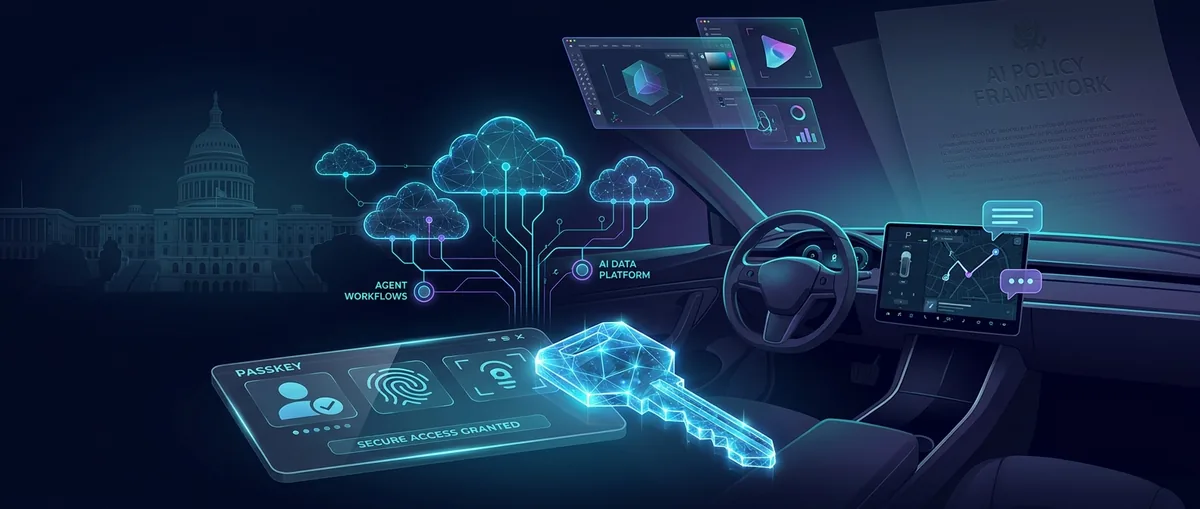
May 2 Roundup: OpenAI locks down identity, AWS becomes an agent platform, Google puts Gemini in the dashboard, and AI policy gets more practical
Yesterday's AI story wasn't one big model launch. It was the market maturing in real time: security becoming product surface, cloud distribution becoming strategy, assistants moving from chat windows into operating environments, creative software turning into agent territory, and policymakers finally focusing on concrete harms instead of abstract doomsday theater. For operators, that mix matters more than benchmark drama. It tells us where budgets, trust, and workflow power are actually moving.
1. OpenAI turns account security into product strategy
OpenAI introduced Advanced Account Security, an opt-in protection mode for ChatGPT and Codex users who face elevated digital risk. This is more than a settings-page cleanup. It bundles passkeys or physical security keys, disables password-based login, disables email and SMS recovery, shortens sessions, adds login alerts, and automatically excludes conversations from model training when the mode is enabled.
“Advanced Account Security requires passkeys or physical security keys while disabling password-based login, helping make phishing-resistant sign-in the default for people who need it most,” OpenAI wrote.
The framing matters. OpenAI is treating the AI account not as disposable SaaS identity, but as a high-value operational surface. It also tied the feature to Codex and to its broader cybersecurity action plan, with a requirement that members of its Trusted Access for Cyber program enable phishing-resistant authentication by June 1.
This is the right direction. If AI agents are becoming workflow hubs, identity hardening becomes part of product-market fit. Enterprises should read this as a warning: agent rollouts without passkeys, tighter recovery policies, and session visibility are going to look increasingly immature. Security is no longer a wrapper around AI. It is part of the AI interface.
2. OpenAI’s AWS move is really about enterprise distribution
OpenAI also announced that its models, Codex, and Amazon Bedrock Managed Agents are coming to AWS in limited preview. According to the company, customers will be able to use frontier OpenAI models in Bedrock, route Codex through Bedrock APIs, and deploy OpenAI-powered managed agents inside existing AWS governance and procurement rails.
“With OpenAI models, Codex, and Managed Agents now coming to Amazon Bedrock, customers have a faster, more secure path to putting AI to work across their business,” OpenAI said.
This is strategically bigger than yet another hosting partnership. The real signal is that the frontier-model market is being pulled into the control planes customers already trust. OpenAI is effectively conceding that winning enterprise AI no longer means forcing everyone through a proprietary front door. It means showing up inside the buyer’s existing stack with security, billing, compliance, and cloud-commit alignment already handled.
The timing matters because the AWS announcement landed just as OpenAI broadened its distribution options beyond the old Microsoft-centric frame. That turns model access into a multi-cloud distribution fight, and agent infrastructure into the next enterprise battleground.
For operators, the question is shifting from “which model is best?” to “where can we safely operationalize agents?” AWS is trying to become the default substrate for governed agent deployment. OpenAI is trying to become the model-and-tool layer inside that substrate. If you run a large business, that combination is more relevant than any benchmark chart.
3. Anthropic is expanding in two directions at once: product surface and capital intensity
Anthropic had two meaningful storylines yesterday. First, it launched Claude for Creative Work, a set of connectors that push Claude into software already used by designers, musicians, 3D artists, and creative technologists. The new integrations span Ableton, Adobe creative tools, Affinity by Canva, Autodesk Fusion, Blender, SketchUp, Splice, and more.
“Claude can’t replace taste or imagination, but it can open up new ways of working—faster and more ambitious ideation, a more expansive skill set, and the ability for creatives to take on larger-scale projects,” Anthropic wrote.
That connector strategy is important because it moves Claude beyond generalized chat into real production environments. Anthropic is not merely selling a writing assistant; it is trying to make Claude a coordination layer across creative pipelines, code, automation, and application bridges.
At the same time, TechCrunch reported that Anthropic is asking investors to submit allocations for a roughly $50 billion round expected to close within two weeks at a valuation of about $900 billion, potentially even higher if demand stays hot. The company reportedly needs the capital to fund its immense compute requirements ahead of a possible IPO later this year.
“The company is raising what is likely to be its last private round before going public to fund its massive computing needs,” TechCrunch reported.
Those two developments reinforce each other. The more deeply Claude enters domain workflows, the easier it becomes to justify massive infrastructure spend. But the more expensive the compute race gets, the more these companies must prove they are durable workflow platforms, not just labs.
Anthropic’s creative push is smart because it targets users with high willingness to pay and strong daily workflow attachment. But the valuation story is just as telling: frontier AI is still a capital furnace. Product traction matters, yet capital access still determines who can keep shipping at model scale. Expect more companies to narrow toward vertical workflows while simultaneously broadening capital sources.
4. Google is pushing Gemini from the phone into the vehicle cabin
Google said Gemini is coming to cars with Google built-in, and TechCrunch reported that the rollout will reach millions of vehicles, including roughly 4 million recent General Motors vehicles. The upgrade replaces a more command-based assistant model with a conversational layer that can reason across routing, messages, media, vehicle controls, and live discussion.
“Soon, drivers will be able to speak more freely to complete tasks, explore ideas, or retrieve information,” TechCrunch wrote, describing Google’s rollout.
Google’s own post emphasized deep integration with both the vehicle and the user’s apps. That means the car is becoming another context-rich execution environment, not just another screen. The bigger strategic point is ambient presence: whoever wins AI adoption will live in dashboards, office suites, IDEs, and line-of-business tools, not only browser tabs.
This is the next phase of assistant competition: not just better answers, but better placement. For enterprises, the lesson is similar. The best AI experience is often the one embedded inside the workflow where the user already is. Distribution into context beats standalone novelty.
5. Big Tech’s AI spend is no longer theoretical — and Google just made the cleanest ROI case
Reuters reported that combined AI outlays across the biggest U.S. tech companies are now expected to exceed $700 billion in 2026, up from roughly $600 billion previously. The reporting also noted that Google Cloud posted a 63% revenue surge, outpacing Amazon and Microsoft cloud growth and giving investors one of the clearest near-term payoff stories in the capex race.
“All four of the U.S. tech giants that reported results on Wednesday signaled that spending on artificial intelligence would not slow down, with combined outlays now set to surpass $700 billion this year,” Reuters wrote.
That growth number matters because it helps calm the market’s core anxiety: whether AI infrastructure spending is running far ahead of monetization. Alphabet’s argument is that AI is already becoming a cloud growth driver, not just a future promise. Peter Diamandis and his Moonshots panel made a parallel point from a different angle, arguing that AI’s real bottleneck is now supply, especially chips and foundry capacity: “It’s all bottlenecked at TSM. That’s the actual bottleneck to all of AI.”
We are moving from speculation about AI capex to segmentation of AI capex. Investors and enterprise buyers are starting to reward spending that clearly maps to revenue, customer retention, or durable workflow lock-in. If your AI plan still sounds like generalized experimentation, the market is moving past you.
6. AI regulation is slowly leaving the abstract phase
On the policy front, CNBC reported on a bipartisan bill led by Rep. Ted Lieu that would crack down on deepfake and non-consensual image distribution, protect AI whistleblowers, and push the U.S. to participate more actively in international technical standards bodies. Separately, search reporting from Politico indicated support from both OpenAI and Anthropic for the Warner-Budd workforce data bill, while Reuters reported that EU countries and lawmakers still failed to reach a deal on softened AI rules.
“It is not designed to be controversial,” Lieu told CNBC. “It is based on bipartisan legislation that other members have introduced, as well as the recommendations of the bipartisan House AI Task Force.”
That is the important shift. Legislative energy is moving toward narrower, more operational issues: deepfakes, whistleblower protection, standards participation, workforce measurement, and deployment accountability. Europe, meanwhile, remains a reminder that broad omnibus frameworks can still bog down in implementation politics.
For businesses, the takeaway is not “wait for one grand AI law.” It is the opposite. Start building compliance muscles around provenance, reporting, explainability, and internal escalation now. The next regulatory wave is likely to arrive as a patchwork of very practical obligations, not one dramatic federal event.
Why this matters
The throughline across yesterday’s news is operationalization. OpenAI is securing identities and distributing through AWS. Anthropic is entering real creative workflows while raising capital for the compute war. Google is embedding Gemini into a live environment where context and safety matter. Regulators are focusing less on philosophy and more on concrete mechanisms. That combination tells us the AI market is hardening into infrastructure, interfaces, and governance.
For executive teams, this is the moment to get practical. Secure the accounts that hold sensitive model context. Choose cloud and agent architectures that match your governance reality. Embed assistants where work already happens. And prepare for compliance on the specific harms lawmakers actually know how to regulate. The teams that do those four things well will be in much better shape than the teams still treating AI as a side experiment.
Sources: OpenAI, OpenAI on AWS, Anthropic, TechCrunch, TechCrunch, Google, Reuters, CNBC, Moonshots transcript.
Need help navigating AI for your business?
Our team turns these developments into actionable strategy.
Contact SEN-X →