May 14 Roundup: Anthropic opens Claude to Main Street, OpenAI’s $4B deployment unit goes live, and Gemini Intelligence rewires Android
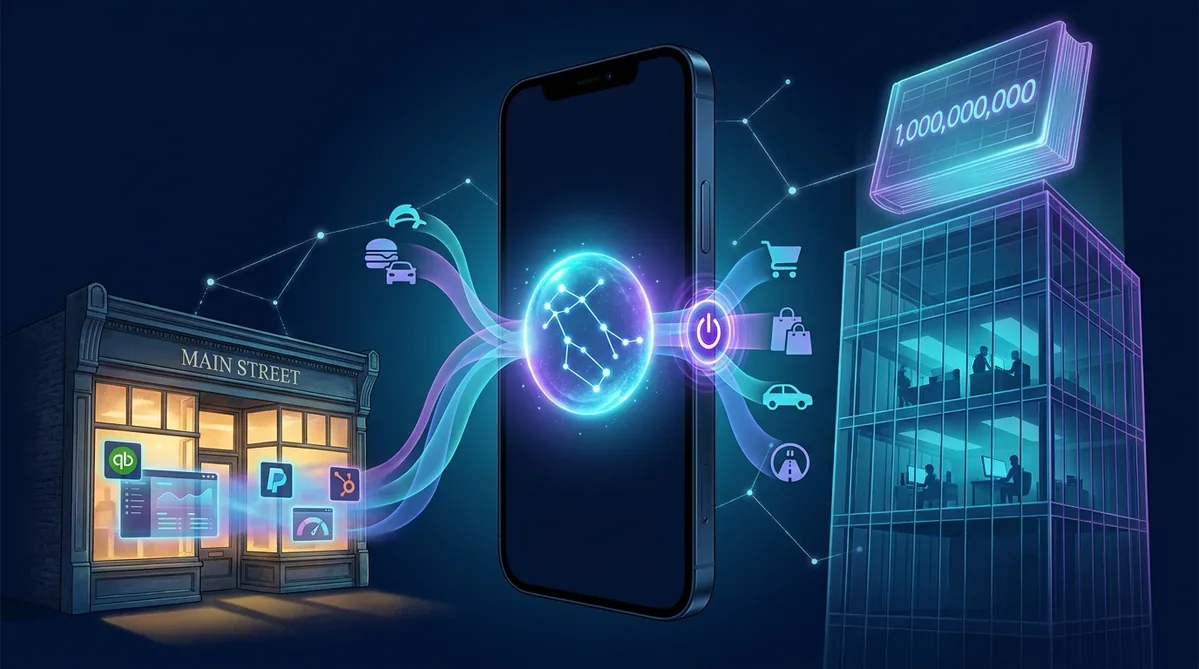
The frontier labs spent yesterday pushing in two directions at once: down-market into small business workflows and out-of-the-app into the operating system. Anthropic launched Claude for Small Business inside QuickBooks, PayPal and HubSpot. OpenAI stood up a $4 billion Deployment Company and bought consultancy Tomoro to embed engineers in the Fortune 500. Google announced Gemini Intelligence — an Android-native agent that controls food, rideshare and shopping apps from the power button. Meanwhile, Ramp data shows Anthropic has quietly overtaken OpenAI in verified business customers, and OpenAI published a Child Safety Blueprint as policy attention shifts from theory to enforceable design choices.
1. Anthropic launches Claude for Small Business — putting agents inside QuickBooks, PayPal and HubSpot
Anthropic’s biggest move yesterday wasn’t aimed at the Fortune 500. It was aimed at the 33 million U.S. small businesses that have so far stayed at the chat window. Claude for Small Business, announced May 13, ships as a toggle inside Claude Cowork that installs a package of connectors and 15 ready-to-run agentic workflows across finance, operations, sales, marketing, HR and customer service.
The connectors are the story. Once enabled, Claude can act inside Intuit QuickBooks, PayPal, HubSpot, Canva, Docusign, Google Workspace and Microsoft 365 — the closest thing the SMB world has to a default stack. From there it can plan payroll, close the month against PayPal settlements, build a 30-day cash forecast, chase invoices, triage leads, generate Canva assets for a campaign, and route a contract through Docusign. The Verge framed it bluntly: “It can plan payroll, close the month, run a sales campaign, chase invoices, and more.”
“Small businesses make up nearly half the American economy, but they’ve never had the resources of bigger companies. AI is the first technology that can finally close that gap… Claude for Small Business runs inside the tools owners already rely on, like QuickBooks, PayPal, and HubSpot, and takes on the work that piles up after hours.” — Daniela Amodei, Co-founder and President, Anthropic
Anthropic paired the launch with a free AI Fluency for Small Business course with PayPal, a 10-city “Claude SMB Tour” starting May 14 in Chicago (Tulsa, Dallas, Hamilton Township, Baton Rouge, Birmingham, Salt Lake City, Baltimore, San Jose, Indianapolis to follow), and partnerships with CDFIs Accion Opportunity Fund, Community Reinvestment Fund USA, and Pacific Community Ventures to put Claude credits into community lenders.
The competitive context matters even more than the announcement. New Ramp card-spend data shows that, for the first time, Anthropic has more verified paying business customers than OpenAI — 34.4% of Ramp’s tracked businesses pay Anthropic versus 32.3% paying OpenAI. The SMB launch is Anthropic trying to widen that lead before OpenAI’s enterprise machine catches up.
This is the first credible attempt to put an AI agent where the work actually happens for a small business: inside the books, the CRM and the payment processor — not in a separate tab. The QuickBooks + PayPal pairing is the wedge; once Claude can read settlements and post journal entries, the chat window stops being the product and the workflow does. Operators should expect their bookkeepers, fractional CFOs and agency partners to start delivering work through Claude Cowork within 90 days. The right move this quarter isn’t to evaluate Claude vs. ChatGPT — it’s to audit which of your 15 highest-frequency back-office tasks already have a Claude SMB skill ready to run, and which still need a human-shaped guardrail before you flip the toggle.
2. OpenAI’s $4 billion Deployment Company goes live — and buys Tomoro to embed engineers in your business
OpenAI’s response to Anthropic’s enterprise pull is no longer a strategy deck. On May 11, Reuters reported, and OpenAI confirmed yesterday, that the OpenAI Deployment Company is operational with more than $4 billion in initial investment and is acquiring AI consulting firm Tomoro, bringing roughly 150 deployment engineers in on day one.
The structure is unusual: a majority OpenAI-owned vehicle backed by a 19-firm consortium led by TPG, with Advent, Bain Capital and Brookfield as co-lead founding partners. The pitch to customers is to embed “engineers specializing in frontier AI deployment” directly inside enterprises and work with their teams to identify where AI can make the biggest impact. Tomoro — formed in 2023 in alliance with OpenAI — already counts Mattel, Red Bull, Tesco, and Virgin Atlantic as clients.
“OpenAI has been working aggressively to sign corporate contracts and establish a large presence in the business world where its AI will see large-scale deployment.” — Reuters
The move closes a structural gap. Anthropic earlier this month launched a $1.5B services venture with Blackstone, Hellman & Friedman and Goldman Sachs; Accenture has been Anthropic’s preferred SI partner since December. Without its own deployment arm, OpenAI was leaving margin and account control on the table for every Microsoft, Accenture, Deloitte and PwC engagement.
The frontier labs are no longer just selling tokens — they’re selling implementation. Expect the next 12 months to look less like “pick a model” and more like “pick a deployment lane.” If you’re a mid-market buyer with no SI relationship, OpenAI Deployment Company and Anthropic + Accenture will start showing up in your inbox with named engineers, fixed-price agent rollouts, and shared-savings pricing. The risk: vendor-led deployment locks the agent architecture to one lab’s tools and one lab’s safety posture. The opportunity: someone else will finally pay for the integration work most companies have been delaying since GPT-4. Buy the outcome, but keep your orchestration layer (MCP, A2A, governed router) portable.
3. Google’s Gemini Intelligence makes Android an agent, not just a phone
Google’s May 12 announcement of Gemini Intelligence on Android is the most aggressive consumer agent rollout to date. Rolling out this summer on the Galaxy S26 and Pixel 10 series and across Wear OS, Android Auto, glasses and laptops later in the year, Gemini Intelligence makes the phone proactive — and gives it the keys to your apps.
The flagship feature is multi-step task automation. From the Gemini app on Pixel 10 and Galaxy S26, users can long-press the power button and tell Gemini to book a ride home, reorder DoorDash, or build a shopping cart from a grocery list. Gemini runs the target app inside a secure, virtual window and reports progress back via live notifications. Google framed the safety model in three words: Control, Transparency, Access — Gemini only acts on command, you can watch it work, and it can only touch the apps you authorize.
“Gemini will navigate tasks for you — whether it’s snagging a front-row bike for your spin class or finding your class syllabus in Gmail then putting the books you need in your cart. Gemini handles the logistics while you stay in the moment.” — Mindy Brooks, VP of Product Management, Android
The release also brings Gemini in Chrome with auto-browse for booking and parking, Gemini-powered Autofill that can fill complex forms from connected apps, a new Rambler voice feature that turns spoken thoughts (with “ums” and code-switching between languages) into polished text, and Create My Widget — generative-UI widgets you build by describing what you want. Google’s framing is unsubtle: “Android is transitioning from an operating system into an intelligence system.”
The competitive subtext is louder. CNBC reported earlier this week that Google is racing to put Gemini at the center of Android before Apple’s expected AI reboot. That race now has a launch date and a button.
When the agent lives in the power button, the browser is no longer the front door to commerce — the OS is. For brands, this is a serious distribution shift. If your customer’s shopping cart, reservation or rideshare is going to be assembled by Gemini reading your app inside a virtual window, your conversion funnel has a new gatekeeper. The action items: (1) audit how your app behaves under accessibility/automation contexts — that’s the surface Gemini drives; (2) make sure your structured product data, prices, and inventory APIs are clean enough for an agent to compare; (3) treat your mobile app as a tool the agent calls, not a destination the user visits. Hospitality, restaurants, retail, ticketing and rideshare get hit first — and Google explicitly named food, grocery and rideshare as the launch categories.
4. Anthropic quietly passes OpenAI in business customers — the SMB launch is a moat play
The data that surfaced alongside the SMB launch deserves its own story. TechCrunch, citing Ramp’s AI Index, reported that 34.4% of Ramp-tracked businesses are paying for Anthropic, versus 32.3% paying for OpenAI. It’s the first time Anthropic has been on top in verified business adoption since Ramp started publishing the series.
The shift isn’t happening in the Fortune 50 — that’s still OpenAI territory through Microsoft. It’s happening in the 10–500 employee band, where Claude Code, Claude Cowork integrations and the Anthropic API have been winning developer-led pilots since late 2025. The Verge’s read on Claude for Small Business — that it’s a “package of ‘connectors,’ installed via a toggle switch” — explains how Anthropic plans to keep that lead: turn developer affinity into administrator-friendly defaults that go live without a deployment SOW.
For OpenAI, this is exactly why Tomoro and the Deployment Company exist. The question is whether $4 billion of services capital can move faster than a connector toggle.
Don’t over-read the Ramp number — it’s a card-spend proxy and skews to the buyers who use Ramp. But the direction is real, and the message to your IT lead is simple: a single-vendor AI strategy is now actively dangerous. Anthropic owns developer trust and SMB connectors; OpenAI owns consumer reach and Microsoft co-sell; Google owns the operating system. Pick a primary, contract a secondary, and route everything through a governed router so you can switch models per task without rewriting the integration. The companies that win the next 18 months will be the ones whose agent layer doesn’t care which logo ships the weights.
5. OpenAI publishes a Child Safety Blueprint — and AI policy becomes engineering work
While the product news was loud, the most consequential policy move yesterday was quiet. OpenAI released its Child Safety Blueprint, a framework built with the National Center for Missing and Exploited Children (NCMEC), the Attorney General Alliance’s AI Task Force, and Thorn. It pairs with The Verge’s reporting that OpenAI endorses the Kids Online Safety Act (KOSA), marking the first time a frontier lab has publicly backed federal teen-safety legislation.
The blueprint moves the conversation from “should AI be safe for kids?” to “what does the audit trail look like?” It calls for three things: modernized laws to address AI-generated and altered CSAM, standardized provider reporting to law enforcement and NCMEC, and safety-by-design requirements built into model training and deployment.
“Effective GenAI safeguards require layered defenses — not a single technical control, but a combination of detection, refusal mechanisms, human oversight, and continuous adaptation to emerging misuse patterns. This mirrors what we see in practice: the threat evolves constantly, and static solutions are insufficient.” — NC AG Jeff Jackson and UT AG Derek Brown, Co-Chairs, AGA AI Task Force
Combined with last week’s Center for AI Standards and Innovation agreements with Google DeepMind, Microsoft and xAI for pre-deployment evaluations, the regulatory map is starting to look operational rather than theoretical. Pre-release red-teaming, CSAM detection pipelines, age estimation, and law-enforcement reporting are becoming product requirements, not compliance posters.
Every AI vendor selling to a regulated sector — healthcare, education, finance, hospitality with minors as customers — should treat the OpenAI blueprint as a preview of the RFP language coming in Q3. The practical work: stand up a documented age-assurance flow, define your CSAM detection and reporting chain, log refusal events as audit artifacts, and require your model vendors to disclose their safety-by-design controls. The window where “we use a frontier API” counted as a control is closing.
6. Anthropic taps SpaceX for compute as the “SpaceXAI” pattern emerges
Anthropic’s capacity story keeps getting weirder and bigger. WIRED reported that Anthropic and SpaceX have signed an agreement letting Anthropic use computing resources tied to xAI’s Colossus data center in Memphis, Tennessee — the same facility built by Elon Musk’s xAI, now operating under the merged “SpaceXAI” umbrella. Anthropic’s post on Claude usage limits last week confirmed the company is using the deal to “substantially increase capacity in the near term.”
The structure is what matters: a frontier lab buying capacity from a competitor’s data center, brokered through the competitor’s parent company. It’s the clearest signal yet that AI compute has moved from strategic asset to commodity that can be wholesaled across rival labs — and that Memphis, Phoenix, and Atlanta are the new compute capitals.
This is what a healthy compute market starts to look like. For buyers, it’s good news: more capacity, fewer rate-limit surprises, less single-vendor lock to one hyperscaler. For builders, it’s a warning: your latency and data-residency assumptions may quietly shift as labs route inference across third-party fabs. Ask your AI vendor where your inference physically runs — and whether that answer is contractual.
7. Peter Diamandis on “a disruptive moment in time” — and why the next 24 months feel different
Peter Diamandis published a piece this week titled “A Disruptive Moment in Time” arguing that the convergence of frontier models, agentic systems, robotics and biology has crossed from “interesting” to “destabilizing” for incumbents. His read is that the largest companies in five years will be the ones currently being founded as AI-native operators of physical work — energy, logistics, healthcare, manufacturing — not just the next SaaS layer.
It’s a useful frame for the rest of yesterday’s news. Claude for Small Business, Gemini Intelligence on Android, and OpenAI’s deployment arm aren’t three product launches — they’re three parts of the same thesis: AI is leaving the chat window. Once an agent can act inside QuickBooks, drive your shopping cart from the power button, and be embedded in your business by a frontier-lab engineering team, the unit of competition is no longer “whose model scores higher.” It’s “whose agent ships the work.”
Why this matters for operators this week
Three concrete moves to make before Monday: (1) Audit your SMB stack — if you run on QuickBooks, PayPal, HubSpot, Canva or Docusign, pilot Claude for Small Business on one finance and one marketing workflow and time the savings. (2) Decide your deployment lane — do you want OpenAI Deployment Company / Tomoro embedding engineers, Anthropic + Accenture, or an independent SI? Each choice locks part of your agent architecture for the next 18 months. (3) Treat your mobile app as agent-readable — Gemini Intelligence will start driving food, grocery and rideshare apps this summer; if your conversion funnel assumes a human user, the funnel will leak.
Need help navigating AI for your business?
Our team turns these developments into actionable strategy — from agent architecture to SMB rollouts to AI governance.
Contact SEN-X →