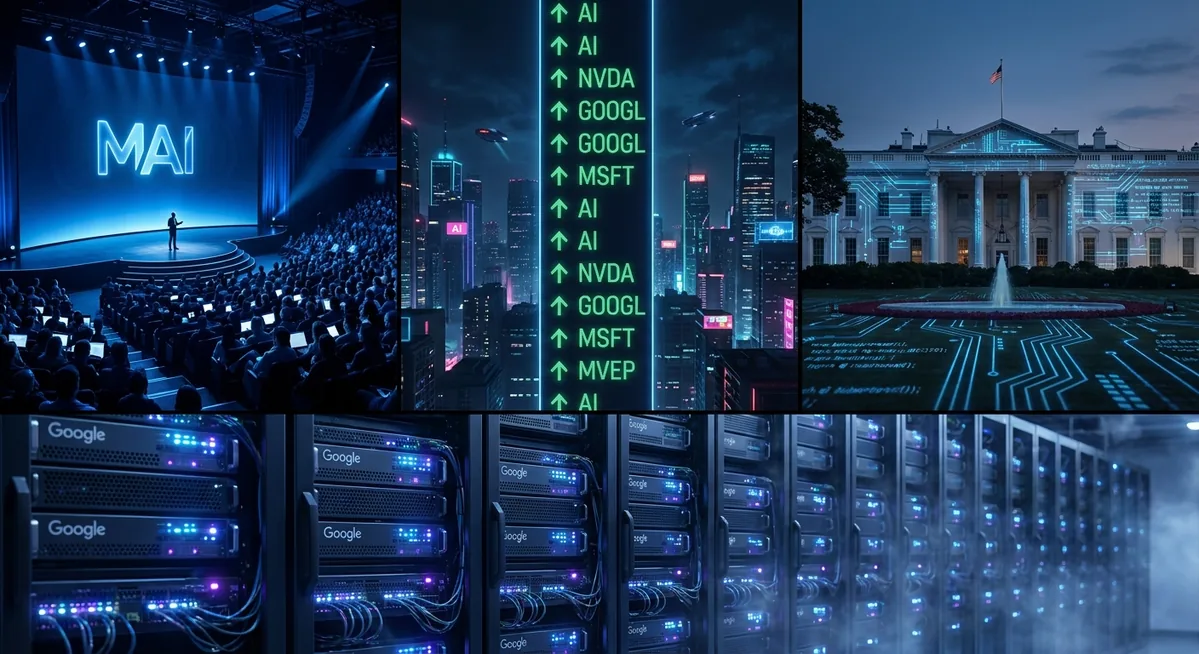
June 3 Roundup: Microsoft Launches Its Own AI Models, Anthropic Files for IPO, Trump Signs AI Executive Order, Google Raises $80B, and Mythos Goes Global
Wednesday brings a cascade of landmark AI news: Microsoft breaks from OpenAI dependency with its own flagship models at Build 2026, Anthropic quietly files for a potentially trillion-dollar IPO while simultaneously expanding its Mythos security AI to 150 organizations across 15 countries, Trump signs a long-delayed AI executive order focused on national security and voluntary model oversight, and Alphabet moves to raise $80 billion to fund an AI infrastructure buildout that could reshape global compute capacity. Here is what you need to know and why it matters.
1. Microsoft Goes Model-Independent: MAI-Thinking-1 and MAI-Code-1-Flash Debut at Build 2026
In what may be the clearest signal yet that the era of Big Tech's dependence on third-party AI model providers is ending, Microsoft used its Build 2026 developer conference in San Francisco on Tuesday to unveil seven new in-house AI models — including two that directly challenge the dominance of OpenAI and Anthropic.
The headline announcements: MAI-Thinking-1, Microsoft's first-ever reasoning model, designed for high efficiency at low token cost, and MAI-Code-1-Flash, the company's inaugural code-generation model that converts natural-language descriptions into working source code. Both are built to run on Microsoft's own Azure infrastructure — which means for the first time, Microsoft can serve cutting-edge AI to developers without writing checks to OpenAI or Anthropic for every inference call.
"MAI-Thinking-1 is built for high efficiency and performance, but importantly, at a low-token cost."
— Kyle Daigle, Microsoft Developer Marketing Chief & GitHub Operating Chief, via CNBC
The economic rationale is straightforward: Microsoft has invested $13 billion in OpenAI and $5 billion in Anthropic — strategic bets that have given it early access to frontier models and a dominant position in enterprise AI. But the margins on reselling third-party model inference are thin, and as OpenAI and Anthropic race toward their own IPOs, Microsoft clearly wants to own more of the value stack. The new models represent Microsoft's bid to compete at the model layer — not just the cloud and productivity layers where it has historically won.
Build 2026 also introduced Project Solara, an Android-based OS designed to run AI agents across multiple device categories including desktop hubs and wearables; the Surface RTX Spark Dev Box, a developer machine running Nvidia's new Arm-based Spark chip with 128GB of unified memory for running local AI models; and Scout, an always-on Microsoft 365 assistant. The company also unveiled Majorana 2, a next-generation quantum computing chip, alongside new developer tools including native Linux container support in WSL and a new Intelligent Terminal.
Microsoft's model move matters more than it looks at first glance. The company isn't trying to beat OpenAI at frontier capabilities — it's trying to own the cost-efficiency tier for enterprise workloads. MAI-Code-1-Flash targets the "vibe coding" market that has exploded among both developers and non-technical users, while MAI-Thinking-1 offers enterprises a reasoning model they can run without the premium pricing of GPT-5.5 or Claude Opus 4.8. For businesses evaluating AI strategy, the message is clear: vendor lock-in at the model layer is loosening, and cost-conscious deployments should be evaluating alternatives. The organization that locks your workflows to a single model provider today is building a problem for 2027.
2. Anthropic Confidentially Files for IPO — Claude Maker Targets Wall Street at Near-$1 Trillion Valuation
In a move that signals a historic inflection point for the AI industry, Anthropic on Monday confidentially filed its IPO prospectus with the SEC, setting the stage for what could be one of the largest technology public offerings in history. The filing comes just days after the company closed a $65 billion funding round that valued it at approximately $900 billion — vaulting it past OpenAI as the world's highest-valued private AI company.
Anthropic, founded in 2021 by former OpenAI research leaders Dario Amodei and Daniela Amodei, has grown from a safety-focused research lab into a full-stack enterprise AI platform. Its Claude family of models — including the recently released Claude Opus 4.8 and the frontier Claude Mythos — are now used by major enterprises, governments, and developers worldwide. The company has also pushed aggressively into the enterprise market with Claude for Small Business and a growing constellation of ecosystem partnerships.
"An IPO filing also ratchets up Anthropic's competition with OpenAI. Last week, Anthropic officially passed OpenAI as the world's highest-flying AI start-up with $65 billion in new financing that valued it at $900 billion before the inclusion of the new capital."
The IPO positions Anthropic as both a direct competitor to OpenAI — which is also pursuing a public offering — and a legitimate challenger to Microsoft and Google in the enterprise AI market. Google has committed up to $40 billion to Anthropic; Amazon is also a major investor through an AWS partnership. Both are now potential major shareholders in a public company, creating a complex web of competitive interests that will define enterprise AI for the next decade.
The company's revenue trajectory supports the ambition: Anthropic was reportedly on pace for $10.9 billion in Q2 2026 revenue and approaching its first profitable quarter. The IPO, if it proceeds, would unlock massive capital for continued model development, infrastructure buildout, and enterprise expansion.
Anthropic going public changes the game on multiple dimensions. As a public company, it will face quarterly earnings pressure that could accelerate the commercialization of its technology and complicate its safety-first branding. More immediately: if you're evaluating enterprise AI platforms right now, you're choosing between two companies (OpenAI and Anthropic) that are racing toward Wall Street simultaneously. Both will have strong incentives to lock you in before going public. Procurement teams should think carefully about contract flexibility and data portability before signing multi-year AI platform agreements in this environment. The "safe" choice won't be the one with the best safety branding — it'll be the one with the best exit clauses.
3. Trump Signs AI Executive Order on Innovation and Security — Voluntary Model Review, 30-Day Pre-Release Window
In a quiet signing ceremony without the usual fanfare — and weeks after postponing a more elaborate event because he "didn't like certain aspects" of an earlier draft — President Trump on Tuesday signed an executive order titled "Promoting Advanced Artificial Intelligence Innovation and Security." The order focuses primarily on AI and national security, asking technology companies on a voluntary basis to give the federal government early access to their most powerful models before public release.
Under the order, AI developers are asked to participate in a voluntary benchmarking process designed to assess a model's "advanced cyber capabilities" and determine whether it should be classified as a "covered frontier model." Companies that participate would provide government access up to 30 days before a planned release, enabling officials to help select "trusted partners" for early access. The order explicitly states it does not create any mandatory licensing, preclearance, or permitting requirements for AI development or distribution.
"In a quiet action with none of his usual fanfare, Trump issued an executive order Tuesday that seeks to address the potentially catastrophic cybersecurity threats posed by artificial intelligence."
— POLITICO
The order arrives at a pivotal moment. The AI industry has been operating in a regulation vacuum since the Biden-era AI executive order was revoked, and there has been intense lobbying — successfully — against any mandatory pre-release review regime. The new order represents a compromise: it signals government interest in frontier model oversight while stopping well short of anything that would require companies to delay or modify releases. Senate Commerce Committee Chairman Ted Cruz and Commerce Secretary Howard Lutnick were present for the signing.
The White House simultaneously published the full order text, which also directs federal agencies to work with the private sector to "harden government and industry systems" against AI-enabled cybersecurity threats — an implicit acknowledgment of Anthropic's Mythos-led Glasswing initiative and similar government-adjacent security programs.
This executive order is notable less for what it does than for what it signals. The Trump administration — historically hostile to AI regulation — has acknowledged that frontier AI models pose real national security risks worth government attention. The "voluntary" framing is a fig leaf; in practice, major AI developers will participate to maintain their government contracting relationships and avoid harsher mandatory frameworks down the road. The 30-day pre-release window is also the first formal step toward a model audit ecosystem. Organizations building on frontier AI platforms should track whether this evolves into mandatory review — it would have significant implications for model release cadences and enterprise planning timelines.
4. Alphabet Raises $80 Billion to Fund AI Infrastructure Buildout — Berkshire Takes $10B Stake
Alphabet announced Monday that it plans to raise $80 billion through equity sales to fund its massive AI infrastructure buildout — including a headline-grabbing $10 billion investment from Berkshire Hathaway, signaling Warren Buffett's firm's formal entry into the AI infrastructure era. The capital raise represents one of the largest equity offerings in corporate history, and underscores just how capital-intensive the race to build out AI compute capacity has become.
In its announcement, Alphabet said the funds would "fund investments in its world-class AI compute infrastructure to meet its unprecedented customer demand," citing supply constraints as the primary bottleneck on growth. Google CEO Sundar Pichai, speaking at Google I/O in May, had already flagged compute capacity as his top concern — "be it power, land, supply chain constraints, how do you ramp up to meet this extraordinary demand for this moment?" The $80 billion raise is his answer.
"The company is experiencing strong demand for its AI solutions and services from enterprises and consumers, at levels that are exceeding the company's available supply."
The raise takes Alphabet's projected 2026 capital expenditure to between $180 billion and $190 billion — up from the prior $175–$185 billion estimate. Combined with similar spending from Microsoft, Meta, and Amazon, analysts estimate total hyperscaler AI capex in 2026 will exceed $700 billion, with the figure potentially crossing $1 trillion in 2027. Berkshire's entry is particularly significant: Buffett's historical skepticism of technology investments makes a $10 billion AI infrastructure bet a powerful signal that the sector's fundamentals have matured beyond speculation.
The raise also comes on the heels of Google I/O 2026, where Google made its most aggressive agentic AI moves yet — deploying Gemini Omni across search, productivity, and developer tools and positioning the company as an end-to-end agentic AI platform. The company also recently acquired Windsurf's AI coding technology in a $2.4 billion licensing deal and hired Windsurf's CEO, Varun Mohan, alongside key researchers, directly competing with Microsoft's GitHub Copilot and OpenAI's Codex.
The $80 billion raise is infrastructure as moat. Google's fundamental strategic challenge is that it has the world's best data advantage — YouTube, Search, Maps, Gmail — but has been slower than OpenAI and Anthropic to ship frontier consumer AI products. The capital is designed to close that gap at the infrastructure layer: build enough compute that Google can match any competitor on model quality, latency, and cost. Berkshire's stake is the cleanest sign yet that AI infrastructure is now a "boring" long-term business bet, not just a speculative play. For enterprises evaluating Google AI products, this signals that Google Cloud AI offerings will be well-funded and aggressively developed for years to come.
5. Anthropic Expands Claude Mythos to 150 Organizations in 15+ Countries — Critical Infrastructure Focus
In a move that dramatically widens the reach of its most powerful AI system, Anthropic on Tuesday announced it is expanding Project Glasswing — its joint industry initiative to find and fix critical software vulnerabilities using AI — to approximately 150 new organizations across more than 15 countries. The expansion centers on Claude Mythos, Anthropic's most capable model, which the company says can autonomously identify thousands of zero-day vulnerabilities over several weeks.
The first cohort of 50 partners, which launched in early April, included the U.S. government and focused primarily on government and defense-adjacent organizations. The new group deliberately expands into sectors that were "not well-represented" in the initial cohort: power grids, water treatment, healthcare systems, communications networks, and hardware supply chains. According to Anthropic, each new partner was selected on the basis that "a successful attack on their codebase could be catastrophic" — with most estimated to have potential blast radii affecting more than 100 million people.
"What each partner has in common is that a successful attack on their codebase could be catastrophic. For most partners, we estimate that a major attack could affect more than 100 million people, with important ramifications for both global and national security."
The expanded partner list covers organizations in countries friendly to the U.S.: Australia, Canada, France, Germany, Italy, Switzerland, the Netherlands, Spain, Belgium, Sweden, India, Japan, New Zealand, and South Korea, according to reporting from the Financial Times. Alongside the partner expansion, Anthropic is also releasing Claude Security, a new capability for codebase scanning and patch suggestion that will be made available more broadly to enterprise customers — bringing some of Mythos's security capabilities downstream to standard Claude tiers.
Project Glasswing is quietly becoming one of the most consequential AI deployments in history — and it's happening largely out of the public spotlight. The scale here is staggering: Anthropic is effectively deputizing an AI system to scan the codebases that keep the lights on, the water running, and the internet working across allied nations. The business model implications are equally significant. This isn't just a research project — it's building the deepest possible enterprise moat. Organizations that integrate Claude Mythos into their security operations create dependencies that are extraordinarily hard to unwind. And for Anthropic, it positions the company as indispensable to national security infrastructure in a way that would make any future government regulatory action deeply complicated.
6. OpenAI Preps GPT-5.6 With Advanced Agentic Workflows as AI Coding Competition Heats Up
With Microsoft, Google, and Anthropic all making major coding AI moves this week, OpenAI is not standing still. According to reporting from Geeky Gadgets, OpenAI is preparing to launch GPT-5.6 in June 2026, focused specifically on advanced agentic workflows — meaning the model would be capable of autonomously completing complex, multi-step software engineering tasks rather than just generating code snippets in response to prompts. The timing is notable: the launch would come as Microsoft's MAI-Code-1-Flash directly challenges OpenAI's Codex in the developer market.
Separately, OpenAI's Codex product continues to expand. A recent release confirmed Codex is now available on Amazon Bedrock, bringing OpenAI's leading software engineering agent — used by more than 5 million people weekly — into the AWS ecosystem. The move follows the end of OpenAI's Microsoft cloud exclusivity and accelerates OpenAI's strategy of treating every cloud platform as a potential distribution channel rather than competing solely through ChatGPT and the OpenAI API.
The broader coding AI landscape is now a four-way race: OpenAI's Codex, Microsoft's new MAI-Code-1-Flash, Google's Windsurf-backed coding technology, and Anthropic's Claude Opus 4.8 (widely regarded as the strongest code-generation model currently available). For enterprise software teams, the practical question has shifted from "should we use AI coding assistance" to "which model fits which task and what's our cost structure."
The AI coding race is compressing what used to be a multi-year software development advantage into months. The question for enterprise engineering leaders isn't whether to adopt AI coding tools — that debate is over. The live question is architectural: are you building workflows that are model-agnostic (so you can swap providers as quality and cost ratios shift), or are you locking your CI/CD pipelines to a single vendor's tool? Given that MAI-Code-1-Flash, Codex on Bedrock, and GPT-5.6 are all hitting the market within weeks of each other, the answer to "which is best" will keep changing. Build for flexibility.
🔭 The Bigger Picture: A Week That Rewrites the Map
If you step back from the individual stories, Tuesday, June 2, 2026 was a day when nearly every major dimension of the AI landscape shifted simultaneously. Microsoft declared model independence. Anthropic and OpenAI both set their sights on Wall Street. The U.S. government acknowledged frontier AI is a national security issue. Google committed to infrastructure spending that will shape global compute capacity for a decade. And Anthropic deployed its most powerful model to protect the literal infrastructure of allied nations.
The common thread: AI has graduated from a product category to a strategic resource with the characteristics of physical infrastructure. The decisions being made right now — about which models get government access, which companies go public and on what terms, which cloud provider wins enterprise AI contracts, and which organizations get access to frontier security AI — are decisions that will define competitive landscapes across industries for years. Businesses that treat AI as a software tool are already falling behind. The ones treating it as strategic infrastructure are building durable advantages.
For SEN-X clients: the coming 60 days will likely bring OpenAI's formal IPO filing, the first major enforcement actions under the new Trump AI EO, and Microsoft's initial commercial availability of its MAI model family. Each is a forcing function for enterprise AI strategy review. If your organization hasn't conducted a structured AI stack assessment in the last 90 days, this week's news is a good reason to start.
Need help navigating AI for your business?
The AI landscape is moving faster than any single team can track. Our experts turn these developments into actionable strategy for your organization.
Contact SEN-X →