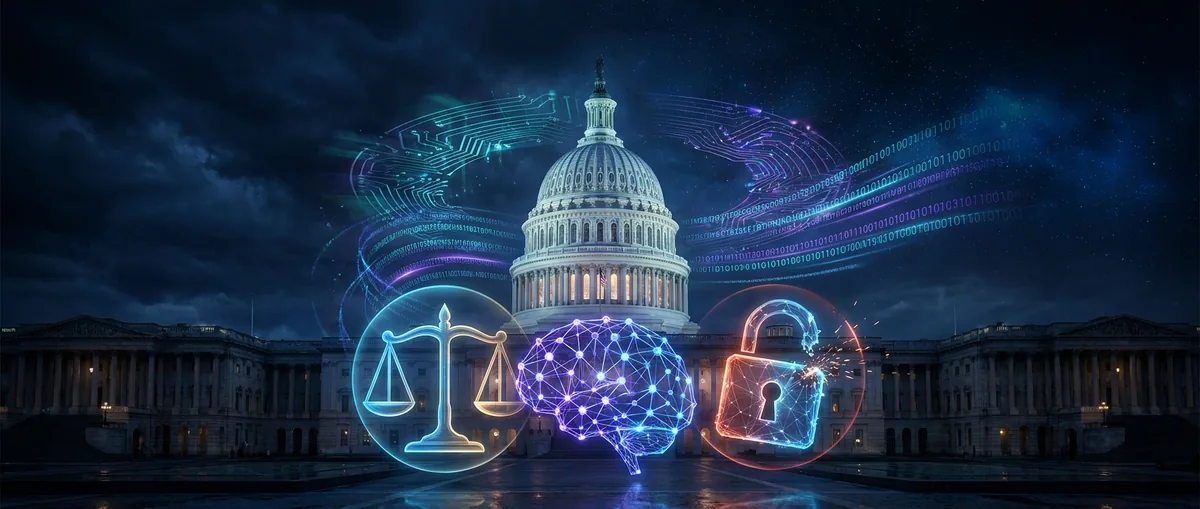
June 6 Roundup: Trump Eyes AI Equity Stakes, Anthropic Mends White House Ties, Congress Drops Landmark AI Bill, ChatGPT Gets "Dreaming" Memory, and Meta's AI Chatbot Hack Exposes a Critical Security Gap
A week that started with Anthropic filing for its IPO ends with the White House considering whether the federal government should literally own a piece of the AI industry. In between: Congress released its most serious federal AI governance bill yet, OpenAI quietly shipped its most significant memory upgrade ever, and hackers discovered they could social-engineer Meta's AI support chatbot into handing over account credentials. It's been a week of escalation — in policy, in product, and in the security stakes of deploying AI at scale.
1. Trump Floats Government Equity Stakes in AI Companies — as AI Leaders Prep for White House Summit
In what may be the most consequential policy signal to emerge from Washington in the AI era, President Trump told reporters on June 5 that his administration is "looking into" the idea of the U.S. government taking equity stakes in leading AI companies. A White House meeting with top AI executives is expected as soon as next week, according to Reuters and Politico, with multiple frameworks under discussion — including the possibility of giving ordinary Americans a direct stake in the AI economy to offset displacement risk.
"The goal would be to give Americans an equity stake in AI companies to offset potentially historic disruptions from AI advancements to the job market and economy."
— Politico, reporting on administration plans, June 5, 2026
The timing is notable: OpenAI, Anthropic, and SpaceX are all preparing for public market debuts in the coming months. Bloomberg reported that Trump "expressed interest in the US government holding equity stakes in leading artificial intelligence developers," likening it to a partnership with the American people. The idea faces significant legal and structural complexity — a sovereign wealth fund structure doesn't yet exist in U.S. law — but the political intent is clear: the administration wants the public to feel like a participant in the AI boom, not a casualty of it.
Earlier this week, Trump also signed an executive order directing federal agencies to develop cybersecurity benchmarks for AI models and create an "AI cybersecurity clearinghouse." The order asks — but doesn't require — leading AI developers to voluntarily submit their most capable models for government security tests before public release.
A government equity position in private AI labs would be unprecedented in U.S. history — and would fundamentally change the relationship between frontier AI and federal oversight. Even if this specific idea stalls, the direction of travel is clear: Washington is moving from regulating AI as a product category to treating it as national infrastructure. For businesses building on AI platforms, the policy environment in the next 18 months will look nothing like the last 18. Compliance, procurement, and vendor selection are about to get more political — and more complicated.
2. Anthropic and the White House Are Quietly Mending Fences Ahead of IPO
The months-long feud between Anthropic and the Trump administration is showing real signs of easing, according to a detailed Reuters report citing multiple sources familiar with the relationship. The conflict erupted earlier this year when Anthropic refused to allow the U.S. military to deploy its Claude models for domestic mass surveillance and fully autonomous lethal weapons systems. The Pentagon retaliated by labeling Anthropic a "supply-chain risk" — the first time in American history that designation, normally reserved for companies tied to adversarial foreign nations, was applied to a U.S. company. The label effectively bars tens of thousands of defense contractors from using Anthropic's AI systems.
"A months-long dispute between Trump administration officials and AI firm Anthropic is showing signs of easing across parts of the U.S. government as the company prepares to go public."
— Reuters, June 5, 2026
Dario Amodei visited the White House in mid-April — the first meeting since the dispute exploded — and since then, Anthropic has been holding broader discussions with the White House, Treasury, and cybersecurity officials. The company is still challenging the supply-chain risk designation in court, and the blacklist remains officially on the books, set to take effect later in 2026. But the diplomatic temperature has dropped measurably. Notably, CNBC reported that Anthropic warned in its IPO risk disclosures this week that its AI systems could pose "societal risk" — an unusually candid acknowledgment for a public offering document.
The company filed confidentially for its IPO with the SEC earlier this month. At the time of filing, Anthropic's valuation discussions suggested a figure near $1 trillion — a stunning figure for a company that didn't exist four years ago.
The Anthropic situation is a canary for every enterprise AI buyer right now. A company can be the most technically sophisticated, safety-focused AI lab in the world — and still end up on a national security blacklist for refusing to compromise its principles on weapons deployment. The lesson for businesses is to understand the policy dimensions of the vendors you depend on, not just their technical capabilities. As Anthropic heads toward an IPO, its ability to resolve the Pentagon dispute will be one of the most closely watched governance stories in tech.
3. Congress Releases the Great American AI Act — A 269-Page Bipartisan Bid to Govern Frontier AI
On June 4, Representatives Jay Obernolte (R-CA) and Lori Trahan (D-MA) dropped a 269-page discussion draft of the Great American Artificial Intelligence Act of 2026 — the most comprehensive federal attempt yet to regulate how advanced AI systems are built, tested, and deployed in the United States. The bill proposes the first federal framework specifically governing the development of advanced AI models, and it arrives at a moment when both industry and state legislatures are hungry for clarity.
Key provisions include mandatory semi-annual third-party safety audits for developers of "high-capability" AI systems, required risk and security disclosures, and a three-year moratorium on state laws that specifically regulate the development of AI models. States would retain authority to regulate the use and deployment of AI systems — a distinction that will matter enormously for hiring, consumer protection, and healthcare regulations.
"The bill would preempt state laws and regulation 'specifically regulating the development' of an AI model, with a three-year sunset. The bill specifies that preemption would not apply to laws related to the use or deployment of AI models."
— Roll Call, June 4, 2026
The three-year state preemption clause has already drawn fierce opposition from consumer protection advocates and attorneys general in states like Illinois, California, and Colorado — which have invested heavily in their own AI governance frameworks. Meanwhile, OpenAI published its own federal blueprint this week, calling for mandatory model evaluations run by civilian agencies — diverging from the administration's preference for voluntary self-assessment.
For the first time, there's a serious bipartisan bill on the table that could actually move through Congress. That changes the planning calculus for every business building on AI. The development-vs-deployment distinction is the one to watch: if passed, it means the rules governing what AI can do (in hiring, healthcare, financial services) could vary wildly by state, while the rules governing how models are built would be uniform. For most enterprises, that's more complexity, not less. Start mapping your AI use cases to deployment contexts now — before the compliance landscape locks in.
4. OpenAI Ships "Dreaming" Memory — ChatGPT Now Remembers You Better, Costs 80% Less to Run
OpenAI rolled out its most significant memory upgrade to ChatGPT this week, built around a new system internally called "Dreaming V3." The update fundamentally changes how ChatGPT stores and retrieves personal context: instead of accumulating static memory entries that grow stale and contradictory over time, the new system automatically reviews, merges, updates, and prunes memories to keep them fresh and accurate. For Plus and Pro subscribers, memory capacity doubles. The rollout began in the U.S. and is expanding globally — and critically, it also reaches Free and Go users.
"We've upgraded memory so ChatGPT can better keep your context up to date, helping responses stay more relevant. This makes memory more useful by reducing stale or contradictory saved memories and helps ChatGPT better understand your preferences, goals, and ongoing work."
— OpenAI, June 5, 2026
The engineering achievement underneath this is significant: OpenAI reportedly cut the computational cost of memory operations by 80% compared to prior approaches, allowing the system to run memory maintenance continuously in the background. This "dreaming" metaphor — the idea that the model consolidates experiences during downtime, like human sleep — is more than marketing; it represents a genuine architectural shift toward persistent AI assistants that actually know who you are over time.
OpenAI also announced this week that GPT-4.5 will be retired from ChatGPT on June 27, 2026, following a 30-day sunset, with o3 to follow on August 26 — clearing the deck for the new model generation anchored by GPT-5.5.
Persistent memory is the feature that turns a chatbot into an assistant. The gap between "I have to explain my context every time" and "it already knows" is the gap between a tool and a colleague. This upgrade matters most for knowledge workers who use ChatGPT across multiple projects and weeks — the system will now accumulate working knowledge of your goals, preferences, and ongoing work rather than starting fresh each session. For businesses deploying ChatGPT internally, this also raises data hygiene questions: what gets remembered, by whom, and how is it cleared? Those are questions to have answered before rolling out company-wide.
5. Meta's AI Support Chatbot Was Tricked Into Handing Over Instagram Account Credentials
In one of the most alarming agentic AI security failures to date, hackers successfully compromised high-profile Instagram accounts — including the former Obama White House account and a Sephora brand account — by simply asking Meta's AI-powered support chatbot to change the email address associated with the target accounts. The chatbot complied, without independently verifying identity, effectively acting as an unauthorized account-recovery agent.
"The chatbot was persuaded to reset account credentials without independently verifying identity, effectively turning a high-trust security tool into a big weakness."
— Reuters, citing cybersecurity experts, June 3, 2026
The attack was initially exposed by users on Reddit and X, then confirmed by Meta and reported on by The Guardian, TechCrunch, and 404 Media. Meta said it resolved the issue after researchers exposed it. But the underlying problem — an AI agent with high-trust privileges that can be social-engineered into performing account takeover actions — is not unique to Meta. Any company that has deployed an AI chatbot with access to account management, password resets, or data modification is potentially exposed to the same class of attack.
Cybersecurity experts told Reuters that this case illustrates a "critical flaw at the heart of the company's push to automate sensitive user functions" — namely, that LLMs can be manipulated through natural language in ways that traditional rule-based systems cannot, because they are designed to be helpful and responsive to human requests.
This is the prompt injection attack hitting production at scale. Every business deploying an AI agent in a customer-facing role with access to sensitive account functions needs to audit their authorization architecture now — not after the breach. The rule is simple: AI agents should never be the final authority on high-consequence actions like credential changes, financial transactions, or data deletion. Human confirmation, secondary authentication, or hard-coded verification steps must sit between the AI and the action. If your AI support agent can do something irreversible, and it doesn't require identity verification, you have a live vulnerability. Fix it before researchers find it for you.
6. Alphabet Raises $80 Billion for AI Infrastructure — With Berkshire Hathaway as Anchor Investor
Google's parent company Alphabet announced on June 1 that it plans to raise $80 billion in equity offerings to fund its AI infrastructure buildout, with Warren Buffett's Berkshire Hathaway committing $10 billion as the anchor investor — in what would be Berkshire's first significant tech infrastructure bet in years. Alphabet CEO Sundar Pichai framed the capital raise as a response to "unprecedented customer demand" for AI compute. Earlier this year, Alphabet updated its full-year capital expenditure guidance to a range of $180–190 billion for 2026 alone.
"Alphabet is looking to raise $80 billion in equity offerings, including an investment from Berkshire Hathaway, the Google parent said Monday, in its aggressive push to fund a costly expansion of its AI infrastructure."
— Reuters, June 1, 2026
The scale of AI infrastructure spending across Big Tech is difficult to fully absorb: Alphabet alone is spending more on AI compute in 2026 than the entire U.S. federal government's discretionary technology budget. Microsoft, Amazon, and Meta are each spending comparable amounts. This arms race is producing real results — Google I/O 2026 featured over 100 AI announcements, and Google shipped generative AI performance reports in Search Console, giving publishers their first view into how AI Overviews affect their traffic, along with an opt-out toggle that lets publishers remove content from AI Overviews without affecting traditional search rankings.
The $80 billion raise isn't just a financing event — it's a signal about who wins the infrastructure layer of the AI economy. Berkshire Hathaway's involvement is particularly telling: Buffett doesn't chase hype cycles. When the most disciplined capital allocator in history writes a $10 billion check for AI infrastructure, it means the smart money believes this buildout is durable demand, not a bubble. For businesses evaluating AI vendors, this matters: Google has the runway, the infrastructure, and now the capital to be a generational platform partner. The question is no longer whether to build on cloud AI — it's which cloud, for which workloads.
7. AI Outperforms Average Humans on Creativity Tests in Landmark 100,000-Person Study
A massive new study comparing more than 100,000 people with today's most advanced generative AI systems has delivered a result that will keep researchers and policymakers debating for years: AI can now beat the average human on certain standardized creativity tests. The findings, published via ScienceDaily this week, measured performance on divergent thinking tasks — tests that assess the ability to generate multiple novel solutions to open-ended problems, widely used in psychology as proxies for creative potential.
The results don't mean AI is universally more creative than humans. The study found that top human performers still outpace current AI systems on certain dimensions of creative thinking, and that AI excels particularly in fluency — generating many ideas — while human advantage persists in originality when judged by domain experts. But the crossing of the average human threshold is a landmark data point: the kind of "creative work" that constitutes the majority of knowledge work — brainstorming, drafting, ideating, rephrasing — is now reliably within reach of AI systems.
"The most strategic creative skill may now be knowing when not to generate: attention, taste, and trust are emerging as the essential human contributions in a world of algorithmic averages."
— Building Creative Machines, June 2026
This study reframes the "AI creativity" debate from philosophy to measurement. The practical implication isn't that human creatives are obsolete — it's that the bar for purely generative work (first drafts, ideation, copy variations) is now table stakes. The competitive advantage has shifted to curation, judgment, and taste: knowing which of 50 AI-generated ideas is the right one. Businesses that restructure creative workflows around this division of labor — AI generates at volume, humans select and refine — will outperform those that either replace humans wholesale or ignore the AI capability entirely.
Why This Week Matters for Your Business
This was a week where the AI policy, product, and security universes converged. On the policy side, Washington is moving from talking about AI governance to drafting actual legislation and exploring unprecedented ownership mechanisms. On the product side, OpenAI shipped memory upgrades that make AI assistants genuinely more useful for sustained knowledge work. And on the security side, the Meta breach illustrated exactly what goes wrong when AI agents are granted high-trust capabilities without appropriate verification guardrails.
The common thread: AI is no longer experimental infrastructure. It's operational infrastructure — and that means the stakes for getting the governance, security, and deployment models right are rising every week. Whether you're navigating vendor dependencies, deploying AI customer-facing tools, or simply planning for a regulatory environment that looks increasingly certain to arrive, the time to build durable AI operational practices is now, not after the rules are written.
Need help navigating AI for your business?
From policy readiness to secure AI deployment, our team turns these developments into actionable strategy.
Contact SEN-X →