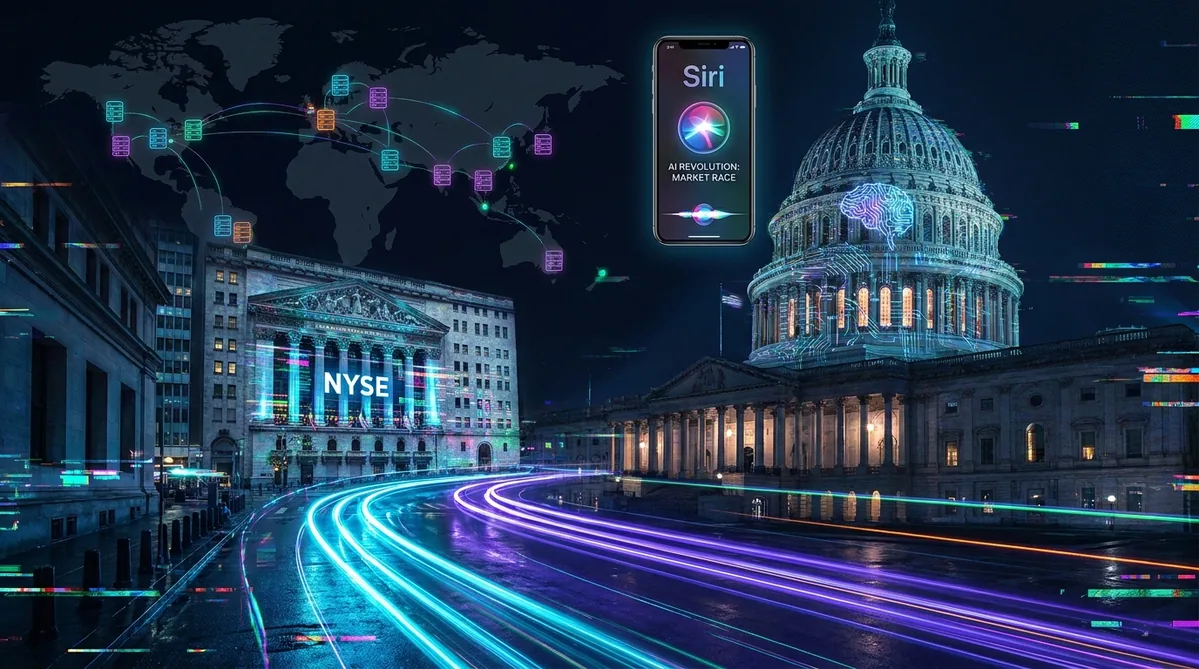
Anthropic vs. OpenAI IPO War, Dario's Regulation Manifesto, Apple's Siri AI Overhaul, and China's Data Center Influence Ops
The AI industry hits a new inflection point this week: two rival companies at the trillion-dollar precipice are racing to Wall Street in an unprecedented simultaneous IPO battle, Anthropic's CEO publishes a landmark policy paper calling for binding government oversight of frontier AI, Apple finally delivers on years of Siri AI promises at WWDC 2026, and OpenAI reveals a sophisticated Chinese influence campaign targeting U.S. data center expansion. Meanwhile, New York state quietly passes the most sweeping package of AI legislation in American history. Here's everything that matters.
1. The AI IPO War: Anthropic and OpenAI Are Both Racing to Wall Street — Simultaneously
In what Reuters is calling an "unprecedented" situation in capital markets, the two dominant forces in frontier AI are now in an active race to go public — at the same time, targeting some of the same banks, and competing for the same investor dollars. Anthropic moved first, making a confidential S-1 filing with the SEC on June 1st. OpenAI followed on June 8th, one week later, confirming its own confidential S-1 submission.
The numbers are staggering. OpenAI is targeting a valuation between $852 billion and $1 trillion, with approximately $25 billion in annualized revenue and a roughly $27 billion annual burn rate — a combination that signals the company is betting that growth velocity justifies profitability patience. Anthropic's filing remains confidential, but its last private valuation was approximately $965 billion, placing it at near-parity with OpenAI heading into the public markets.
"The competition is spilling into Wall Street. It's rare for two such big direct rivals to raise capital at the same time, and the IPOs will be so big that they are by necessity turning to some of the same banks for help." — Reuters, June 11, 2026
The rivalry between CEO Sam Altman (OpenAI) and Dario Amodei (Anthropic) runs deep: Amodei was a senior researcher at OpenAI and is credited as one of the key architects behind the core technology that made ChatGPT possible. His 2020 departure to co-found Anthropic, along with a group of OpenAI colleagues including his sister Daniela, is now playing out as a full-scale commercial war at trillion-dollar scale. Reuters reports that the two CEOs even rejected a coordinated show of unity at a recent AI summit, preferring to let the competition speak for itself.
OpenAI is reportedly targeting a public listing as early as September 2026, with plans for a concurrent tender offer to allow employees to sell shares at the $852B valuation. Analysts note that the timing — both companies filing simultaneously — is forcing major investment banks to choose sides in a way that rarely happens outside of sector-defining moments.
This is a defining moment for the entire AI industry, not just two companies. When the two most capable frontier AI labs go public within weeks of each other at combined valuations approaching $2 trillion, every enterprise buyer, partner, and regulator has to re-evaluate the landscape. For business leaders, the immediate practical implication is this: both companies will face intense investor pressure to show enterprise revenue growth, meaning you'll see more aggressive enterprise pricing, deeper integrations, and competitive feature parity plays in the next 12 months than the previous 36 combined. This is also a signal that the window to establish strategic AI partnerships at current pricing and terms is closing fast.
2. Dario Amodei Drops a Landmark AI Policy Manifesto — and Calls for Government Power to Block Dangerous Models
On June 10th, Anthropic CEO Dario Amodei published "Policy on the AI Exponential," a sweeping essay and accompanying pair of regulatory frameworks that marks a significant shift in how a major AI lab is engaging with government. This is no longer voluntary disclosure or soft advocacy — Amodei is explicitly calling for binding, enforceable regulation of the most powerful AI systems, including granting governments the legal authority to block or reverse deployments that fail safety standards.
The two published frameworks — the Advanced AI Framework and the Economic Policy Framework — lay out a detailed regulatory blueprint. The Advanced AI Framework proposes that safety rules should apply to any AI model trained using more than 10²⁵ floating-point operations (FLOPs) and developed by companies earning more than $500 million in AI-related revenue or spending more than $1 billion on AI R&D. The scope of catastrophic risks addressed includes: biological risk (AI-assisted bioweapons development), cyber risk (large-scale critical infrastructure vulnerability discovery), AI control loss (recursive self-improvement escaping human oversight), and geopolitical concentration (a single actor using AI to illegitimately seize power).
"When a model poses risks of this kind, the government should have the legal authority to block or deter its deployment — beyond what exists in current law — with civil penalties tied to global annual revenue that escalate with repeated violations." — Dario Amodei, Anthropic, June 10, 2026
Significantly, Anthropic also weighed in on the federal preemption debate that has roiled Congress for months. In testimony and statements timed to coincide with the essay, the company urged Congress not to block state AI regulations unless lawmakers simultaneously pass a "rigorous" federal law that addresses catastrophic AI risks. This puts Anthropic directly at odds with much of Silicon Valley's lobbying posture and with parts of the Trump White House that favor minimal federal footprint on AI.
The Economic Policy Framework addresses worker displacement and distributional concerns, acknowledging that AI will reshape labor markets at scale and calling for proactive policy responses including retraining programs and mechanisms to broadly share the financial benefits of AI productivity gains.
The timing here matters enormously. Anthropic published this manifesto while actively pursuing an IPO — which means Dario Amodei is willing to put binding regulatory risk on the table as a policy position even while trying to attract public investors. That's either a confidence play (they believe they can meet any safety standards that get enacted), a strategic regulatory moat play (requirements at the 10²⁵ FLOP threshold favor a handful of companies and exclude most potential entrants), or a genuine belief that the stakes are high enough to warrant the risk. Probably all three. For enterprise buyers, the key signal is that this framework, if adopted in some form, will mean AI procurement increasingly involves compliance, audit, and documentation requirements — not unlike how pharmaceutical or financial software procurement works today.
3. Apple Finally Delivers at WWDC 2026: Siri Gets a Real AI Overhaul, iOS 27 Lands, and Tim Cook's Final Keynote
Apple's WWDC 2026 keynote on June 8th delivered what many had been waiting years to see: a genuinely capable, contextually-aware Siri AI that understands personal context, can act across apps, and carries natural conversation. Apple officially rebranded its AI effort as "Siri AI" — a distinct product from the older Siri assistant — built on Apple Intelligence and capable of understanding deep personal context from your apps, files, emails, and calendar.
The new Siri AI fulfills promises Apple first made in 2024 but struggled to deliver. According to Apple's announcements, Siri AI can now perform multi-step tasks across apps without prompting, understand what's on your screen and act on it, and handle complex natural language requests that previously fell apart. The most powerful features require iPhone Air, iPhone 17 Pro, iPhone 17 Pro Max, or iPad (M4) or later with at least 12GB of unified memory, and Mac (M3) or later with at least 12GB of unified memory.
The event also marked the official announcement that CEO Tim Cook will hand the reins to Senior Vice President of Hardware Engineering John Ternus on September 1st — making this Cook's final WWDC after more than a decade of transforming Apple from a post-Jobs company into the world's most valuable one. The product lineup update includes iOS 27, iPadOS 27, macOS 27, watchOS 27, visionOS 27, and tvOS 27.
"Apple said it uses Apple Intelligence, and it will be able to understand personal context and what apps can do — fulfilling promised Siri improvements that were first announced in 2024." — CNBC, June 8, 2026
The broader significance of the Apple announcement extends beyond the feature set. For years, Apple has watched Google and OpenAI eat its lunch on AI capabilities while maintaining its privacy-first narrative. Siri AI represents Apple's attempt to compete on AI capability without abandoning on-device processing and user privacy. Google's own Gemini integration remains available as an option for users who want cloud-based AI depth, but Apple is clearly signaling it wants Siri AI to be the primary assistant layer going forward.
Apple has 2.2 billion active devices. If Siri AI performs at even half the level Apple demonstrated on stage, the impact on AI adoption curves is enormous. The key question for enterprise deployments: Apple's on-device, privacy-first approach means your employees' work context stays on-device by default — which addresses a major corporate security concern that has slowed ChatGPT enterprise adoption in regulated industries. If Siri AI delivers genuine cross-app intelligence at the iOS 27 / macOS 27 launch this fall, expect enterprise IT departments to revisit their AI tool policies with a fresh perspective on what Apple-native AI can now handle without a cloud subscription or data sharing agreement.
4. OpenAI Reveals China-Linked Influence Campaign Targeting U.S. Data Centers
In a threat intelligence report published June 10th, OpenAI disclosed that a group of ChatGPT accounts with connections to China had been orchestrating a covert influence operation designed to stoke local opposition to AI data centers across the United States. The campaign — active since late 2025 and into early 2026 — used AI-generated content to amplify community concerns about power consumption, water usage, and environmental impact of data center construction projects in multiple U.S. states.
The operation echoes OpenAI's previous threat intelligence disclosures about state-sponsored misuse of its models for information operations, but this is the first time the company has specifically linked a campaign to infrastructure interference — a more direct form of strategic AI competition than election meddling or opinion manipulation. The framing from OpenAI is that this represents an attempt by China-based actors to hinder U.S. competitiveness in AI by slowing the physical infrastructure buildout that underpins frontier model development.
"China-based actors are likely behind the use of ChatGPT for 'covert influence operations' aimed at stoking opposition to data centres in the United States." — Al Jazeera / OpenAI Threat Intelligence Report, June 11, 2026
The disclosure arrives amid a broader geopolitical context: the U.S. is in the middle of an aggressive AI infrastructure buildout with major data center investments from Google, Microsoft, Amazon, and Meta collectively exceeding hundreds of billions of dollars. OpenAI itself, along with Anthropic, depends on this infrastructure buildout for compute access. Meanwhile, China has separately been advancing its own AI infrastructure, with companies like EngineAI (a Shenzhen-based humanoid robot manufacturer) recently filing confidentially for a Hong Kong IPO at a $1.5 billion valuation.
The weaponization of AI-generated content for infrastructure influence operations is a new and underappreciated category of AI risk for enterprises. If similar tactics are deployed against corporate supply chains, regulatory filings, or community stakeholder processes — which is a logical extension of this playbook — businesses that depend on data center capacity or AI infrastructure need to factor geopolitical information operations risk into their resilience planning. More immediately: this disclosure will accelerate Congressional support for data center security provisions and may give political momentum to federal preemption of certain state-level permitting challenges to AI infrastructure projects.
5. New York Passes the Most Comprehensive State AI Legislation in American History
While federal AI regulation remains stalled in partisan disputes over preemption, Albany quietly wrapped up the most sweeping package of AI legislation passed by any U.S. state — not just one bill, but five, signed into law before the close of the New York legislative session on June 1st. The package includes: a kids chatbot safety bill requiring age verification and parental controls for AI-powered chatbots; an AI training data transparency act requiring disclosure of datasets used to train commercial AI systems; the FAIR News Act, which addresses AI use in news generation and requires disclosure; a data center moratorium for certain localities; and a ban on AI-assisted surveillance pricing that adjusts consumer prices based on personal data.
The package is significant both for its breadth and for its timing. It arrives as the U.S. Senate debates whether a federal AI bill should preempt state-level regulation entirely — a provision that Silicon Valley has lobbied aggressively to include. New York's move creates a direct conflict: companies selling AI products in New York now face state-level compliance requirements that may conflict with or exceed any eventual federal standard.
"Legislators in Albany wrapped up the 2026 session on June 1 by passing a kids chatbot safety bill, an AI training data transparency act, the FAIR News Act, a data center moratorium, and a ban on AI-assisted surveillance pricing." — Transparency Coalition, June 12, 2026
The surveillance pricing ban is particularly notable for retail and e-commerce sectors: it directly targets the practice of using AI to personalize pricing based on inferred characteristics, purchase history, or behavioral data — a capability that many major retail AI platforms have been developing aggressively. Maryland passed a similar ban on "dynamic pricing" that adjusts grocery costs based on consumer data earlier this month, suggesting a coordinated state-level movement.
The New York legislation creates an immediate compliance checklist for any enterprise deploying consumer-facing AI in New York state. The training data transparency act alone will require legal review of existing AI vendor agreements — most of which do not currently include the kind of dataset provenance documentation New York will require. For companies with e-commerce or consumer AI pricing tools, the surveillance pricing ban is not a distant regulatory risk; it's a near-term product review requirement. We expect other large states — California, Illinois, Texas — to introduce similar packages within 18 months. If you haven't started an AI regulatory compliance audit, the window to do it proactively rather than reactively is closing.
6. Google in Talks with Samsung to Co-Manufacture Next-Gen AI Chip — and the Infrastructure Race Intensifies
In a sign that the great AI chip war is entering a new manufacturing dimension, Reuters and The Information reported on June 11th that Google is in active discussions with Samsung Electronics to manufacture part of its next-generation AI processor. The move would represent a significant expansion of Google's chip manufacturing partnerships beyond its current reliance on TSMC, and a strategic bet on Samsung's foundry capabilities as both companies compete for advanced node capacity against Nvidia's supply chain.
The context matters here: Google has been investing heavily in its proprietary Tensor Processing Unit (TPU) architecture for training and inference workloads. A Samsung manufacturing partnership would give Google a second source for TPU production, reducing concentration risk as AI compute demand continues to outpace foundry capacity. It also signals that Google is making long-term bets on in-house silicon as a competitive advantage — rather than paying Nvidia's premium margins for H100/H200-class GPUs.
Separately, Bloomberg reported that infrastructure startup Crusoe is being pushed aside from a Wyoming AI data center campus project after failing to secure Google as an anchor tenant. The details illustrate the increasing power that hyperscalers have to reshape the AI infrastructure landscape simply through their tenancy decisions — a dynamic that plays into OpenAI's and Anthropic's strategic positioning as they approach their IPOs with infrastructure partnerships as key valuation drivers.
The Google-Samsung discussions, if they result in a manufacturing agreement, accelerate the AI chip supply chain away from its current TSMC concentration risk. For enterprise AI buyers, the downstream effect is that Google's AI services — Gemini, Vertex AI, Google Cloud AI infrastructure — gain cost and resilience advantages over the 3-5 year horizon. That makes Google a more credible long-term partner for enterprises building AI-dependent applications, especially those that need predictable infrastructure costs as AI workloads scale. This is also a reminder that the AI arms race is fundamentally a hardware race — and whoever controls the silicon supply chain controls the economics of intelligence.
7. OpenAI's New ChatGPT Memory System and the Workspace Agent Pricing Shift
OpenAI shipped a significant ChatGPT memory upgrade in the June 8th timeframe, releasing a more capable and scalable memory system that better carries context, follows user preferences, and stays current over time. The update adds a reviewable memory summary page — a first for the product — and is rolling out to Plus and Pro users in the U.S. first, with Free and Go tiers coming soon. The move addresses one of the longest-standing user complaints about ChatGPT: that it forgets context between sessions in ways that make it feel like starting over each time.
On the enterprise pricing front, OpenAI also extended the free period for workspace agents until July 6, 2026. Credit-based pricing for workspace agents begins on that date. This is a notable moment for businesses that have been experimenting with OpenAI's agentic workspace tools at no incremental cost — the transition to credit-based billing will require budget allocation and potentially force prioritization of which agent workflows are worth the ongoing expense.
OpenAI also confirmed its GPT-4.5 deprecation timeline: GPT-4.5 will be retired from ChatGPT on June 27, 2026, following a 90-day sunset period. GPT-4o will be retired from ChatGPT on August 26, 2026. The pattern reflects OpenAI's strategy of rapidly cycling out older model generations as newer, more capable versions reach production maturity — with GPT-5.5 and Codex now handling the workloads previously assigned to GPT-4 generation models.
"OpenAI releases a more capable and scalable ChatGPT memory system that better carries context, follows preferences, and stays current over time. The update adds a reviewable memory summary page." — OpenAI Release Notes via Releasebot, June 2026
The memory system upgrade is more strategically important than it appears. Persistent, reviewable memory transforms ChatGPT from a stateless question-answering tool into something closer to a genuine ongoing assistant — which is the interface model that makes enterprise productivity use cases actually work. The reviewable memory summary page also addresses the enterprise compliance concern that "what does the AI know about me?" has no auditable answer. For organizations evaluating ChatGPT for knowledge worker productivity, this update meaningfully changes the ROI calculation. The workspace agent pricing transition, meanwhile, is a reminder to build AI budget line items now — the free experimentation window is closing.
Why This Week Matters for Your Business
The news this week isn't just headlines — it's a cascading set of strategic inflection points that will reshape the AI landscape for enterprise buyers, regulators, and builders over the next 12–24 months.
On AI procurement: The simultaneous Anthropic and OpenAI IPO filings mean both companies will face public market pressure to grow enterprise revenue aggressively. Lock in pricing and terms now. The favorable partnership windows of the pre-IPO era are closing.
On AI compliance: New York's five-bill AI package, Anthropic's regulatory framework, and the ongoing federal preemption debate mean your AI vendor agreements, product features, and internal policies need a compliance review. Training data transparency, surveillance pricing bans, and chatbot safety rules are no longer theoretical.
On AI infrastructure: The Google-Samsung chip discussions and the China data center influence operation both point to AI infrastructure as a strategic battleground. Your supply chain for AI services has geopolitical risk embedded in it now.
On AI in your devices: Apple's Siri AI at WWDC 2026, if it delivers on its promises in the fall release, will make AI-native workflows accessible to every iPhone, iPad, and Mac user in your organization — without requiring a separate subscription or IT policy exception. That's both an opportunity and a security surface area to plan for now.
Need help navigating AI for your business?
From IPO-era pricing pressure to state AI compliance — our team turns these developments into actionable strategy for your organization.
Contact SEN-X →