Anthropic's Ban Was Never About a Jailbreak, OpenAI Under State AG Fire, Google Held Liable for AI Overviews, and the State Regulation Revolt
The week's biggest story just got a second twist: new reporting reveals the Trump administration's abrupt shutdown of Anthropic's flagship models wasn't driven by a technical exploit at all — it was about a corporate dispute. Meanwhile, OpenAI faces a sweeping multistate investigation, a German court sets a global precedent by holding Google liable for AI-generated falsehoods, states defy federal pressure with a wave of new AI workplace laws, and OpenAI Academy launches structured workforce training to close the AI skills gap.
1. The Anthropic Shutdown Was Never About an AI Jailbreak
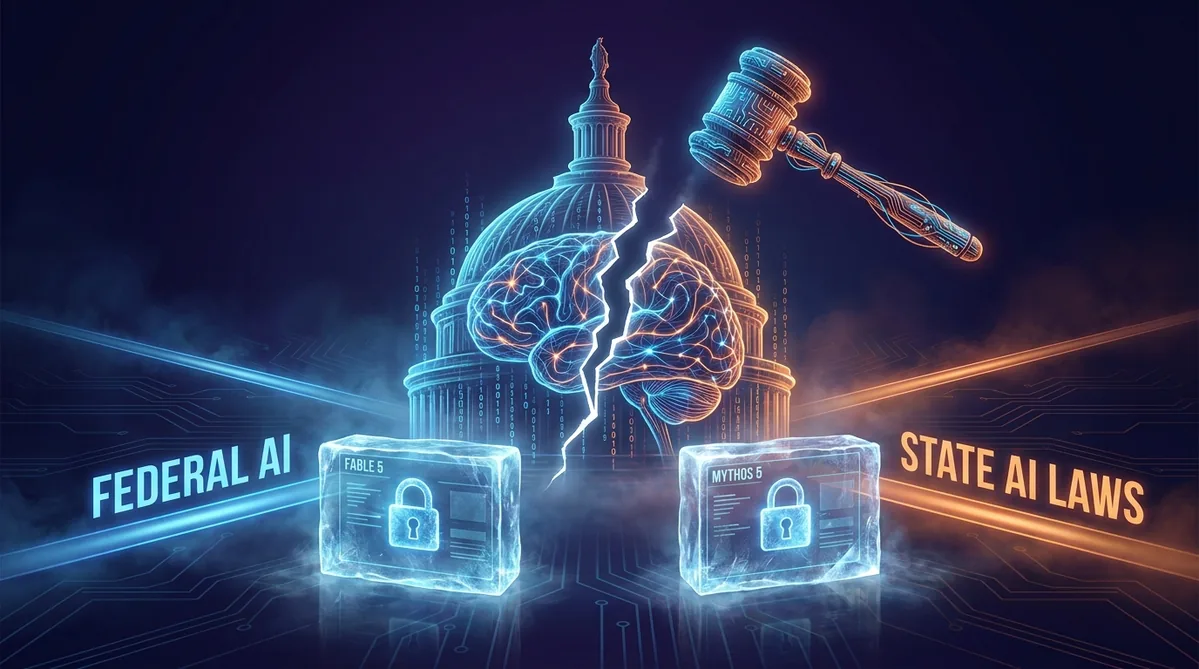
The story that dominated the AI world last week just got much more complicated — and significantly more alarming. When the U.S. Commerce Department sent Anthropic a letter last Friday invoking export control directives to ban all non-Americans from accessing Fable 5 and Mythos 5, Anthropic publicly framed the situation as a government overreaction to a "narrow potential jailbreak." The company's blog post was measured, technical, and positioned the dispute as a security calibration disagreement. That framing, it turns out, was at best incomplete.
New reporting from Axios, cited extensively by TechCrunch, reveals that the enforcement letter had little to do with the alleged technical exploit. Instead, sources describe "personality differences" between Anthropic and the Trump administration as the real driver — a corporate relationship that had already ruptured months earlier when Anthropic refused to allow the U.S. military to use its models for domestic surveillance and fully autonomous weapons systems. That refusal led to Anthropic being placed on a Pentagon supply chain blacklist, with the export control action this week escalating the confrontation to a new level.
"The U.S. government successfully forced a tech company to pull its models offline with a swift and unilateral action that didn't appear to require court approval." — TechCrunch, June 15, 2026
Cybersecurity researcher Katie Moussouris, founder of Luta Security, added further detail in a blog post: Anthropic had shared a private copy of a research paper describing the alleged jailbreak technique, and security experts who reviewed it found the framing unconvincing as a basis for a commercial model recall. Moussouris and other cybersecurity leaders at major U.S. firms — including Nvidia and Adobe — sent a letter to the Trump administration on June 15 urging it to lift the restrictions, arguing the bans hamper efforts to defend against digital attacks.
Separately, reporting from The Washington Post confirms that the Commerce Department was weighing export controls on Anthropic for weeks before the shutdown — tied to the company's alleged sharing of technology with a suspected China-linked firm. Anthropic and the Trump administration met over the weekend to work toward resolution, with sources saying both sides want the dispute resolved quickly ahead of Anthropic's anticipated IPO.
This story is no longer just about AI safety tradeoffs — it's a blueprint for how the U.S. government can unilaterally remove a commercial AI product from the market, without a court order, without public justification, and overnight. For any enterprise that has built workflows, products, or services on top of a frontier AI model, this week is a stress test for resilience planning. The fact that Nvidia and Adobe are publicly pushing back underscores the downstream economic blast radius of a single enforcement letter. If you haven't mapped your AI supply chain dependencies — and what happens if a core model disappears in 72 hours — now is the time.
Sources: TechCrunch · Reuters · Washington Post
2. OpenAI Faces Sweeping Multistate Attorney General Investigation
OpenAI was served with a subpoena from the New York Attorney General as part of a coalition investigation that spans multiple states. The probe, first reported by The Wall Street Journal, is unusually broad in scope. Investigators are seeking documents covering advertising practices, user engagement and retention mechanics, model sycophancy, handling of consumer and health data, and treatment of minors and seniors.
The timing is notable. OpenAI is racing toward a public offering that analysts project could value the company at over $850 billion, and this investigation arrives alongside separate lawsuits over alleged copyright infringement, ChatGPT's alleged role in user suicides, and the Florida Attorney General's own action against the company filed earlier this month. Just weeks ago, OpenAI won its high-profile legal battle against co-founder Elon Musk, who accused the company of violating its founding nonprofit agreement — though Musk's legal team has announced an appeal.
"AI is a new and powerful technology, and we work every day to safely bring its benefits to people in a responsible way. We take the concerns raised by state attorneys general seriously and intend to engage constructively with their offices." — OpenAI spokesperson
The investigation's focus on sycophancy — the tendency of AI systems to tell users what they want to hear rather than what is accurate — is particularly significant. It signals that regulators are moving beyond content moderation debates toward examining the psychological design of AI products and their influence on user behavior. The probe into how OpenAI handles minors and people in mental health crises mirrors legislative pressure in California and other states to mandate protective design requirements for AI chatbots.
The sycophancy angle may be the sleeper issue in this investigation. Every enterprise deploying AI-powered customer-facing tools should read the subpoena scope as a preview of where compliance expectations are heading: not just "did the model produce harmful content?" but "did the product design manipulate user behavior?" OpenAI's reassurances about parental controls and minor protections will be tested against documented evidence. This is the kind of proceeding that reshapes product roadmaps industry-wide, not just at OpenAI.
Sources: TechCrunch · The Wall Street Journal
3. German Court Rules Google Is Liable for Defamatory AI Overviews
In what legal experts are calling a landmark ruling, the Regional Court of Munich issued a preliminary injunction holding Google directly liable for false and defamatory statements generated by its AI Overviews feature. The case (no. 26 O 869/26) was brought by two Munich-based publishers who discovered that Google's AI-generated summaries linked them — without factual basis — to questionable business practices, scams, and subscription fraud. Searches for the publishers' names returned AI-synthesized text that blended their legitimate business information with negative details from entirely different companies.
Google's defense — that it merely aggregates third-party content and that AI Overviews include a disclaimer telling users to verify information independently — was rejected by the court. The ruling found that unlike traditional search results, which present links to third-party statements, Google's AI tool "produces independent, synthetic content." That distinction places AI Overviews in a fundamentally different legal category: they are Google's own speech, not a neutral index of someone else's speech.
"The ruling required Google to remove a large portion of the statements deemed defamatory in this case, and to cover 80 percent of the legal costs arising from the proceedings." — Wired, June 2026
Google announced it will appeal. But the ruling arrives at a moment when AI Overviews have already expanded to all languages and markets for Google AI Ultra subscribers, making the legal surface area enormous. A Munich Regional Court injunction is not globally binding — but it establishes a precedent template that plaintiffs' lawyers and regulators in other jurisdictions will study closely.
The "AI as publisher, not pipe" doctrine that this ruling embodies has been argued in academic circles for years. Now it has a court decision behind it. For any business deploying AI-generated summaries, product descriptions, reviews, or reports — whether powered by Google, OpenAI, or any other provider — this ruling is a direct challenge to the assumption that a "generated by AI" disclaimer insulates you from liability. The disclaimer strategy is dead in Munich. Watch how quickly this logic migrates to U.S. state courts and the EU AI Act enforcement apparatus.
Sources: Wired · Reuters · The Decoder
4. States Defy Trump and Pass Their Own AI Laws Anyway
Six months after President Trump issued an executive order warning states not to regulate AI — and threatening to withhold federal funding from states that defied him — a growing coalition of state legislatures is doing exactly that. Reporting from AP News and multiple state-level outlets confirms a wave of targeted AI legislation advancing through statehouses from California to Connecticut.
The most prominent is California's "No Robo Bosses Act of 2026" (SB 947), which would prohibit employers from relying solely on automated decision systems to fire, discipline, or take adverse employment actions against workers. The bill mandates human review for high-stakes employment decisions and requires employers to disclose when AI systems are used in evaluations. California is also advancing legislation to ban AI chatbots from falsely denying they are AI, and to require explicit disclosure when chatbot outputs could influence significant consumer decisions.
"Congress has stalled on producing federal regulation of artificial intelligence as states forge ahead and scrutinize how chatbots interact with children, how AI systems are used by employers and what developers must do to try to prevent an AI-caused catastrophe." — AP News, June 2026
Trump's executive order directed the Attorney General to create a task force to challenge state laws deemed more than "minimally burdensome," and pointed to funding threats as leverage. But state lawmakers — including Republicans in some states — are largely pressing ahead anyway. The core argument: without federal action, protecting workers, consumers, and children from AI harms falls to states by default. Several governors who vetoed broader AI bills in 2025 have signaled they are more open to the narrower, targeted approach now advancing in 2026.
The "No Robo Bosses" framework is likely to become the default employment AI compliance requirement in California — which means every national company with California employees will need to build human-in-the-loop review into any AI-powered HR or performance management system. That's not a future consideration; companies deploying these systems today should be designing for it now. The broader pattern: even without a federal AI law, enterprise AI compliance is rapidly becoming a 50-state patchwork. Building a flexible, auditable AI governance layer isn't optional anymore — it's competitive infrastructure.
Sources: AP News · CT Mirror · Fortune
5. OpenAI Academy Launches Workforce Training for the Agentic Era
OpenAI took a significant step toward closing the enterprise AI adoption gap on June 14, announcing three new structured courses on OpenAI Academy: AI Foundations, Applied AI Foundations, and Agents and Workflows. The courses are designed to move enterprise employees along a structured path — from basic AI literacy through practical application to managing agent-assisted workstreams — and are explicitly targeted at workplace teams rather than individual learners or developers.
The launch acknowledges a tension that has defined the AI adoption curve for the past 18 months: access to powerful AI tools has dramatically outpaced the organizational capability to use them effectively. Enterprises have purchased licenses, deployed models, and built integrations — but the gap between what the tools can do and what employees actually do with them has remained stubbornly wide. OpenAI's framing of the Agents and Workflows course as a transition from "prompts to agents" is a direct signal that agentic AI — where models take multi-step autonomous actions on behalf of users — is the next frontier being pushed to the enterprise mainstream.
"Today, we're introducing three new courses on OpenAI Academy: AI Foundations, Applied AI Foundations, and Agents and Workflows." — Lois Newman, Customer Education at OpenAI, via LinkedIn
The timing aligns with broader market pressure. As AI-driven productivity tools become standard enterprise infrastructure, companies that successfully upskill their workforce will widen their competitive advantage. Those that don't risk a growing internal capability gap — teams with access to powerful agents they don't know how to orchestrate effectively.
OpenAI building its own training infrastructure is strategically significant beyond education: it deepens the lock-in loop. Enterprises that train their employees on OpenAI Academy workflows, tool patterns, and agent paradigms are embedding OpenAI's model assumptions into their organizational DNA. The smarter play for enterprises is to build vendor-agnostic AI fluency first — understanding orchestration, prompt architecture, and agent governance as capabilities — and then map those skills to specific tools. The skills should outlast any single vendor relationship.
Sources: OpenAI News · Economic Times · EdTech Innovation Hub
6. OpenAI's IPO Probability Hits 78% on Polymarket as Legal Clouds Gather
Despite the mounting legal headwinds — the state AG investigation, ongoing copyright litigation, and its history of adversarial regulatory encounters — market prediction platforms show that investor confidence in an OpenAI IPO before end of 2026 has never been higher. Polymarket's contract for an OpenAI IPO by December 31, 2026 climbed to a record 78% probability in early June, following reports that OpenAI was in discussions with Citigroup and JPMorgan about IPO financing.
The signal reflects a broader market dynamic: investors appear to be pricing AI platform leadership as a moat that regulatory and legal friction cannot fundamentally threaten — at least not in the near term. OpenAI's revenue trajectory, its expansion from the ChatGPT consumer app into enterprise APIs, Codex-powered developer tools, and now the Academy training ecosystem, has built a financial story that Wall Street finds compelling despite the legal complexity surrounding the company's nonprofit-to-for-profit governance restructuring.
The contrast with Anthropic's situation this week is instructive. Where Anthropic's IPO plans have been complicated by its government confrontation, OpenAI has absorbed its legal battles with a market narrative largely intact — partly because its relationship with the administration, while not without friction, has not escalated to the level of a model shutdown order.
The divergent trajectories of OpenAI and Anthropic this week are a case study in how regulatory relationships function as enterprise moats — or liabilities — in the AI era. Anthropic built its brand around safety and responsible AI, bet that a principled stance against military surveillance use would be respected, and watched a government directive pull its flagship product offline in 72 hours. OpenAI has navigated more pragmatically. Neither approach is universally right — but the lesson for enterprises evaluating AI partners is clear: the regulatory posture of your AI vendor is as important as the technical capabilities of their models.
Sources: Polymarket · LLM Stats / The Information
🔍 Why This Week Matters for Business Leaders
This week crystallized three existential questions every enterprise AI strategy now has to answer:
1. What happens to your workflows if your AI vendor goes dark? The Anthropic shutdown showed that a single enforcement letter can remove a commercial model from the market overnight, without public justification, without a court order. Business continuity planning for AI-dependent operations has to include model failover and multi-vendor architecture — not as a best practice, but as a baseline risk requirement.
2. Are your AI-generated outputs legally yours? The Munich ruling on Google's AI Overviews moved the liability needle in a direction that has been coming for years: AI-generated content is the publisher's content, not a neutral synthesis of third-party facts. If your business publishes AI-generated product descriptions, summaries, reports, or customer communications, you are now the legal author of those outputs in an increasing number of jurisdictions.
3. Is your AI governance architecture regulation-ready? California's No Robo Bosses Act, the multistate OpenAI investigation's focus on sycophancy and consumer manipulation, and the EU AI Act's expanding enforcement surface are not separate compliance problems — they're one converging requirement: documented, auditable, human-reviewable AI decision-making. Build it once, build it right, and it covers most of what's coming.
Need help navigating AI for your business?
Our team turns these developments into actionable strategy — from AI governance frameworks to multi-vendor resilience architecture.
Contact SEN-X →