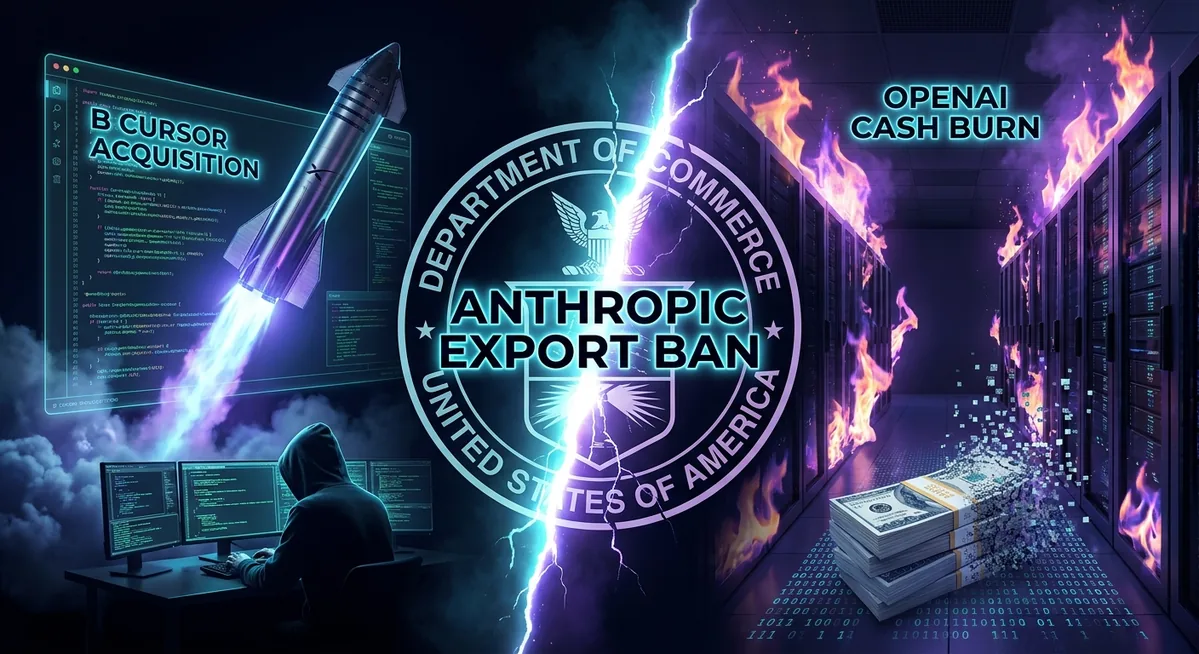
SpaceX Buys Cursor for $60B, OpenAI Burns $3.7B a Quarter, Anthropic Fights an Unprecedented Export Ban, and the AI Layoff Wave Hits 148K
Tuesday's AI landscape was defined by dramatic financial headlines: the largest AI acquisition ever announced, leaked proof that the industry's frontrunner is spending faster than it earns, an unprecedented government crackdown on a commercially deployed AI model, and fresh evidence that the AI employment disruption is no longer a prediction — it's a quarterly data point. Here's everything you need to know.
1. SpaceX Acquires AI Coding Startup Cursor for $60 Billion
In what is almost certainly the largest AI acquisition ever announced, SpaceX confirmed Tuesday it will acquire Anysphere — the San Francisco startup behind AI coding assistant Cursor — in an all-stock transaction valued at $60 billion. The deal is expected to close in Q3 2026, and Cursor will become a wholly owned SpaceX subsidiary.
The move surprised the industry, which had assumed Cursor — ranked No. 37 on the 2026 CNBC Disruptor 50 list — was on an independent IPO path after its explosive growth among software engineers. Instead, SpaceX apparently exercised an option embedded in an existing AI training partnership, giving the company the choice to pay $10 billion for their collaborative work or $60 billion to acquire the whole firm outright. They chose full ownership.
"SpaceX will not use proceeds from its IPO to fund the transaction," the company said in a statement, signaling that this is a strategic long-game move, not a capital deployment from public market money. The deal represents a 3.4% dilution at SpaceX's IPO valuation. (Reuters, June 16, 2026)
Why does SpaceX want an AI coding tool? The subtext is competition. Elon Musk's Grok and xAI have been playing catch-up with Anthropic's Claude — which powers GitHub Copilot for many teams — and with OpenAI's Codex. Cursor has become the developer-facing IDE of choice for AI-assisted coding, with millions of engineers integrating it into their daily workflow. Owning Cursor gives SpaceX/xAI direct access to one of the highest-leverage user bases in tech: developers who are actively choosing their AI stack.
The $60B price tag is also a statement about AI coding tool valuations. Cursor reportedly raised at a ~$2 billion post-money valuation from Tencent in a recent round, meaning this deal represents a roughly 30x markup — a multiple that reflects not just revenue multiples but platform control premiums.
The Cursor acquisition is a textbook infrastructure power grab. AI-assisted coding is quickly becoming the dominant layer where developers interface with AI models — it's not just about writing code faster, it's about which AI company gets the feedback signal from hundreds of millions of keystrokes and completions every day. SpaceX buying Cursor effectively places xAI's Grok models inside the developer workflow at scale. For businesses currently standardizing on Cursor for their engineering teams: watch for a gradual shift toward xAI models as the default provider. The open question is how the developer community — which historically resists lock-in — responds to a SpaceX-owned IDE.
Sources: CNBC, Reuters, Ars Technica
2. OpenAI's Leaked Financials: $21B in Losses, $3.7B Cash Burn in Q1 Alone
The Information and Fortune both published what they claim are OpenAI's internal financial documents — shared with shareholders in preparation for the company's confidential S-1 filing with the SEC. The numbers are jaw-dropping: OpenAI burned through $3.7 billion in the first quarter of 2026 alone, against $5.7 billion in quarterly revenue. Over full-year 2025, the company recorded approximately $21 billion in total losses against $13 billion in revenue.
"OpenAI burned through $3.7 billion in the first quarter of 2026, more than half its $5.7 billion in revenue." — Reuters, June 16, 2026, citing The Information
OpenAI's losses are dominated by three cost centers: compute (the raw cost of training and running frontier models), headcount (the company has grown dramatically and hired some of the most expensive engineers in the world), and the enormous cost of operating ChatGPT at 800 million monthly active users. Revenue is growing fast — $5.7 billion in a single quarter annualizes to well over $20 billion — but costs are growing faster, primarily because training runs for each successive generation of GPT models are exponentially more expensive.
The financial leak lands just days after OpenAI made a confidential S-1 filing for what multiple sources say could be a September 2026 IPO at a valuation of up to $1 trillion. Chief Scientist Jakub Pachocki has also hinted that GPT-5.6 is coming by late June — another enormously expensive training run that will further inflate Q2 costs before the roadshow.
Separately, OpenAI introduced "Deployment Simulation" on June 16 — a method that replays past real-world conversations through candidate models before public release to predict behavior regressions. It's a meaningful safety/reliability improvement, but it's also one more expensive compute-intensive layer in the release pipeline.
Investors need to decide whether OpenAI is Amazon circa 1999 — bleeding cash to own a transformational platform — or a company where the unit economics will never improve because the product requires perpetual, ever-escalating compute. The honest answer is: we don't know yet. What we do know is that at $3.7B/quarter in cash burn, OpenAI has roughly 18 months of runway at current raise pace before needing either an IPO or another mega-round. That timeline creates real strategic pressure — and explains why the Pentagon ChatGPT deployment (3 million DoD personnel via GenAI.mil, announced the same day) matters so much: government contracts are high-margin, recurring revenue at scale.
Sources: Reuters, Fortune, LLM-Stats
3. Anthropic's Claude Fable 5 Remains Offline as Export Ban Standoff Continues
The most dramatic regulatory story in AI right now is playing out between Anthropic and the Trump administration, and it escalated again Tuesday. On June 12 — just three days after Anthropic launched Claude Fable 5 (its most capable publicly available model) and Mythos 5 (a more powerful version available to vetted security partners) — Commerce Secretary Howard Lutnick sent a letter to Anthropic CEO Dario Amodei ordering the company to suspend all access to both models by any foreign national, anywhere in the world, including foreign nationals employed by Anthropic inside the United States.
"The U.S. government, citing national security authorities, has issued an export control directive to suspend all access to Fable 5 and Mythos 5 by any foreign national, whether inside or outside the United States, including foreign national Anthropic employees." — Anthropic's official statement via X, June 12, 2026
The administration cited broad "national security authorities" but did not publicly specify its concern. The timing is widely noted: the directive landed just days after Anthropic CEO Dario Amodei published an essay explicitly advocating for "serious and binding regulation" of frontier AI models — regulation that the Trump administration has generally opposed in public. CNBC reported Tuesday that the administration "asked for regulation" and then went dramatically further than even Anthropic expected.
By June 16, the fallout had widened considerably. Nearly 150 senior cybersecurity leaders — organized by former Facebook CISO Alex Stamos — signed an open letter calling on the Trump administration to reverse the order, arguing that restricting access to Claude Fable 5 actually weakens U.S. cybersecurity defenses because it denies defenders a powerful tool while doing nothing to prevent adversaries from using competing models. The Guardian's Nathan E. Sanders and Bruce Schneier published a widely circulated op-ed arguing the episode proves "we have opened the AI Pandora's box."
Anthropic executives are in active discussions with White House officials, but Politico reported that a resolution is unlikely to come quickly — "it will probably take more than a few days," according to a White House official. Meanwhile, Claude's service experienced a separate outage on June 16 that CNET tracked in real-time, likely caused by the infrastructure strain of disabling global access to specific models across the platform.
This situation is unprecedented and consequential for every enterprise AI buyer. The Lutnick letter establishes, for the first time, that the U.S. government can use export control authority to take a commercially deployed AI model offline mid-customer-engagement — with no advance notice and no clear appeal process. If you are an enterprise that has built workflows on Claude Fable 5, those workflows simply stopped working on June 12. That's an operational risk that no AI vendor due diligence checklist has previously needed to account for. The practical implication: any enterprise running mission-critical workflows on a single frontier AI model now has a new category of operational risk to manage — regulatory downside — and multi-model architectures with fallback providers are no longer a nice-to-have; they're a business continuity requirement.
Sources: Forbes, Bloomberg, Axios, CNBC
4. OpenAI Launches Partner Network and Deploys ChatGPT to 3 Million Pentagon Personnel
While the financial headlines dominated Tuesday, OpenAI also made two strategic announcements that deserve attention from an enterprise perspective. First, the company formally introduced the OpenAI Partner Network — a structured program to certify and coordinate the growing ecosystem of consultancies, systems integrators, and deployment partners who implement OpenAI technology for enterprise clients. The Partner Network formalizes what had been an informal set of relationships and signals OpenAI is moving toward a channel sales model as it prepares for its public offering.
Second, and perhaps more financially significant: ChatGPT is set to become available through the Pentagon's generative AI platform, GenAI.mil, in early July 2026 — covering an estimated 3 million Department of Defense personnel. The deployment was confirmed by Mohammed Husain, OpenAI's strategic delivery lead for cyber, speaking at the Defense One Tech Summit in Virginia. This is precisely the kind of high-margin, large-volume government contract that analysts believe OpenAI needs to improve its unit economics ahead of an IPO.
"GenAI.mil will make ChatGPT available to approximately 3 million DoD personnel beginning in early July." — Mohammed Husain, OpenAI, Defense One Tech Summit, June 16, 2026
The Pentagon announcement also carries strategic weight beyond the revenue line. With Anthropic locked in an export-control standoff, OpenAI deepening its DoD footprint creates competitive separation in the government sector at exactly the moment when Anthropic's access to national security clients is most constrained.
The Partner Network launch and Pentagon contract together tell a coherent story: OpenAI is rapidly industrializing. The days of "we make a model, you figure out the deployment" are over. By establishing a formal partner ecosystem and locking in government-scale deployments, OpenAI is building the infrastructure for recurring, predictable revenue — exactly what public market investors will want to see in an S-1. For businesses evaluating AI vendors: the partner certification program matters because it creates a quality signal for implementation firms. Certified OpenAI partners will have access to deeper technical integration, likely better pricing, and early feature access. Start asking your AI consultancy whether they're in the Partner Network.
Sources: OpenAI News, PYMNTS / Nextgov FCW
5. The AI Layoff Wave: 148,000 Cuts in 2026, AI Now Most-Cited Reason for Three Consecutive Months
Tech layoffs hit their highest single month in two years in May 2026, with nearly 40,000 cuts in a single month, and AI is now the most-cited reason for layoffs across every industry for the third consecutive month, according to outplacement firm Challenger, Gray & Christmas. Year-to-date through mid-June, an estimated 363 separate layoff events have affected nearly 150,000 tech workers — a pace roughly 44% faster than the same period in 2025, according to TrueUp's layoff tracker.
But TechCrunch's analysis of the trend cuts through the narrative more carefully: there is growing skepticism among economists and investors that AI is actually the operational cause of most of these cuts, or whether it has become "a convenient cover story" for layoffs that are really about post-pandemic overhiring corrections. Marc Andreessen called it the "silver bullet excuse" in a March conversation, noting that most large tech companies are overstaffed by at least 25%, and many by 50% or more.
"Essentially, every large company is overstaffed by at least 25%. I think most large companies are overstaffed by 50%." — Marc Andreessen, in conversation with Harry Stebbings, early 2026
What is not in dispute is the directional trend: regardless of whether AI is the cause or the convenient explanation, it is being deployed at sufficient scale to measurably reduce headcount needs in functions like customer support, content production, data annotation, QA, and certain categories of software development. Jack Dorsey's Block — which laid off roughly half its company earlier this year — exemplifies the dynamic: Dorsey insisted AI was enabling "a new way of working" while simultaneously acknowledging that Block had overhired during the pandemic.
The political implications are also materializing. The Great American AI Act of 2026, advanced by Reps. Jay Obernolte (R-CA) and Lori Trahan (D-MA), would nationalize frontier-model governance, in part by addressing the employment disruption that state-level legislators are increasingly hearing from constituents.
For business leaders, the AI layoff story is a two-edged sword. On one side: AI-driven productivity gains are real and will accumulate, giving early adopters a durable cost advantage. On the other: companies that announce layoffs citing AI are increasingly facing reputational and regulatory scrutiny — and in some cases, the layoffs are creating talent vacuums in exactly the roles that remain irreplaceably human (judgment, client relationships, strategic creativity). The smarter posture we're seeing from well-run enterprises is "AI augmentation first, attrition second" — using AI to increase output per employee rather than immediately cutting headcount, which preserves institutional knowledge and reduces the regulatory and PR risk. The headcount reductions will come, but the companies doing it well are being deliberate rather than reactive.
Sources: TechCrunch, Challenger Gray & Christmas, TrueUp
6. Congress Moves on AI: Great American AI Act Advances, Senate NDAA Bans AI Nuclear Authority
Two separate legislative tracks advanced on Capitol Hill this week, representing the most significant federal AI governance activity in years. The Great American AI Act of 2026 — bipartisan legislation from Reps. Obernolte and Trahan — would establish a federal framework for governing frontier AI models, explicitly preempting the patchwork of state-level AI regulations that has companies navigating conflicting requirements in California, Illinois, Texas, and a dozen other states. Goodwin Law analysis published Tuesday notes the bill would "nationalize the frontier-model governance approach emerging in several states."
Simultaneously, the Senate's National Defense Authorization Act (NDAA) includes a provision — originating with Senators Slotkin and Gillibrand's Secure and Accountable Military AI Act — that would explicitly ban AI systems from having authority to launch nuclear weapons or order lethal force without human oversight. The provision passed committee and is now headed to the full Senate floor. It represents the first hard legal constraint on autonomous military AI decision-making to be embedded in binding U.S. law.
"The Great American AI Act of 2026 would nationalize the frontier-model governance approach emerging in several states, providing a single federal standard in place of the current patchwork." — Goodwin Law analysis, June 16, 2026
The state attorneys general investigation into OpenAI — confirmed by the ABA Journal as of June 16, with "several" state AGs opening formal inquiries — adds another dimension. OpenAI is now simultaneously navigating a confidential IPO filing, a multistate AG probe, and Congressional scrutiny of its governance transition from nonprofit to for-profit. The Pentagon contract, paradoxically, may offer some federal-level political protection.
The federal AI governance trajectory is becoming clearer: Congress wants a single national standard that preempts state-level AI rules, the Senate wants hard human-in-the-loop requirements for lethal force decisions, and the executive branch is using export-control powers to assert unilateral authority over which models can be deployed globally. For enterprises: federal preemption of state AI laws — if the GAAIA passes — would be a compliance relief, consolidating what is currently a compliance nightmare of conflicting state requirements into a single federal framework. The nuclear/lethal force provision is largely symbolic for most businesses, but it signals Congress's broader appetite for "human control" mandates that could eventually extend to financial systems, healthcare diagnostics, and autonomous infrastructure management.
Sources: Goodwin Law, Crypto Briefing / Senate NDAA, ABA Journal
7. Google Deploys DeepMind AI to Reshape UK Government Planning
At the Google Cloud Summit London on June 17, Google announced a significant milestone in the UK Government's use of AI for public sector operations. The Ministry of Housing, Communities and Local Government (MHCLG) and the Department for Science, Innovation and Technology (DSIT) revealed major updates on two landmark projects: a national rollout of the AI-powered "Extract" tool for processing planning documents, and continued progress on the "Augmented Planning Decisions" prototype developed jointly with Google Cloud, Google DeepMind, and consultancy Faculty.
The Augmented Planning Decisions prototype uses DeepMind AI to help local authorities process planning applications — one of the most document-intensive, legally complex, and chronically backlogged administrative functions in British government. The national rollout of Extract marks the first time a DeepMind-assisted planning tool has gone beyond prototype into live government deployment at scale.
"The Ministry of Housing and DSIT have shared major updates on two landmark projects that are set to redefine how local authorities operate: the national rollout of the Extract tool and the continued progress of the Augmented Planning Decisions prototype." — Google Cloud Summit London blog, June 17, 2026
The announcement sits in the broader context of Google's 2026 AI Responsibility Plan, which AI Magazine summarized as Google's effort to "embed safety, governance and trust into increasingly powerful, autonomous AI systems." The UK government initiative demonstrates what that looks like in practice: not a consumer-facing chatbot, but a back-office AI layer that processes legal documents, cross-references regulations, and surfaces recommendations to human decision-makers who retain final authority.
The UK planning AI story is worth watching because it's a template for how frontier AI moves into regulated industries. Planning decisions are legally binding, politically sensitive, and involve enormous financial stakes — exactly the kind of high-stakes domain where "AI assists, human decides" is the only viable operating model for the foreseeable future. Google DeepMind has essentially built the proof-of-concept for what AI looks like inside a national government's bureaucratic infrastructure. The pattern: AI handles document extraction, cross-referencing, and recommendation generation; civil servants retain sign-off authority. Industries like financial services, healthcare compliance, and legal discovery should be mapping their workflows against this template now.
Sources: Google Blog, AI Magazine
Why It All Matters
June 17, 2026 is a day that crystallizes where the AI industry actually is — past the hype cycle, deep into the hard realities of infrastructure, economics, regulation, and power. The SpaceX-Cursor deal confirms that AI coding tools are now strategic infrastructure worth tens of billions, not productivity software. OpenAI's leaked burn rate reveals that the most valuable AI company in history is spending faster than it earns, betting on scale to fix its economics. The Anthropic export ban proves that government can take a frontier model offline mid-deployment with essentially no warning. And the layoff wave — real or exaggerated by corporate cover stories — is producing political pressure that will drive regulation faster than any AI safety argument has managed to.
For business leaders, the through-line is dependency risk. Dependency on a single AI vendor, a single coding tool, a single model that could be regulated out of service. The companies building resilient AI strategies right now are the ones treating every vendor relationship as a potentially interruptible service, and designing their workflows accordingly.
Need help navigating AI for your business?
From vendor risk assessment to multi-model architecture design, our team turns these developments into actionable strategy — before your competitors do.
Contact SEN-X →