G7 AI Showdown, Shazeer Jumps Ship & Anthropic's White House Standoff
Wednesday, June 18, 2026 delivered one of the most consequential 24-hour cycles in AI history. AI lab CEOs sat across from world leaders at the G7 in France, Google's most prominent model architect defected to OpenAI hours before its expected IPO road show, the Trump administration's forced takedown of Anthropic's frontier models sparked a geopolitical firestorm, and enterprises quietly crossed a threshold: 40% of business applications are now expected to run AI agents by the end of this year. Here's everything you need to know.
1. AI Takes the G7 Stage: Amodei, Altman & Hassabis Pitch a Global Coalition
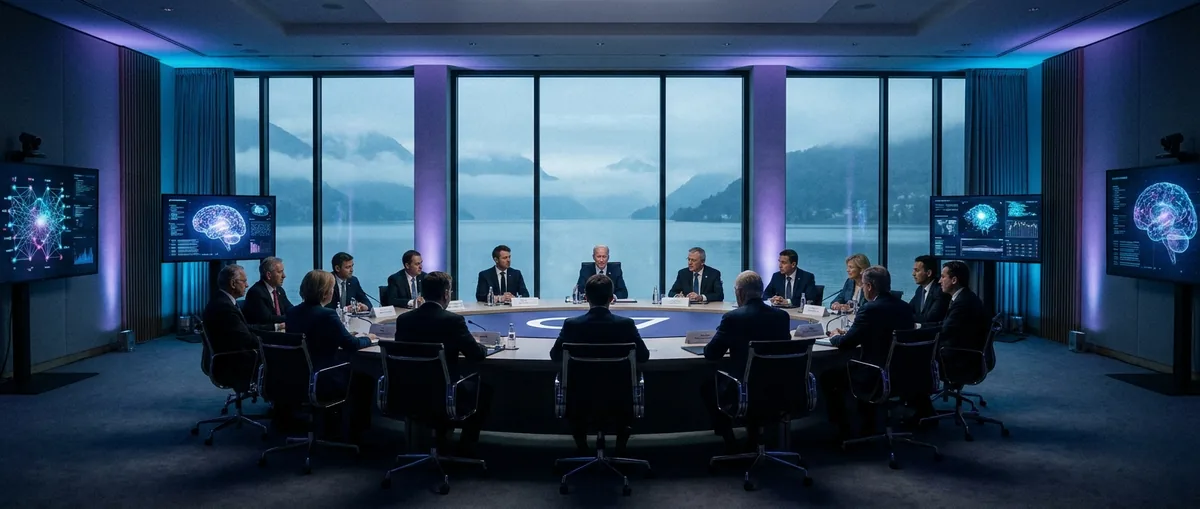
For the first time in G7 history, the most powerful AI laboratory CEOs sat alongside world leaders at an official working lunch. At the summit in Évian-les-Bains, France on Wednesday, Anthropic CEO Dario Amodei, OpenAI CEO Sam Altman, and Google DeepMind CEO Demis Hassabis joined approximately a dozen other tech executives in a session themed "ensuring a safe, rapid and effective deployment of artificial intelligence." Also in the room: President Donald Trump, Treasury Secretary Scott Bessent, Commerce Secretary Howard Lutnik, and Secretary of State Marco Rubio.
Amodei and Hassabis reportedly called for a U.S.-led international coalition to shape global AI standards—one that would enforce structured access to frontier models, exclude China from critical chip supply chains, and create cooperative frameworks for defending against AI-enabled cyber threats and bioterrorism risks. Canadian Prime Minister Mark Carney reportedly agreed the U.S. should lead such a coalition.
"Resist the temptation to splinter. The frontier model is a challenge before us all—better regulation is needed to avoid it falling into the hands of an authoritarian regime." — Dario Amodei, Anthropic CEO, G7 Évian-les-Bains
French President Emmanuel Macron struck a more cautious tone. He praised the U.S. for taking frontier AI safety seriously, but called the administration's recent export controls on Anthropic's models "a strictly nationalist reaction." Macron made a forceful plea for America not to hoard cutting-edge AI, warning that if U.S. firms could "switch off access like a light switch," allied democracies would have no choice but to build their own AI stacks—a costly and duplicative outcome for everyone. He announced France would boost funding to its own AI industry as an insurance policy.
OpenAI's Altman echoed the call for multilateral guardrails, arguing that an "international forum" is needed to develop AI safety rules and that the task of AI safety should not be left to the companies themselves. "Governments need to lead," Altman said, in what amounts to an unusual acknowledgment of limits on private sector self-regulation.
Having the three most powerful frontier AI lab CEOs in the same room as G7 heads of state is a geopolitical turning point. AI has formally graduated from a Silicon Valley story into a matter of national security and diplomatic strategy. For enterprises, the coming months will determine whether access to the most capable frontier models becomes a function of your company's nationality—or your vendor's relationship with the current administration. Start mapping your AI dependencies and build contingency access strategies now.
Sources: AP News, CNBC, Fortune, Politico EU
2. Trump Forces Anthropic to Kill Its Most Powerful Models — Then the G7 Fallout Begins
The inciting event that overshadowed nearly every other G7 conversation: on the Friday prior (June 13), Anthropic's leadership received an urgent message from the White House. They had 90 minutes to take their newest frontier AI models—Fable 5 and Mythos 5—completely offline. The directive cited national security concerns, invoking export control authorities to bar all foreign nationals from accessing what the administration described as models with "elite cyber capabilities."
Anthropic complied, but with visible frustration. The company said it had received explicit prior government approval to deploy Fable 5, making the sudden reversal all the more jarring. In internal messages that quickly became public, Anthropic employees described the episode in stark terms. The New York Times reported that engineers and policy staff lit up private group chats within minutes, many expressing that the government had "screwed" them by pulling the rug out from under a launch that had already been cleared.
"Anthropic did not believe the steps taken by the government were warranted by the concern it flagged about a potential security issue." — Anthropic official statement
The episode exposed a dangerous ambiguity in the emerging regulatory landscape: frontier AI models are now subject to export control regimes designed for weapons and semiconductors, but the frameworks for what triggers those controls remain opaque and inconsistently applied. Vox noted that the Fable takedown followed a pattern where the administration cited national security risks to selectively restrict access—a move critics say has more to do with political signaling than with coherent AI policy.
As of Wednesday's G7 summit, Anthropic remained in active negotiations with the administration over the terms under which Fable 5 and Mythos 5 might be permitted to re-launch. The company's market position—already facing the dual pressure of an IPO road show and a talent exodus (more on that below)—makes the resolution of this standoff a top-tier business priority.
This is not just Anthropic's problem. If a frontier AI vendor can have their most capable models yanked offline with 90 minutes' notice, any enterprise running mission-critical workloads on those models faces existential continuity risk. The lesson isn't "don't use Anthropic"—it's "don't run single-vendor AI architectures for critical systems." Multi-model redundancy strategies and vendor-agnostic AI infrastructure should be at the top of every CTO's 2026 planning document.
Sources: TIME, Axios, Vox, Politico
3. Noam Shazeer Leaves Google for OpenAI — The Biggest AI Talent Defection Yet
In a move that sent shockwaves through the AI research community, Noam Shazeer—Google's vice president of engineering and co-lead of its Gemini AI models—announced Wednesday morning that he is departing to join OpenAI. Shazeer posted on X: "I'm excited to share that I'll be joining OpenAI and look forward to working with the exceptional team there."
The timing is pointed. Shazeer returned to Google less than two years ago, in August 2024, as part of a landmark $2.7 billion partnership in which Google absorbed Character.AI—the startup Shazeer co-founded after leaving Google in 2021. Shazeer and fellow researcher Daniel De Freitas had originally quit Google after the company declined to aggressively pursue a conversational AI chatbot project they had championed. The irony: that project became the blueprint for the generative AI wave that followed. Shazeer is widely credited with architectural innovations that power much of modern large language model design.
"It was a difficult decision to move on. I'm incredibly proud of the amazing team at Google and everything we've built together. It has been an honor and a pleasure to work with all of you." — Noam Shazeer, on X, June 18, 2026
His departure from Google comes weeks after Google unveiled Gemini 3.5 Flash and the Gemini Spark AI agent platform at Google I/O 2026—products Shazeer's team contributed to directly. The move to OpenAI is strategically significant: OpenAI confidentially filed for an IPO on June 8, targeting a listing before year-end at a valuation of $730B–$850B. Bringing in one of the field's most respected model architects—just before going public—is both a technical and a signal play.
The war for AI talent has entered a new phase—it's no longer about startups poaching from incumbents, it's about the very top of the frontier model talent stack moving between the hyperscalers themselves. For Google, this is a credibility hit at the worst possible moment, coming directly off I/O 2026. For OpenAI, Shazeer's arrival ahead of its IPO is a statement of intent: they're building a research bench capable of sustaining frontier leadership for the next decade. Watch for downstream effects on Gemini's roadmap velocity over the next two quarters.
4. OpenAI Heads Toward IPO as o3 Retirement and Partner Network Signal Maturation
The Shazeer hire lands in the middle of OpenAI's most consequential week since the launch of ChatGPT. On June 8, OpenAI filed confidentially for an initial public offering with the SEC, underwritten by Goldman Sachs and Morgan Stanley. The company is targeting a public listing by late 2026 at a valuation between $730 billion and $850 billion—projecting $25 billion in annualized revenue even as it burns through approximately $27 billion annually in compute, talent, and infrastructure costs.
Separately, OpenAI is rationalizing its model portfolio ahead of the IPO. Its o3 reasoning model will be retired from ChatGPT on August 26, 2026, following a 90-day sunset period. GPT-4.5 will be retired sooner—on June 27, 2026, after a compressed 30-day period. Both retirements signal that OpenAI is consolidating around its newer o4 and o4-mini reasoning stack, simplifying its product surface for enterprise buyers and the public markets alike.
The company also announced the OpenAI Partner Network on June 14—a structured program to formalize relationships with enterprise solution providers, systems integrators, and platform builders. The network is designed to accelerate deployment of OpenAI's API and Codex coding infrastructure across enterprise verticals, and represents a significant step toward the kind of go-to-market organization that public company investors will want to see.
"OpenAI is targeting a public listing by December 31, 2026, although that timeline depends on SEC approval and broader market conditions." — Multiple IPO tracking sources
OpenAI going public is the moment the AI industry becomes a fully mainstream financial asset class. The confluence of its IPO preparations—model consolidation, partner network launch, strategic talent acquisition, and G7 diplomatic presence—paints a picture of a company that has shifted from "move fast and break things" to "build a durable, defensible enterprise." For buyers: model sunset timelines matter for procurement planning. If your business is on o3 or GPT-4.5, update your dependency map now.
Sources: CNBC IPO Filing, OpenAI Release Notes, OpenAI News
5. Peter Diamandis: "AGI Is Here — And Society Isn't Ready"
While world leaders debated AI at the G7, Peter Diamandis—the founder of XPRIZE and co-founder of Singularity University—released a widely circulated analysis titled "AGI Is Here — And Society Isn't Ready." Published June 11 and gaining traction this week on Substack and YouTube, the piece argues that the threshold for Artificial General Intelligence has already been crossed in functional, practical terms—not as a singular event, but as a gradual transition that most institutions have failed to register.
Diamandis frames the current moment as a pivot point comparable to the invention of the printing press or the industrial revolution, but compressed into years rather than generations. His central claim: AI systems are already surpassing humans on the majority of cognitive tasks required for professional knowledge work, and the societal, economic, and legal infrastructure designed for a human-labor economy is nowhere near prepared for the implications.
"These tools can revolutionize healthcare by curing major diseases within a decade. The economic shift toward a future of 'universal high income' is already beginning. Move past fear, embrace these new tools, and focus on leveraging technology to solve the world's biggest challenges." — Peter Diamandis, June 2026
In a companion piece on his Metatrends Substack, Diamandis also weighed in on the SpaceX IPO, arguing that the confluence of Starlink's connectivity infrastructure and SpaceX's frontier AI compute ambitions positions the company as a hyperscaler delivering hundreds of gigawatts of AI compute from orbit—framing it as the "railroad" on which humanity's next economic era runs.
Diamandis is not a researcher—he's an evangelist with a track record of getting directional calls right on long timescales. The "AGI is already here" framing is worth taking seriously not because it's technically precise, but because it captures a real business reality: the cost of cognitive labor has dropped by orders of magnitude, and organizations that treat AI as a pilot program rather than a core operational infrastructure are already falling behind. The institutions that adapt fastest won't be the ones who waited for a consensus definition of AGI.
Sources: AGI Is Here Transcript, Metatrends Substack
6. Google AI Mode Gets "Information Agents" — Search Becomes Surveillance (of Things You Actually Care About)
Google quietly rolled out a new capability in its AI Mode search product this week: "information agents." Rather than waiting for users to search, these AI-powered agents proactively monitor topics, news feeds, price signals, and web content that users have flagged as relevant—and push alerts when something meaningful changes. Think of it as a personal AI analyst that never sleeps.
The feature is currently available in AI Mode for Google Search, the company's conversational search interface that has been steadily displacing traditional ten-blue-links search for information-intensive queries. Information agents can be configured to track competitors, monitor regulatory developments, follow scientific research in specific domains, or watch for pricing changes on products and services.
The launch follows Google's broader strategy unveiled at I/O 2026: transforming Google from a reactive search engine into a proactive AI assistant capable of autonomous monitoring and outreach. Gemini Spark, the agentic AI platform announced at I/O, provides the underlying infrastructure for multi-step, multi-tool workflows that information agents can leverage.
Information agents are the commercial-grade preview of what agentic AI means at consumer scale. For enterprise teams, the implication is broader: your customers, your competitors, and your regulators now have access to always-on AI monitoring of everything your business does publicly. Competitive intelligence, PR monitoring, and regulatory tracking are no longer optional investments—they're table stakes. Businesses that adopt these tools proactively will spot opportunities and threats days ahead of those who don't.
Sources: Lifehacker, Google AI Blog
7. The Agentic AI Inflection Point: 40% of Enterprise Apps Go Agentic in 2026
Buried beneath the geopolitical headlines, a structural shift in enterprise technology is accelerating. According to MarketsandMarkets data cited this week, 40% of enterprise applications are expected to include task-specific AI agents by the end of 2026—up from fewer than 5% just one year ago. The agentic AI market, valued at $7.06 billion in 2025, is projected to reach $93.2 billion by 2032.
Forbes contributor Tim Bajarin noted this week that enterprise AI has decisively crossed the line from copilot-style augmentation to fully agentic systems that act autonomously on behalf of organizations. The shift is being driven by three converging forces: vastly improved foundation model quality, better enterprise data governance frameworks, and the emergence of interoperable agentic platforms that can coordinate multiple AI systems across business functions.
GitHub Copilot's standalone desktop application reached general availability in 2026, transforming coding assistance into a supervised multi-agent control plane. Sessions run in isolated git worktrees, with a shared "canvas" workspace where both AI agents and human developers collaborate in real time. The pattern—autonomous agents operating in bounded, supervised environments—is becoming the design template for enterprise agentic deployment broadly.
"Only 11% of CIOs and CTOs say they are fully ready for the next wave of AI agent deployment." — Forbes / Info-Tech LIVE 2026
The readiness gap is striking: while 40% of applications are expected to include agents, only 11% of technology leaders say they're prepared for the operational, governance, and security demands that come with autonomous AI systems operating inside live business processes. The sprint to deploy is outpacing the infrastructure for control.
We're at a rare moment where the gap between early adopters and the laggard majority is still wide enough to create meaningful competitive differentiation. The 89% of CIOs who say they're not ready aren't failing because agentic AI is hard—they're failing because they haven't committed to building the governance and monitoring infrastructure that safe agent deployment requires. The first mover advantage in agentic AI isn't just about speed; it's about building the institutional muscle to run AI agents safely at scale before your competitors do.
Sources: SumGeniusAI, Forbes, Windows Forum / GitHub Copilot
Why It All Matters Right Now
June 18, 2026 is a hinge date. The intersection of geopolitical AI governance (G7), talent consolidation (Shazeer to OpenAI), regulatory volatility (Anthropic's models taken offline), a landmark IPO filing (OpenAI), and the mass enterprise adoption of agentic AI creates a moment of maximum complexity—and maximum opportunity. The organizations that move with clarity and preparation through this turbulence will define the AI landscape of the next decade. Those that wait for the dust to settle will find the positions have already been taken.
The throughline across all of today's stories: AI is no longer a technology decision. It's a governance decision, a geopolitical decision, a talent decision, and a competitive strategy decision—all at once.
Need help navigating AI for your business?
Our team turns these developments into actionable strategy — from multi-vendor AI architecture to agentic deployment readiness.
Contact SEN-X →