OpenAI's IPO Talent Blitz, Anthropic's White House Framework Deal, Google's Smart Speaker Returns & AI Diagnoses 18 Kids
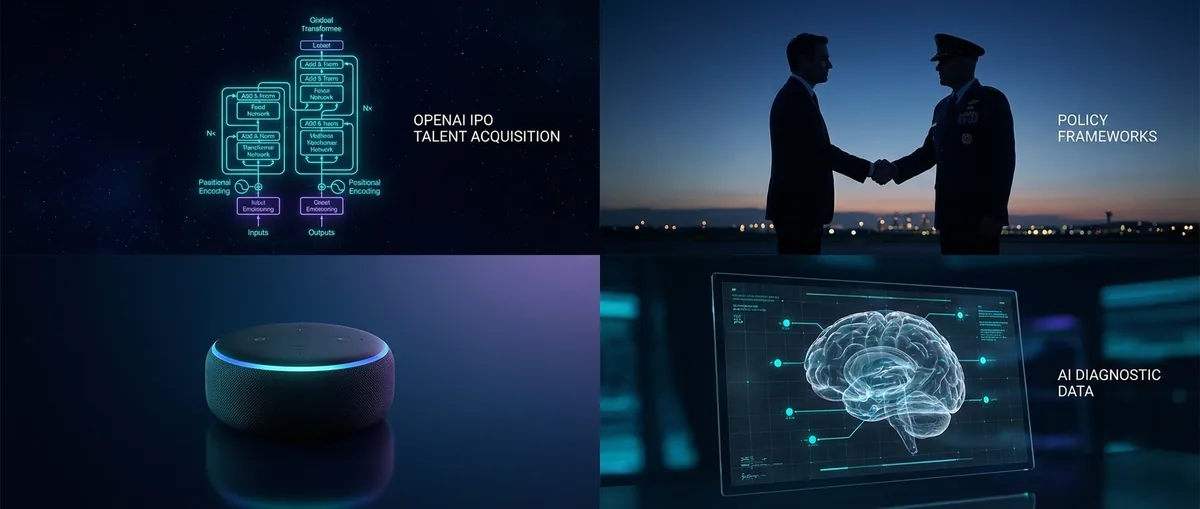
The week's biggest moves: OpenAI lures the co-inventor of the Transformer from Google DeepMind days before its IPO roadshow kicks off. Anthropic and the Trump White House pivot from a bruising export-control standoff to drafting a joint AI security framework. Google ships its first smart speaker in six years, powered entirely by Gemini Live. And in what may be the week's most important story outside of Silicon Valley, researchers at Boston Children's Hospital use OpenAI's o3 model to identify 18 diagnoses that had stumped some of the world's best pediatric specialists — saving, potentially, 18 young lives.
1. OpenAI's IPO Talent Blitz: Noam Shazeer and Dean Ball Join the Roster
In back-to-back announcements this week, OpenAI executed what may be the most consequential pre-IPO talent acquisition in Silicon Valley history. On Wednesday, Noam Shazeer — a co-author of the landmark 2017 "Attention Is All You Need" paper that birthed the Transformer architecture, former founder of Character AI, and co-lead of Google's Gemini program — announced his departure from Google to join OpenAI. Shazeer had been at Google since 2000, left only briefly to co-found Character AI (which Google re-acquired in a $2.7 billion deal in 2024), and had since returned to lead Gemini's development from the inside.
Then on Thursday, former White House AI policy official Dean Ball announced he would join OpenAI on July 6 to lead a newly formed team called Strategic Futures. Ball had spent time at the Foundation for American Innovation and helped publish America's AI Action Plan from inside the Trump White House before stepping down earlier this year.
"I am pleased and honored to announce that, on July 6, I'll be joining OpenAI as leader of a new team called Strategic Futures. Our mandate will be to help the company's leadership shape frontier AI policy."
— Dean Ball, on X (formerly Twitter)
Ball will report to Chief Strategy Officer Jason Kwon. The team's mandate spans catastrophic risk, recursive self-improvement, labor market impact, and the relationship between frontier labs, governments, and society. On the technical side, Sam Altman reportedly quipped that landing Shazeer "only took 10 years" — a nod to the long competitive dance between the two organizations. Shazeer's departure from Google is being felt: he was instrumental in shaping Gemini's architectural direction and had deep knowledge of Google's most sensitive research pipelines.
The hires arrive as OpenAI's IPO roadshow is believed to be just weeks away. The company's S-1 has been filed confidentially with the SEC and valuations floated publicly range from $852 billion to over $1 trillion, depending on the source. OpenAI filed for IPO in June 2026, according to multiple reports including coverage from Gigazine citing official SEC documentation. GPT-4.5 is simultaneously being retired from ChatGPT by June 27, part of the ongoing model lifecycle management as the company consolidates its product line ahead of the public offering.
The Shazeer hire is not just a talent win — it's an architectural signal. Shazeer co-invented the substrate that every major AI model runs on today. His decision to leave Google Gemini's leadership for OpenAI suggests he believes the next era of AI architecture is being built in San Francisco, not Mountain View. For enterprise AI buyers, the message is clear: the talent gravity in this industry continues to flow toward OpenAI ahead of its IPO. The Ball hire is equally notable for what it says about OpenAI's political strategy — embedding a former White House insider who helped write AI policy now gives them an insider who can shape the next set of rules. That's not coincidence; that's positioning.
2. Anthropic and the White House Start Writing a Joint AI Security Framework
After nearly two weeks of bitter standoff over the government's export-control order forcing Anthropic to shut down its Fable 5 and Mythos 5 models for foreign nationals, the conflict is beginning to defuse — but the terms are revealing. According to Politico reporting, the White House and Anthropic are now collaborating on a framework that would assess the severity of security flaws in new AI models and define when government intervention is warranted.
The pivot matters enormously. Rather than simply fighting to restore access to Fable 5 and Mythos 5, Anthropic has effectively agreed to help co-author the rules that will govern how frontier AI models are evaluated for national security risk — and at what point the government can order a shutdown. It's a deal that could look like a concession or a masterstroke depending on where you sit.
"Anthropic shut down both of its top models to all customers to ensure that it complied with the directive. The result was that the U.S. government successfully forced a tech company to pull its models offline with a swift and unilateral order."
— TechCrunch, June 15, 2026
The backdrop to the framework talks is the G7 summit earlier in the week, where Anthropic CEO Dario Amodei and Google DeepMind CEO Demis Hassabis jointly called for a U.S.-led AI coalition in a closed-door meeting with heads of state including President Trump. Canadian Prime Minister Mark Carney reportedly agreed that the U.S. could take the lead. OpenAI CEO Sam Altman, also present, called for "an international forum for discussion that establishes globally accepted standards for testing, provides expert and impartial analysis of capabilities and risks, and serves as a venue for cooperation among nations."
Meanwhile, Dario Amodei published a sweeping essay on his personal website outlining Anthropic's evolving regulatory philosophy — including the company's support for transparency legislation, having helped pass SB 53 in California, RAISE in New York, SB 315 in Illinois, and now advocating for a federal-level transparency standard.
The Anthropic-White House framework negotiation is arguably the most consequential AI governance development of the month. Whoever writes the evaluation criteria for "dangerous AI" effectively determines which models can be deployed and which can be shuttered. Anthropic is negotiating to be at that table — not just as a regulated party, but as a co-author of the rulebook. That's a very different posture from fighting the government in court. For enterprise AI buyers, this signals something important: the era of unchecked frontier model deployment is ending. Models capable of causing "major disasters," in the words of the export-control order, will face scrutiny that ordinary software doesn't. Your AI vendor relationships, and the geopolitical exposure of your model usage, now belong on your risk register.
3. Google Ships Its First Smart Speaker in Six Years — Powered Entirely by Gemini
Google is finally re-entering the smart speaker market after a six-year absence. The new Google Home Speaker, priced at $99.99, opened for pre-orders on June 17 and ships on June 25. Unlike the original Google Home lineup, which ran on the Assistant stack, this device is built from the ground up as a native Gemini hardware product.
Key features include Gemini Live integration — Google's conversational AI mode that allows free-flowing back-and-forth dialogue without needing a wake word for every exchange — along with 10 built-in voice options, multi-step smart home control, and natural language device orchestration. The speaker can interpret multi-part commands like "dim the bedroom lights, set the thermostat to 70, and play rain sounds" as a single conversational request rather than requiring three separate wake-word interactions.
"You can now pre-order the new Google Home Speaker for $99.99, with units hitting shelves on June 25. This device features Gemini for Home, allowing for natural, multi-step conversations and more intuitive control over your smart home."
— Google Blog, June 17, 2026
Wired described the launch as "finally go time" after Google announced the speaker concept at its hardware event last August. Ars Technica noted that the 10-month gap between announcement and availability reflects the depth of the Gemini integration required — this isn't a Google Assistant product with a Gemini badge slapped on; it's a native reimagining of what voice AI in the home looks like when the underlying model is genuinely multimodal and capable of reasoning over context.
The Google Home Speaker's launch is less a product announcement and more a statement of architectural intent: Google believes the smart home interface layer belongs to conversational AI, not app-based control. At $99, this is an aggressive price point against Amazon's Echo lineup. But the real competition isn't for smart home market share — it's for which AI assistant becomes the ambient layer of your life. Google is betting on Gemini Live's no-wake-word conversational flow as the differentiator. For businesses building hospitality, retail, or facilities management experiences, this is an early look at what the next consumer AI interaction paradigm looks like. The enterprise analog to this product — ambient AI that controls systems through natural language — is closer than most operators realize.
4. OpenAI's o3 Diagnoses 18 Children With Rare Diseases That Stumped Specialists
In one of the most striking real-world AI deployments reported this week, researchers at Boston Children's Hospital and Harvard used OpenAI's o3 Deep Research model to re-examine 376 previously unsolved pediatric rare-disease cases — cases that had already been reviewed and set aside by expert specialists. The result: 18 new diagnoses confirmed, a 4.8% resolution rate on cases that human experts had given up on.
The model generated hypotheses by cross-referencing phenotypes (observable characteristics), genetic variants, and published scientific literature — a task that requires synthesizing across thousands of data points simultaneously, something even highly trained specialists struggle to do comprehensively. The system's outputs were then reviewed and validated by human experts before any clinical action was taken.
"According to OpenAI, the hospital's use of AI has led to more than 40 previously unsolved rare disease diagnoses, saved 60,000 hours in work time, and redeployed over $7 million in labor costs."
— OpenAI / Boston Children's Hospital via iHeart
OpenAI framed the study as part of its broader Applied AI push into healthcare, which also included the June 18 announcement of improved health intelligence features in ChatGPT and a separate initiative using AI to assist physicians in clinical workflows. The Boston Children's work is notable because it targets rare diseases — a domain where the combination of vast literature, small patient populations, and extreme phenotypic variation makes human diagnosis genuinely difficult. AI's ability to surface connections across that haystack is not incremental; it's categorically different from what any individual clinician can do.
This is the story of the week, and it's not getting the attention it deserves relative to the IPO drama. Eighteen children who would have continued to suffer without a diagnosis now have answers. That's not a benchmark; that's a life outcome. But the broader implication for healthcare operators is equally important: AI's highest-leverage application in medicine may not be in high-volume, well-understood conditions — it may be in the long tail of rare and complex cases where human expertise saturates and AI's ability to hold thousands of data points in context simultaneously becomes genuinely decisive. If you're in healthcare AI, this case study belongs in every executive conversation you're having.
5. A New Landmark Study: Generative AI Now Outscores Average Humans on Creativity Tests
A massive comparative study — spanning more than 100,000 participants — published this week in a peer-reviewed journal has delivered a result that will generate significant debate: current generative AI systems can now beat the average human on standardized tests of divergent thinking. Published results covered by ScienceDaily and Silicon Canals show that multiple frontier AI models scored above the human average on creativity measures designed to assess the ability to generate novel, varied, and original ideas.
The specific test used was a standard divergent-thinking benchmark — the type that asks participants to come up with as many uses as possible for a common object, or to find original connections between unrelated concepts. These are precisely the skills associated with creative ideation, lateral thinking, and brainstorming — tasks that many knowledge workers consider distinctly human cognitive territory.
The researchers themselves were careful to note that "beating the average" is a different claim from "displacing exceptional human creativity" — the top percentiles of human creative performance still outpace current AI systems. But the study's scope (100,000+ participants) makes the result statistically robust. And the direction of travel is unambiguous: AI's performance on creativity benchmarks has been improving sharply, while the human average does not change.
This study will be weaponized in both directions — by those arguing AI is replacing creative workers, and by those arguing the benchmarks don't capture true creativity. Both camps will have a point. What's genuinely useful for business leaders is this: if AI can outperform the average human on divergent thinking at scale, the economics of creative brainstorming, content ideation, product concept generation, and marketing campaign development have changed. Not replaced — restructured. The question isn't whether AI beats human creativity in the abstract. It's whether your team is using AI to dramatically extend their creative throughput, or whether they're competing against it without realizing it. The answer should be obvious.
6. OpenAI Sunsetting GPT-4.5 and Retiring o3: What the Model Churn Means for Enterprise
In a quieter but operationally significant development, OpenAI's official release notes confirmed that GPT-4.5 will be retired from ChatGPT on June 27, 2026, following a 30-day sunset period, and that o3 will be retired on August 26, 2026, following a 90-day sunset. The moves are part of OpenAI's ongoing model lifecycle management as the company consolidates its portfolio around GPT-5.5 and its successor family ahead of the IPO.
Separately, OpenAI launched new credit usage analytics and updated spend controls for ChatGPT Enterprise, giving Global Admins visibility into consumption across ChatGPT, API usage, and third-party integrations. The enterprise controls update reflects a broader push to make AI spending manageable and auditable — a recurring complaint from enterprise procurement teams who have struggled to forecast AI costs amid unpredictable usage patterns.
Also this week: OpenAI's Codex received updates strengthening remote execution security, improving cross-platform working-directory preservation, and adding richer MCP (Model Context Protocol) support — moves that signal the company is taking the agentic coding workflow seriously as a product category ahead of the IPO.
Model deprecation is not a minor housekeeping matter for enterprise teams — it's a supply chain risk. If your internal tools, workflows, or third-party integrations are pinned to GPT-4.5 or o3, you have until June 27 and August 26 respectively to migrate or face service interruption. OpenAI's new enterprise spend controls are a welcome but overdue addition; the inability to forecast and cap AI costs has been a genuine boardroom concern. For organizations thinking strategically, this model churn is also a reminder that vendor lock-in to specific model versions is not a stable architecture. Build against abstraction layers, not specific model endpoints.
7. The State-Level AI Regulation Wave Keeps Building
While federal AI governance remains gridlocked, states continue to legislate at an accelerating pace. This week's policy roundup:
New York wrapped its 2026 legislative session with a package that includes a kids chatbot safety bill, an AI training data transparency act, the FAIR News Act, a data center moratorium, and a ban on AI-assisted surveillance pricing. The breadth of the New York package reflects how state legislators are tackling AI across consumer protection, media, and infrastructure simultaneously — without waiting for Washington.
Connecticut's SB 5 — a broad AI transparency regime covering employment decisions — goes into effect in stages from October 1, 2026 through October 1, 2027. It requires employer accountability and disclosure wherever AI "materially influences" employment decisions, establishing one of the more operationally specific state AI employment standards yet passed.
At the EU level, the European retail association EuroCommerce formally asked the European Commission to exempt AI-generated advertisements from the bloc's new regulation requiring disclosure of AI use in content — drawing the line between AI-generated commercial communications and other AI-generated content that the rules were designed to flag.
The state-level AI regulation wave is not slowing down — it's accelerating and diversifying. New York's multi-bill package in a single legislative session is a template other states will follow. Connecticut's employment AI disclosure rules are particularly material for HR technology buyers: if your applicant tracking system, interview scoring tool, or performance management platform uses AI to make or influence decisions, you now have a compliance obligation in Connecticut starting this fall. For multi-state employers, the patchwork is becoming genuinely complex. If your legal team isn't tracking AI-specific legislation across every state where you employ people, that gap is a liability.
🔭 The Week in Context: A Sector at an Inflection Point
This week's stories share a common thread: AI is moving simultaneously up the capability curve and deeper into institutional frameworks. OpenAI's talent acquisitions aren't just about research horsepower — they're about winning the regulatory conversation before the rules are written. Anthropic's framework talks with the White House signal that the most powerful AI companies are now co-authoring the governance structures that will constrain their own products. Google's smart speaker demonstrates that the interface layer for AI is migrating from apps and browsers to ambient hardware. And the Boston Children's Hospital study shows what genuine real-world impact looks like when AI is applied to problems that have resisted human solution for years.
For business leaders, the signal across all of these stories is the same: the AI landscape is not stabilizing. The talent moves, the regulatory shifts, the product launches, and the capability demonstrations are all accelerating simultaneously. Organizations that are still in evaluation mode risk waking up in Q3 or Q4 to find that their competitors, their regulators, and their talent market have all moved on without them.
Need help navigating AI for your business?
From model selection and vendor strategy to AI regulation compliance and enterprise deployment — our team turns these developments into actionable strategy for your organization.
Contact SEN-X →