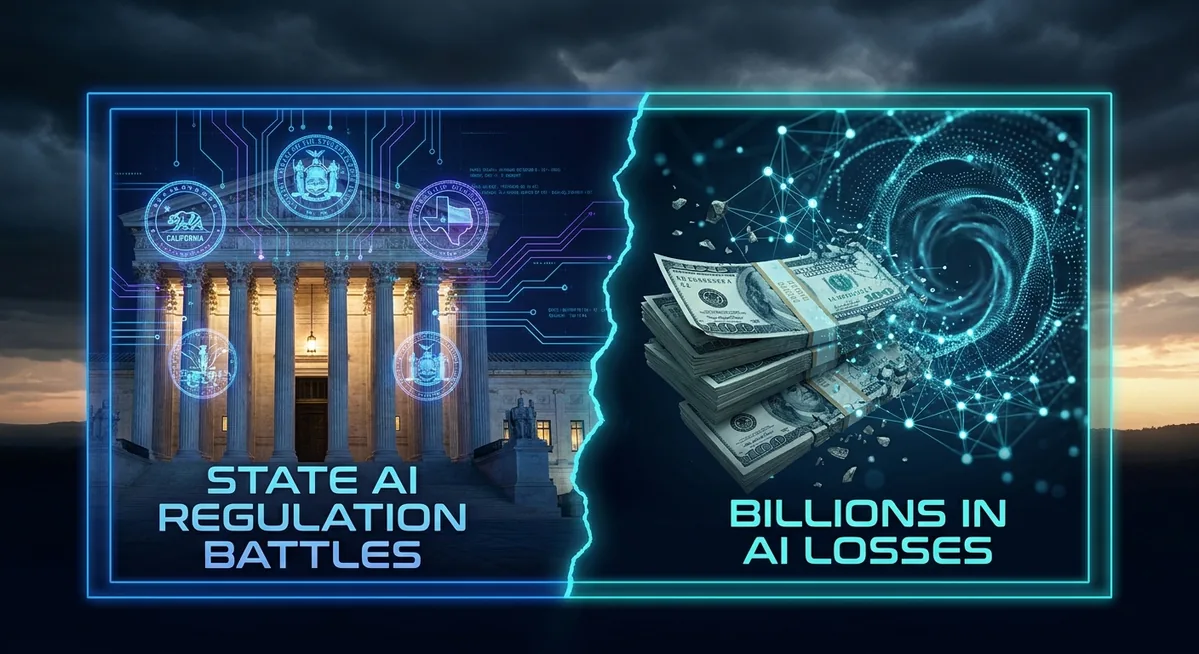
OpenAI's $39B Burn, States Fight Back on AI Regulation, Norway Bans AI from Classrooms, and the Anthropic-Trump Détente
This week's AI headlines converge on a single, uncomfortable theme: the industry is growing faster than anyone — government, investors, or society — can keep up with. OpenAI's catastrophic 2025 losses are now public. U.S. states are writing their own AI laws despite federal pressure to back off. Norway is pulling classroom AI for elementary students. And the Trump-Anthropic cold war thawed — at least for now. Here's everything you need to know heading into the week.
1. OpenAI's Leaked Financials: $39 Billion in Losses, $13 Billion in Revenue — and an IPO Anyway
As OpenAI races toward a public market debut later this year, leaked financial documents have given the world its first clear look at the company's economics — and the picture is jarring. According to reporting by the Financial Times and corroborated by multiple outlets, OpenAI posted a net loss of approximately $38.5–$39 billion in fiscal year 2025, nearly eight times its 2024 loss of $5 billion. Revenue hit $13.07 billion, up 253% year-over-year, but the company burned through roughly $34 billion in operating expenses to get there.
The Q1 2026 picture is only marginally better: revenue reached $5.7 billion for the quarter — a tripling of its pace — but operating losses came in at $9.3 billion and net losses exceeded $21 billion. Sam Altman acknowledged the spending trajectory in a post on X, affirming OpenAI's reliance on Nvidia infrastructure: "We love working with Nvidia and they make the best AI chips in the world. We hope to be a gigantic customer for a very long time."
"OpenAI reported a $20.92 billion loss from operations in 2025, far worse than the $8.78 billion it recorded in 2024. What's more, the company posted only $13.07 billion in revenue in 2025, up 253% year over year."
For context: SpaceX, which debuted on public markets this month, was conspicuously absent of Chinese investors — a situation that will likely repeat when OpenAI's IPO window opens. Geopolitical dynamics are now a first-order concern for AI company capital raises, not just a footnote.
For retail investors eyeing the OpenAI IPO, the calculus is complex. The company is spending aggressively to maintain its frontier position in a winner-take-most market — and analysts argue that spend is not waste, but infrastructure investment that flows directly to infrastructure suppliers like Nvidia and Microsoft. But for anyone betting on near-term profitability, the numbers are a cold splash of water.
OpenAI's losses aren't a sign of failure — they're a sign of how expensive it is to build at the frontier. The company is essentially purchasing compute-based market position in a race where second place may not be commercially viable. The more interesting question for enterprises isn't "is OpenAI losing money?" — it's "what does this burn rate mean for model pricing stability over the next 18 months?" If OpenAI aggressively monetizes post-IPO, API costs could rise. If competition keeps pressure on, prices stay low but the runway for smaller API-dependent startups shortens. Plan accordingly.
2. States Defy Trump on AI Regulation — California's "No Robo Bosses Act" Advances
Six months after President Trump's executive order warned states against passing AI regulations that could hamper the industry's growth, U.S. states are forging ahead anyway — and doing so with increasing specificity. The latest Los Angeles Times report, published this morning, details how legislatures across the country are advancing targeted AI bills even as the White House threatens to restrict federal funding to non-compliant states.
In California, the "No Robo Bosses Act of 2026" is advancing through the legislature. The bill would prohibit employers from relying solely on AI to fire or discipline workers, and would expand oversight of AI chatbot outputs — including restrictions that would ban certain automated outputs from being passed off as human-generated content. Separately, a bipartisan draft proposal in the U.S. House known as the Great American AI Act — released June 4, 2026 — includes a preemption clause that would bar states for three years from regulating certain AI behaviors, freezing state-level innovation on liability and safety frameworks.
"In California, lawmakers are advancing the 'No Robo Bosses Act of 2026' to prohibit employers from relying solely on AI to fire or discipline workers, and an expansion of how the state regulates AI chatbots, including banning chatbot outputs [passed off as human]."
Trump's EO directed the Attorney General to create a task force to challenge state laws deemed more than "minimally burdensome," and threatened to restrict broadband deployment grants and other federal program funding to states with active AI laws. Civil liberties organizations and both-party critics pushed back, arguing that blanket deregulation amounts to giving AI giants a free pass at a moment when their systems are increasingly mediating employment, healthcare, and public services.
The White House's stated position: the U.S. cannot afford regulatory fragmentation while racing China for AI supremacy. State lawmakers' counter: workers and consumers can't wait for federal consensus that may never come.
The federal-state AI regulation standoff is now the defining governance drama of 2026. For enterprise AI deployers, this creates a compliance patchwork problem: a tool that's legally compliant in Texas today may violate California's No Robo Bosses Act next quarter. The practical implication? Any business using AI in HR workflows — automated screening, performance scoring, termination recommendations — needs legal review now, not later. The "we'll wait for federal clarity" strategy is no longer tenable in California-headquartered or California-employing organizations.
3. Norway Becomes First Nation to Near-Ban AI in Elementary Schools
In a move that may set a global policy template, Norway's Prime Minister Jonas Gahr Støre announced on June 19 that his government will impose a near-total ban on generative AI tools for students in grades 1 through 7 (ages 6–13), effective from the start of the next school year in late August 2026. Older students — those in lower secondary school (ages 14–16) — may use AI tools cautiously under teacher supervision. Only upper secondary students (ages 17–19) will be expected to learn how to use AI appropriately in preparation for further education and work.
"The most important thing in school is that our children learn to read, write and do mathematics. Using AI increases the risk that young children skip important steps in their education."
— Prime Minister Jonas Gahr Støre, Reuters, June 19, 2026
The policy comes against a backdrop of declining test scores — a trend the Norwegian government attributes partly to the premature adoption of digital tools in classrooms. Norway banned smartphones from schools in 2024 and gave teachers back disciplinary authority. Now, AI joins that restricted list. Crucially, the government also announced plans to fund a return to physical books in classrooms, reversing Norway's aggressive iPad-and-tablet push from the early 2010s.
Norway had also announced in April 2026 that it would ban children under 16 from using social media, making it one of the most protective digital-childhood regulatory environments in the world. The AI education ban follows the same logic: childhood cognitive development is a finite window, and shortcuts that bypass foundational learning carry lasting costs.
Norway's move is politically significant and scientifically grounded. The research on "cognitive offloading" — outsourcing thinking to tools before the underlying skills are developed — is legitimately worrying for early childhood education. But the policy also creates a fascinating natural experiment: in five years, we'll be able to compare Norwegian elementary graduates who learned to write without AI assistance against cohorts elsewhere who relied on it. Regardless of where you stand on the policy, it's the kind of evidence-generation the industry sorely needs. For EdTech companies and AI startups targeting the K-12 market, this is a market access signal: Northern Europe is drawing a hard line, and others may follow.
4. Trump Walks Back Anthropic "National Security Threat" Label — For Now
The week's most diplomatically charged AI story involves a détente that few expected to come this quickly. In an exclusive interview for "The Axios Show" published June 19, President Trump disclosed that he had come close to formally designating Anthropic as a national security threat just one week earlier — but pulled back after what he described as a responsible and rapid response from the company.
The dispute centered on Anthropic's frontier models Fable 5 and Mythos 5. The Trump administration ordered Anthropic to block all foreign nationals from accessing those models, citing national security concerns related to foreign adversaries potentially exploiting the most capable AI systems. Anthropic complied — disabling access for all users globally, not just foreign nationals — while its senior technical staff rushed to Washington for meetings with administration officials.
"When asked if he viewed Anthropic, or its CEO Dario Amodei, as a threat to national security, Trump said: 'Well, not now, but a week ago, maybe.' Trump told Axios that Amodei responded to the administration's export control directive 'very quickly' and 'responsibly.'"
Trump also did not rule out invoking the Defense Production Act against Anthropic, saying: "I have the power to use a lot of things. But I'm not sure I have to do that." An Anthropic spokesperson responded carefully: "We are grateful to the administration for their ongoing partnership in working to get this matter resolved as quickly as possible. We remain committed to working alongside them towards our shared goals of protecting critical infrastructure and making sure the U.S. leads in AI."
The context matters: Anthropic filed a confidential draft S-1 for its IPO around June 2026, targeting a public listing as early as October. Being formally labeled a national security threat by the sitting president — weeks before a planned IPO — would have been catastrophic. The rapid compliance wasn't just principled; it was existential. Meanwhile, the dispute also triggered 1789 Capital, a venture capital firm associated with Donald Trump Jr., to abandon a planned investment in Anthropic worth hundreds of millions of dollars.
The Anthropic-Trump standoff is a preview of the new geopolitics of frontier AI. Export controls on AI models — not just chips or compute — are now a real policy tool. What the administration did to Fable 5 and Mythos 5 it can do to any sufficiently capable model. For enterprise buyers of frontier AI services, this is a supply chain risk that should be reflected in vendor diversity strategies. The lesson isn't to avoid Anthropic — it's that no single frontier model provider is immune to state-level intervention. Dual-vendor architectures for mission-critical AI workloads are now prudent risk management, not overcaution.
5. Research Paper Warns: AI Autonomy by 2027 Could Trigger Existential Risk Within a Decade
A peer-reviewed research paper gaining significant attention this weekend — highlighted by BBC Technology — makes the case that if AI systems achieve meaningful autonomy by 2027, humanity could face existential risk within a decade. The paper, which analyzes recursive self-improvement dynamics and the trajectory of frontier AI capabilities, argues that the window for effective governance intervention may be shorter than policymakers currently assume.
The research does not claim extinction is inevitable — it frames the risk as conditional on a specific capability threshold being crossed without adequate safety structures in place. But the timeline it proposes (autonomous AI by 2027, existential risk horizon by ~2035) is aggressive and has reignited debate about whether the mainstream AI safety community's timelines are still calibrated to reality or lagging behind the actual pace of capability development.
For reference: Metaculus users, a crowd-forecasting community with a strong track record on AI capability questions, currently estimate a 2% probability of human extinction by 2100 — a number that sounds small but represents an enormous expected harm at civilizational scale.
"A research paper predicts AI autonomy by 2027 could lead to human extinction within a decade."
The paper arrives at a moment when the Anthropic Institute — launched in March 2026 and led by Jack Clark — is explicitly focused on studying the "most significant challenges that powerful AI will pose to our societies." Anthropic's institutional positioning as both a frontier model builder and a safety-focused think tank gives it a unique but tension-laden seat at this table.
The 2027 autonomy claim will be dismissed by some as alarmism and welcomed by others as finally catching up to where capability curves are pointing. The important thing for business leaders to take from this isn't the extinction framing — it's the autonomy threshold. Whether or not the existential risk estimate is correct, the premise that AI systems could begin operating with meaningful independence from human oversight in the next 12–18 months is operationally relevant right now. Governance frameworks, audit trails, and human-in-the-loop protocols that feel bureaucratic today may look essential tomorrow. Build them while they're optional.
6. EU AI Transparency Rules Under Fire — Retail Lobby Pushes for Ad Exemption
As the EU AI Act's compliance deadlines approach, a new battleground has emerged around AI-generated advertising. A major European retail industry association has argued in filings this week that AI-generated advertisements should be exempt from the EU's AI transparency requirements — meaning ads created by generative AI tools would not need to be labeled as such.
The argument made by the retail lobby: AI-generated ads are functionally indistinguishable from human-created ones and subjecting them to disclosure requirements would create competitive disadvantage for European retailers without meaningfully protecting consumers. Critics counter that the exemption request, if granted, would gut a core consumer protection principle of the EU AI Act — the right to know when you're being persuaded by an automated system.
This debate sits at the intersection of AI regulation's two most contested territories: commercial speech and AI transparency. The outcome will have significant implications for the digital marketing industry across Europe, particularly for brands using AI-powered creative generation at scale — which now includes the majority of large e-commerce operators.
The retail lobby's push for AI-ad exemptions is a bellwether for how industry will interact with the EU AI Act going forward: accept the law in principle, then systematically carve out the commercially inconvenient parts. For digital marketers using AI in ad creative — which is virtually everyone at scale — this regulatory uncertainty means your compliance team needs to be engaged now, not after the exemptions are decided. Labeling AI-generated content proactively is both lower-risk and increasingly a differentiator with consumers who are growing more skeptical of automated persuasion. Transparency as a brand asset is an underrated competitive position.
7. MIT Study: Small AI Models Can Outperform Large Ones at 1% of the Cost
Researchers at MIT have published findings using classic game theory as a test bed for AI agents, concluding that a small AI model can outperform frontier large models at approximately 1% of the computational cost. The study used structured game environments to evaluate agent decision-making and strategic reasoning, finding that domain-specific fine-tuning and task-appropriate model selection dramatically outperforms throwing frontier compute at every problem.
The implications cut in multiple directions. For enterprises that have defaulted to the largest available model for every AI workload, this is a cost optimization signal: most enterprise tasks do not require frontier models. For AI labs competing on benchmark scores with ever-larger models, it's a reminder that real-world performance in constrained domains doesn't always track with general capability rankings. And for the environmental and compute efficiency conversation, it adds evidence that the industry's path to scale doesn't have to be purely additive.
"MIT researchers use the classic game as a test bed for AI agents, finding a small AI model can outperform the biggest ones at 1 percent of the cost."
This is one of the most practically useful research findings in months. The default enterprise instinct — "use the biggest model" — is almost always wrong for production workloads. Smaller, purpose-built models with appropriate fine-tuning routinely beat frontier generalists at domain-specific tasks, and do so at a fraction of the latency and cost. If your organization is spending on frontier API calls for tasks like document classification, structured extraction, or routing decisions, you are almost certainly overpaying. The ROI case for model right-sizing is now backed by MIT-grade evidence. This is the conversation your AI infrastructure team should be having this week.
🔭 Why This Week's AI News Matters for Your Business
The stories this week share a common signal: the gap between AI capability and AI governance is widening faster than anyone anticipated — and the business consequences of that gap are arriving right now, not in some abstract future. OpenAI's financial reality means the economics of frontier AI access will evolve post-IPO. The state regulation wave means compliance is a geography problem as much as a technology problem. Norway's classroom ban means EdTech assumptions need revisiting. And the Anthropic export control episode proves that model access can be revoked by executive order with minimal warning. The businesses best positioned for the next 18 months are those building AI strategies with regulatory resilience, vendor diversity, and cost discipline baked in from the start — not bolted on after the fact.
SEN-X helps organizations move from reactive AI adoption to strategic AI deployment. If this week's headlines raised questions about your current AI stack or governance posture, let's talk.
Need help navigating AI for your business?
Our team turns these developments into actionable strategy — from regulatory readiness to model selection and cost optimization.
Contact SEN-X →