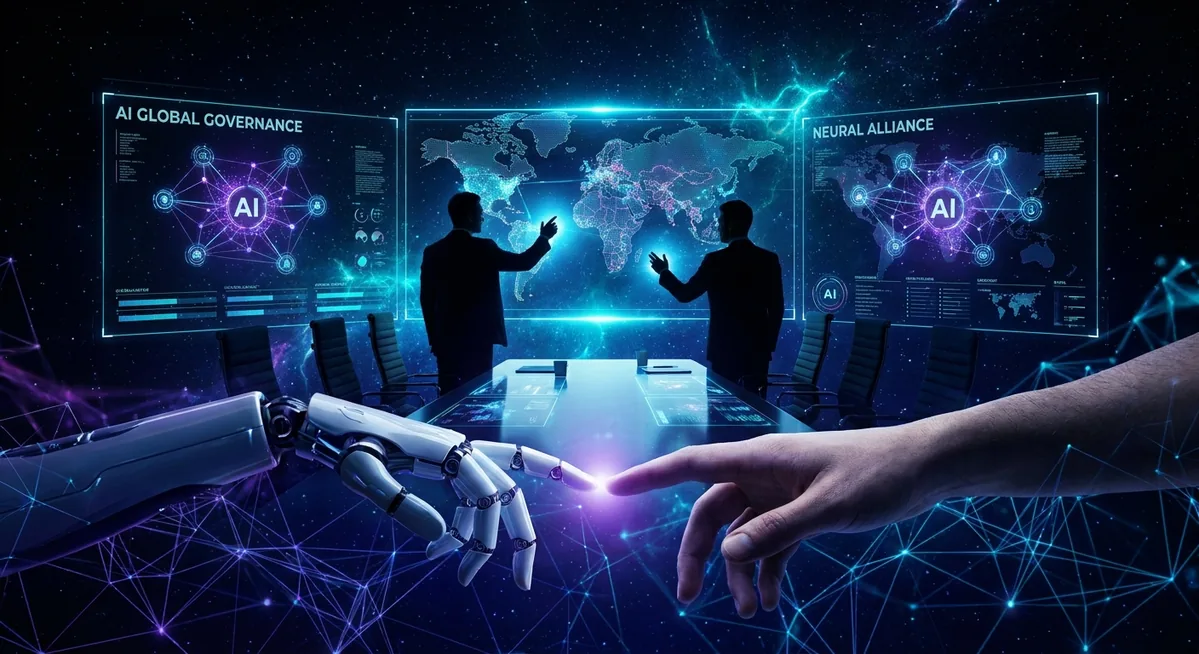
Anthropic-Trump Truce Holds, White House AI Executive Order Drops, Shazeer Confirmed at OpenAI, Shift's Robot-Training Cleaning Crews Hit NYC, and Gemini 3.5 Pro Enters Final Countdown
The week's biggest geopolitical AI saga gets an uneasy resolution as Trump backs off the Anthropic "national security" label, a landmark new Executive Order reshapes AI cybersecurity mandates, Noam Shazeer's defection to OpenAI signals an intensifying pre-IPO talent war, a startup is paying cleaners to let cameras into your home in exchange for robot training data, and Google's Gemini 3.5 Pro is running out of June to ship.
1. Trump: Anthropic "Not a Threat Now" — But Defense Production Act Still on the Table
The most consequential AI geopolitical saga of the month reached a fragile détente this week. In an exclusive interview with The Axios Show, President Trump acknowledged he had reached the point of viewing Anthropic as a national security threat "a week ago," but said the company had since come around. The crisis — triggered when the administration directed Anthropic to block all foreign nationals from accessing its most advanced models, Fable 5 and Mythos 5 — appears to have been defused through a combination of diplomatic scrambling and direct CEO engagement at the G7 summit in France, where Trump met with Dario Amodei and other tech leaders.
"Well, not now, but a week ago, maybe." — President Trump, when asked whether he viewed Anthropic or its CEO Dario Amodei as a national security threat, speaking to The Axios Show, June 19, 2026
Trump added that Amodei responded "very quickly" and "responsibly" to the export control directive. An Anthropic spokesperson told Reuters: "We are grateful to the administration for their ongoing partnership in working to get this matter resolved as quickly as possible. We remain committed to working alongside them towards our shared goals of protecting critical infrastructure and making sure the U.S. leads in AI."
Notably, Trump did not close the door on using emergency powers under the Defense Production Act against the company. "I have the power to use a lot of things," Trump said of the DPA. "But I'm not sure I have to do that." That qualifier — plus the context revealed by Wikipedia's chronicling of the dispute — is important: the administration's frustration partly stemmed from Anthropic's hiring of several Biden administration officials, including Elizabeth Kelly (former director of the AI Safety Institute), Tarun Chhabra (NSC technology and national security coordinator), and Ben Buchanan (Biden's AI adviser). The rift was political as much as technical.
The Anthropic situation isn't fully resolved — it's paused. The DPA threat remains live, foreign access to Fable 5 and Mythos 5 is still restricted, and the underlying tension between Anthropic's hiring practices and the current administration's political preferences hasn't gone away. For enterprise buyers, the lesson is clear: model access is no longer purely a commercial decision. Understand your vendor's political exposure before you build critical workflows on any single frontier model family.
Sources: Reuters · Axios · CNBC
2. White House Drops Major AI Security Executive Order — Creates Cybersecurity Clearinghouse, Upgrades National Systems
The Trump administration's June 2 Executive Order 14409, "Promoting Advanced Artificial Intelligence Innovation and Security," is now generating serious implementation activity — and its implications for enterprises with critical infrastructure exposure are substantial. The order, which was published on the White House website and dissected in detail by Foley & Lardner, positions AI security not as a brake on innovation but as its prerequisite.
The EO's centerpiece is a new AI Cybersecurity Clearinghouse — a voluntary industry-government collaboration to be stood up within 30 days of the order, coordinated by the Secretary of the Treasury alongside the NSA and CISA. It will scan for software vulnerabilities, validate them, and coordinate patch distribution across critical infrastructure sectors. Separately, the order directs the Secretary of Defense (referred to as "Secretary of War" in the order's formal text) to prioritize hardening information systems within 30 days.
"The United States continues to lead the world in Artificial Intelligence because of the enormous talent and innovation of our AI industry, and because we refuse to stifle this innovation with overly burdensome regulation." — Executive Order 14409, Section 1, June 2, 2026
The EO explicitly frames American AI dominance as an "America First" cybersecurity effort — tying national security to global AI leadership in a way that the Anthropic dispute illustrates in real time. The European Union, meanwhile, announced on June 19 that the EUROPA consortium won the Frontier AI Grand Challenge, a project to build an open-source frontier AI model in all 24 EU languages — a direct counter to U.S. export controls. The regulatory environment is fragmenting fast.
The new EO is innovation-first but security-mandatory — and the 30-day timelines are aggressive. Any company in financial services, healthcare, energy, or defense that uses AI tools and touches critical infrastructure should be actively mapping their exposure to the clearinghouse's scope. This isn't hypothetical: the Anthropic situation showed the administration will act swiftly. Voluntary participation in the clearinghouse now is far better than a forced audit later.
Sources: White House · Foley & Lardner · EU AI Act
3. Transformer Co-Author Noam Shazeer Officially Joins OpenAI Ahead of IPO
The talent war between the major AI labs hit a new high-water mark this week as Noam Shazeer — one of the eight co-authors of the 2017 "Attention Is All You Need" paper that birthed the Transformer architecture — confirmed he is joining OpenAI. The move is extraordinary on multiple levels: Shazeer had been at Google since 2000, left only briefly to co-found Character.AI, and was brought back in 2024 via a $2.7 billion acquisition deal that gave Google access to Character.AI's technology and talent. Now, the architect of modern AI is heading to Google's most formidable rival — just as OpenAI prepares for its IPO.
"Shazeer is one of the foundational minds behind modern generative AI. He co-authored the seminal 2017 paper 'Attention Is All You Need,' which introduced the Transformer architecture." — TechCrunch, June 18, 2026
Simultaneously, OpenAI hired Dean Ball — a former Trump White House AI policy official who helped publish America's AI Action Plan — to lead a new team called Strategic Futures. Ball will report directly to OpenAI's Chief Strategy Officer and will shape frontier AI policy for the company. The double hire — one technical legend, one political insider — reflects OpenAI's dual preparation for its public market debut: it needs both the credibility of world-class research leadership and the political cover of Washington relationships as it navigates IPO scrutiny and the regulatory environment emerging from EO 14409.
OpenAI also announced new enterprise usage analytics and updated spend controls on June 21, and confirmed that GPT-4.5 will be retired from ChatGPT on June 27, 2026 — a final cleanup of the model deck as the company consolidates around its GPT-5 family ahead of going public.
Shazeer's move to OpenAI is the clearest signal yet that the talent market at the frontier of AI has become winner-take-most. OpenAI can offer IPO equity, global reach, and the weight of building the models that dominate the market. For Google, losing Shazeer — twice — is a cultural wound as much as a technical one. For businesses evaluating AI partners: a company that can attract the literal inventor of the Transformer architecture has serious momentum. Factor that into your platform bets.
Sources: TechCrunch · Reuters · OpenAI
4. Shift Sends Camera-Clad Cleaners Into NYC Apartments to Train the Next Wave of Home Robots
AI startup Micro AGI — operating under the brand name Shift — is running a program that may be the most audacious physical-world AI data collection scheme yet attempted: free professional cleaning and cooking services for New York City residents, delivered by humans wearing head-mounted cameras that record every motion for robot training purposes. The BBC, Business Insider, and Crypto Briefing have all covered the story, and it's generating equal parts fascination and unease.
"In the real world, every object is slightly different, so robots will need to be trained to adapt to being in different spaces and using different items." — Bercan Kilic, founder of Shift / Micro AGI, speaking to the BBC
The model is straightforward: New Yorkers sign up through an app, cleaners show up for free with cameras attached to their caps, sessions are recorded and then anonymized before being sold to AI and robotics firms as high-quality physical task training data. The cleaners are focused specifically on dexterous hand tasks — the hardest thing to teach robots. Kilic told the BBC the goal is to collect "tonnes" of data, because unlike text on the internet, physical task data from real homes at scale essentially doesn't exist.
Shift is not alone: TechCrunch reported that XDOF, a competing startup, has partnered with UC Berkeley's AI Research lab to release what they believe is the largest high-quality robot training dataset ever assembled, dubbed ABC. The physical AI data economy is being built right now — and it's being bootstrapped on the backs of human demonstrators who are, in many cases, the very people whose jobs these robots are meant to eventually replace.
The economics here are clever and the ethical questions are real. Shift is giving away valuable services to collect data that will ultimately help train robots that can do those same services autonomously. That's a bootstrapping loop that only works if people consent — and the consent question gets thornier when you consider that data gathered in your home, even "anonymized," is inherently sensitive. For businesses watching the humanoid robotics sector: the data bottleneck is being cracked. Physical AI is moving faster than most people realize.
Sources: BBC News · Business Insider · TechCrunch
5. Anthropic Integrates Claude Into Apple's Foundation Models Framework on iOS 27 and macOS 27
Despite its White House turbulence, Anthropic continued to ship product this week. The company announced that Claude support via Apple's Foundation Models framework will be available on iOS 27, iPadOS 27, macOS 27, visionOS 27, and watchOS 27. Developers can add it to their projects by signing in with an Anthropic API key and using Apple's typed output system. Separately, Anthropic is merging its Claude Code and Design capabilities so they can work in concert — a move that, as CNET reported June 17, signals Anthropic's ambition to own the full software creation stack, not just the model inference layer.
The Guardian also reported that Anthropic released a "safe" version of Claude Mythos publicly this week, while continuing to offer the unrestricted version to approximately 200 organizations across 15+ countries in its Project Glasswing cybersecurity program — a number that has grown since the program expanded in early June. Mythos 5, despite the export controls, is continuing to reach vetted defense and security partners.
The Apple integration is strategically significant: it means Claude will be available natively across the Apple device ecosystem to developers who have an API key, positioning Anthropic alongside OpenAI in the iOS developer stack. For businesses building on Apple platforms, this opens a new path to enterprise Claude deployments that bypasses some of the infrastructure overhead of self-hosting API calls. Watch for Claude Code + Design integration to become a serious competitor to GitHub Copilot in the agentic coding space by Q3 2026.
Sources: Releasebot / Anthropic · CNET · The Guardian
6. Gemini 3.5 Pro Enters Final Countdown — 2M Token Window, Deep Think Reasoning, and a June 30 Deadline
Google's Gemini 3.5 Pro was announced at I/O on May 19, 2026, with a June general availability target. As of June 23, it has not shipped to the public — and with June 30 approaching, prediction markets on Polymarket have strong consensus around an end-of-month release. Confirmed specs include a 2-million-token context window, Deep Think extended reasoning mode, and pricing reportedly around $15 per million input tokens and $60 per million output tokens.
Meanwhile, Google announced at the Gemini API level that several video generation models will be deprecated and shut down on June 30, 2026 — a cleanup that runs parallel to the 3.5 Pro launch timeline. The Google Home smart speaker built around Gemini also shipped this week, dropping the command-phrase requirement and allowing natural conversation with the home assistant — a consumer AI milestone that previously proved difficult for Google to land at scale.
"Gemini 3.5 Pro pairs a 2M-token window with frontier-class quality — the best balance of context and capability, though as of mid-June 2026 it is still in limited rollout rather than wide availability." — The AI Rankings
A 2M token context window at frontier quality is genuinely transformative for long-document analysis, codebase-level reasoning, and multi-session agent memory. If Gemini 3.5 Pro ships at or near the advertised specs and pricing, it will reset the competitive context for enterprise deployments against OpenAI and Anthropic. The $15/$60 per million token pricing is aggressive — likely designed to win share from organizations currently anchored to GPT-5.5. Plan an evaluation now so you're ready the moment it hits GA.
Sources: Google AI Developer · GrowwingAssistant · Google Blog
7. EU Selects EUROPA Consortium for Frontier Open-Source AI Grand Challenge
The European Commission announced on June 19 that it selected the EUROPA consortium as the winner of the Frontier AI Grand Challenge — a project to build a European open-source frontier AI model in all 24 official EU languages. The timing is pointed: this announcement came the same week that the U.S. was restricting Anthropic's model access to foreign nationals, and as the Great American AI Act discussion draft continues to circulate in Congress proposing federal preemption of state AI laws.
The EU's move signals that U.S. export controls are accelerating European AI sovereignty efforts, not deterring them. An open-source model in 24 EU languages would give European businesses, governments, and developers a credible alternative to U.S. proprietary APIs — reducing dependency on systems now subject to political disruption. The model will not match GPT-5.5 or Claude Fable 5 at launch, but it doesn't need to. It needs to be good enough for government and regulated industry use cases in Europe — a very achievable bar.
The EU is playing a longer game here. The EUROPA initiative won't produce a frontier model overnight, but it seeds an institutional AI capability in Europe that is sovereign by design. For global enterprises operating across the Atlantic, this matters: within 18–24 months, European-regulated industries may have a strong preference — or legal requirement — to run models built and maintained on EU soil. Factor that into your AI vendor and architecture strategy if you have significant European exposure.
Sources: European Commission
🔭 The Bigger Picture
This week crystallized a theme that has been building all month: the AI landscape is undergoing a profound geopolitical bifurcation. The U.S. is asserting control over frontier AI exports — to the point of temporarily labeling an American AI company a national security threat. The EU is responding by funding sovereign open-source alternatives. Meanwhile, OpenAI is consolidating the world's top AI talent ahead of an IPO, Anthropic is shipping into Apple's platform stack, and an entirely new physical-AI data economy is being bootstrapped through consumer services like free apartment cleaning.
For business leaders, the signal is clear: AI is no longer just a technology decision. It is a geopolitical, regulatory, and sovereignty decision. The companies that will navigate this well are the ones who are mapping their AI dependencies now — across models, vendors, jurisdictions, and data practices — rather than waiting for the next export ban or executive order to force the conversation.
Need help navigating AI for your business?
From model strategy to regulatory compliance to agentic workflow design — our team turns these developments into actionable strategy for your organization.
Contact SEN-X →