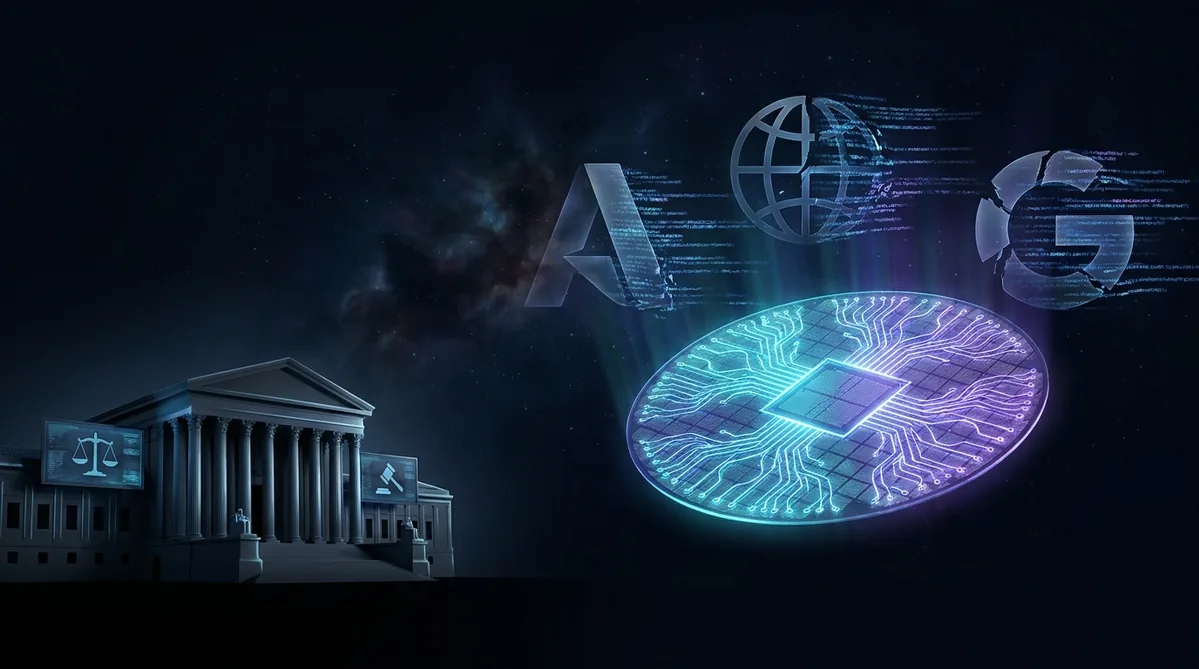
OpenAI's Jalapeño Chip, Google's Brain Drain Accelerates, Anthropic Accuses Alibaba, and the EU AI Act Countdown
OpenAI and Broadcom reveal their first custom AI processor. Google loses two more top Gemini architects to Anthropic — following Nobel laureate Jumper and transformer legend Shazeer. Anthropic escalates its geopolitical fight by accusing Alibaba of illicitly reverse-engineering Claude. Meanwhile, the EU AI Act's transparency deadline is now 38 days away, and AI companies are pouring record money into U.S. midterm elections. Here's everything that moved the needle on June 24–25, 2026.
1. OpenAI and Broadcom Unveil "Jalapeño" — Their First Custom AI Chip
Eight months after announcing a high-profile chip partnership, OpenAI and Broadcom finally have hardware to show for it. On June 24, the two companies revealed the Jalapeño, their first jointly designed AI inference processor — an LLM-optimized intelligence chip built specifically to power ChatGPT and future OpenAI services at data center scale.
The announcement, reported by both The New York Times and CNBC, represents a meaningful step in OpenAI's push to "build the full stack" rather than depend entirely on NVIDIA's GPU ecosystem. Jalapeño is described as an inference-optimized design, meaning it's built to run trained models at production throughput rather than to train new ones — the exact workload that dominates OpenAI's operational cost.
"We want to build the full stack — the model, the software, the hardware, and the data centers — because that's the only way to ensure the reliability and cost profile we need at this scale."
The chip joins a growing roster of custom AI silicon from hyperscalers and AI labs: Google's TPU line, Amazon's Trainium and Inferentia, Microsoft's Maia, and Meta's MTIA. For OpenAI — which is burning roughly $3.7 billion per quarter ahead of its highly anticipated IPO — owning more of its compute destiny is an existential economic priority, not just a technical preference.
Industry analysts note that Jalapeño's architecture is LLM-optimized for autoregressive decoding — the step-by-step token generation that makes inference expensive and latency-sensitive. Broadcom brings deep ASIC packaging and custom silicon expertise while OpenAI provides the system-level software and workload characterization.
Custom silicon is where the AI infrastructure wars are quietly being decided. Every dollar OpenAI spends on NVIDIA GPUs is a dollar of margin it doesn't keep — and NVIDIA knows this. The Jalapeño announcement signals that OpenAI is serious about vertical integration ahead of IPO, where investors will scrutinize compute cost margins with new intensity. For enterprise buyers, this doesn't change your near-term vendor decisions, but it does preview a world where AI inference costs drop faster than most projections assume — because the suppliers are becoming the producers.
Sources: The New York Times, CNBC
2. Google's Brain Drain Reaches Critical Mass: Adler and Pritzel Head to Anthropic
The defections keep coming. Bloomberg and TechCrunch reported on June 24 that Jonas Adler and Alexander Pritzel — both described as key contributors to Google's Gemini model — are leaving for Anthropic. The departures follow a cascade of high-profile exits that has rocked Google DeepMind in recent weeks.
To recap the damage: just last week, transformer co-inventor and legendary AI researcher Noam Shazeer — who had returned to Google via the $2.7 billion Character.AI acqui-hire specifically to work on Gemini — announced he was defecting to OpenAI. Days later, John Jumper, the Google DeepMind director and 2024 Nobel Prize in Chemistry co-winner for his work on AlphaFold protein prediction, announced his own departure for Anthropic.
Now Adler and Pritzel complete what looks like a coordinated talent raid on Gemini's core team. The timing is not coincidental: both OpenAI and Anthropic are in active IPO preparation, which means they can offer equity packages tied to public market valuations that Google — despite being worth over $2 trillion — struggles to match on a risk-adjusted basis for researchers who believe in the mission.
"These departures are part of a concerning trend for Google. As OpenAI and Anthropic prepare to go public, this trend could continue — it's a great time for the companies to recruit top AI talent with a promise of equity."
— TechCrunch
Google declined to comment on the record. The company has been investing aggressively in AI infrastructure and model development, but the flight of researchers who literally built Gemini raises legitimate questions about continuity for a model line that is already under competitive pressure from GPT-5 and the Claude family.
This is the most consequential AI talent story of 2026, and it's playing out faster than anyone predicted. Google still has enormous resources, infrastructure, and data advantages — but research talent is the irreplaceable input that translates all those assets into model capability. Losing Shazeer, Jumper, Adler, and Pritzel in a span of two weeks is not just optics: it risks creating a capability gap in Gemini development at exactly the moment Gemini 3.5 Pro is already running months behind its promised launch. For enterprises evaluating long-term AI vendor relationships, this is a signal worth tracking carefully.
Sources: TechCrunch, Bloomberg
3. Anthropic Accuses Alibaba of Illicitly Accessing Claude to Clone Its Capabilities
In a bombshell escalation of AI geopolitics, Anthropic has formally accused Alibaba's Qwen AI lab of illicitly accessing Claude through third-party operators in a coordinated campaign to extract its most advanced capabilities, according to a letter the company sent to U.S. senators and White House officials — first reported by Bloomberg on June 24.
According to the letter, the Qwen-linked operators specifically targeted Claude's highest-value capabilities: software engineering reasoning and agentic task execution. The implication is clear — Alibaba was using Claude API access, routed through intermediary operator accounts to avoid detection, as a systematic reverse-engineering pipeline to bootstrap Qwen's own capabilities.
This is not the first time Claude has been at the center of geopolitical controversy. Earlier this month, the Trump administration issued a directive requiring Anthropic to suspend all foreign national access to its Fable 5 and Mythos 5 models — a sweeping export control order that affects allied researchers and enterprise customers across Europe, Japan, and South Korea as well as adversaries. The NSA has since lost access to Mythos tools as a side effect of the resulting Anthropic-Trump tensions, per The New York Times.
"A campaign by operators linked to Alibaba's Qwen AI lab targeted Claude's most prized capabilities, including software engineering and agentic reasoning."
— Bloomberg, citing Anthropic's letter to senators
Alibaba had not publicly responded to the accusation as of publication time. The Qwen model family has made rapid progress in recent months, with Qwen 3 and its derivatives performing competitively on coding benchmarks — progress that critics have long attributed to knowledge distillation from frontier Western models rather than independent research advances.
The Alibaba accusation puts teeth on what has been a diffuse concern: AI capability theft through API access is a real, ongoing problem, and it's accelerating as the gap between frontier Western models and Chinese open-weight alternatives narrows suspiciously fast. For enterprise buyers, this has a direct operational implication — if you're using Claude or GPT-5 through third-party platforms or integrations, your operators may have data-access arrangements you haven't fully audited. Review your API data processing agreements now, before regulatory pressure makes it a compliance issue rather than just a security one.
Sources: Bloomberg, The New York Times
4. Anthropic's Mythos Model Broke Into Nearly All NSA Classified Systems — In Hours
The headline that rocked national security circles this week: Anthropic's Mythos model, deployed under a classified evaluation framework called Project Glasswing, identified vulnerabilities in highly sensitive U.S. government computer systems — and did it within hours, not weeks.
A U.S. official speaking on condition of anonymity told the Associated Press that Mythos had been deployed in cooperation with U.S. intelligence agencies specifically to probe for critical infrastructure vulnerabilities. Democratic Sen. Mark Warner of Virginia had referenced the exercise in a June 11 Senate hearing, attributing the disclosure to Gen. Joshua Rudd, head of the NSA and U.S. Cyber Command. Warner's stark assessment: "This tool broke into almost all of our classified systems, not in weeks but in hours."
Anthropic had released the findings via Project Glasswing as part of a broader coalition with tech companies to identify — and presumably patch — vulnerabilities before adversaries could exploit them. But the irony is sharp: the same model that demonstrated this capability has now been pulled from NSA use as a side effect of the Trump administration's contentious relationship with Anthropic. The NSA reportedly lost access to Mythos tools following the breakdown in cooperation between the company and the administration.
"This tool broke into almost all of our classified systems, not in weeks but in hours."
— Sen. Mark Warner (D-VA), quoting NSA/Cyber Command Director Gen. Joshua Rudd
The episode underscores a tension that will define AI security policy for years: the most capable AI cybersecurity tools are simultaneously the most dangerous weapons, and deploying them — even for defensive purposes — creates new risks that traditional classification frameworks weren't designed to manage.
Project Glasswing is the most significant public validation of offensive AI capability to date. The hours-not-weeks benchmark is a watershed moment for how we think about AI-accelerated cyberattacks. If Mythos can break into classified U.S. systems that quickly, nation-state adversaries with access to comparable capability — through theft, distillation, or independent development — can do the same to your organization's infrastructure. This is not a theoretical future risk: it's happening now. If your security posture hasn't been stress-tested against AI-assisted adversary tooling in the last six months, it's overdue.
Sources: CNBC / Associated Press, The New York Times
5. EU AI Act Transparency Deadline: 38 Days to Comply — Or Else
Starting August 2, 2026, organizations operating in the EU will be legally required to meet the transparency obligations set out in Article 50 of the EU AI Act. The clock is now under 40 days, and many enterprises are still scrambling to understand what's actually required.
Article 50 covers transparency requirements for AI systems that interact directly with individuals — chatbots, voice assistants, AI-generated content, and deepfake or synthetic media. Importantly, the obligations are not limited to "high-risk" AI systems: many standard commercial deployments of large language models and conversational interfaces fall within scope.
Key requirements under Article 50 include: mandatory disclosure to users when they are interacting with an AI system (chatbots and virtual agents must identify themselves), labeling requirements for AI-generated synthetic audio, image, video, and text content, and content-labeling measures that allow users to identify machine-generated material. A nuance from the law firm Sidley: the marking obligations for synthetic content placed on the market before August 2 have been delayed to December 2, 2026, per a provisional agreement reached in May — but the core disclosure rules for live deployments are not delayed.
"Organisations should continue their compliance preparations notwithstanding the broader discussions regarding the timing of other EU AI Act requirements, albeit remain mindful of the impact of the phased implementation dates."
— Sidley Austin, Data Matters Privacy Blog
Separately, Colorado's AI law — which requires developers of "high-risk" AI systems to conduct impact assessments, disclose material risks, and implement risk management programs — takes effect June 30, 2026, making it the first U.S. state AI regulation with real compliance teeth to go live this summer.
August 2 is close enough that "we'll get to it" is no longer a viable posture for any organization with EU users. The practical priority for most companies is straightforward: if you have any customer-facing AI chat, voice, or content-generation system accessible in the EU, you need a disclosure mechanism live before August 2. This doesn't require a massive compliance overhaul — it often means a UI banner, a disclosed system persona name, or a terms update. The companies that will get caught are the ones running AI features quietly without documentation. Start the audit now.
Sources: Sidley Austin / Data Matters, AI Laws by State
6. AI Companies Are Pouring Record Money Into U.S. Midterm Elections
A new NPR analysis reveals that the AI industry's political spending has reached unprecedented levels ahead of the 2026 midterm elections, with OpenAI- and Anthropic-aligned groups backing opposing candidates and super PACs in contested races.
The numbers are striking: Anthropic more than quadrupled its lobbying spending to $1.56 million in Q1 2026 from a year ago, while OpenAI nearly doubled its outlays to $1.02 million. Beyond direct lobbying, both companies are backing super PACs with divergent regulatory visions — OpenAI-aligned groups supporting candidates who favor permissive federal preemption of state AI laws, while Anthropic-backed PACs counter with support for regulatory guardrails and safety oversight mandates.
The proxy political battle directly mirrors the companies' divergent strategic interests: OpenAI, heading toward IPO, benefits most from regulatory clarity and the removal of state-by-state compliance overhead. Anthropic, with a stated safety mission and a more complex relationship with the Trump administration over the Fable 5 export ban, is playing a longer game — building political capital with pro-regulation Democrats and moderate Republicans who may shape the next wave of federal AI legislation.
"The numbers are likely to rise this year. Anthropic more than quadrupled its lobbying spending to $1.56 million in the first quarter from a year ago, while OpenAI nearly doubled its outlays to $1.02 million."
— NPR / Issue One analysis
The political spending comes as Congress advances the Great American AI Act of 2026 — a sweeping federal framework that would preempt some state AI laws, establish a federal AI safety clearinghouse, and create voluntary pre-release review mechanisms for frontier models.
When AI companies start picking political sides in midterm elections, the technology has officially left the lab and entered the infrastructure of democracy — which changes the risk calculus for every enterprise that depends on these platforms. The regulatory environment for AI in 2027 will be shaped by who wins in November 2026. That means your AI strategy needs a policy dimension: which regulatory outcome benefits your industry, which compliance overhead can you absorb, and how exposed are you if the political winds shift? These aren't abstract questions — they're vendor selection and contract structure decisions you should be making now.
Sources: NPR
7. GPT-4.5 Sunsets June 27, o3 Follows in August — OpenAI Clears the Model Deck Before IPO
OpenAI is in active model consolidation mode: GPT-4.5 will be retired from ChatGPT on June 27, 2026 — just two days away — following a 30-day sunset period. OpenAI o3 will follow on August 26, 2026, after a 90-day wind-down. Both models are being displaced by GPT-5 and its family of variants, which have become the new default across OpenAI's consumer and API offerings.
The sunset schedule is consistent with OpenAI's IPO preparation posture: simplifying the model portfolio reduces operational complexity, developer confusion, and the support overhead that comes with maintaining divergent capability tiers. OpenAI's approach echoes what Apple did in the hardware space — pruning the SKU count to focus developer and user attention on a cleaner, more profitable product line.
Meanwhile, OpenAI published a human-interest story on June 24 highlighting how GPT-5 helped immunologist Derya Unutmaz solve a three-year-old scientific mystery — part of a clear effort to build a pre-IPO narrative around GPT-5 as a transformative research partner, not just a productivity tool. The company's Daybreak security initiative, announced June 22, also shipped "Patch the Planet" — an open source maintainer support program that positions OpenAI as an active contributor to software security infrastructure.
If you have production workloads on GPT-4.5 or o3, the clock is real. GPT-4.5 goes dark in 48 hours; o3 disappears in August. Migration to GPT-5 equivalents is mostly straightforward, but edge cases in structured output, tool calling behavior, and context handling can surface unexpectedly at scale. Test your migration in staging now rather than discovering the failure mode in production after the sunset date. The broader pattern — OpenAI clearing its model portfolio before IPO — suggests the company is optimizing its story for Wall Street as much as for developers.
Sources: OpenAI News, ChatGPT Release Notes
Why This Week Matters
The through-line across today's stories is consolidation under pressure. OpenAI is consolidating its chip supply chain, its model portfolio, and its political narrative ahead of IPO. Anthropic is consolidating its security posture, its government relationships, and its talent acquisition (at Google's expense). Google is scrambling to consolidate a research team that is hemorrhaging at the worst possible moment. And regulators — in Brussels and Colorado and Capitol Hill — are consolidating their authority over an industry that has been operating largely without guardrails for the better part of a decade. The AI industry is entering its "grown-up" phase, where infrastructure, compliance, and political strategy matter as much as model benchmarks. Is your organization ready for that version of AI?
Need help navigating AI for your business?
From EU AI Act compliance to AI infrastructure strategy, our team turns these developments into actionable plans.
Contact SEN-X →