Google Loses the AlphaFold Team, White House Gates GPT-5.6, China's Z.ai Closes the Gap, and SpaceX Bets on Orbital Compute
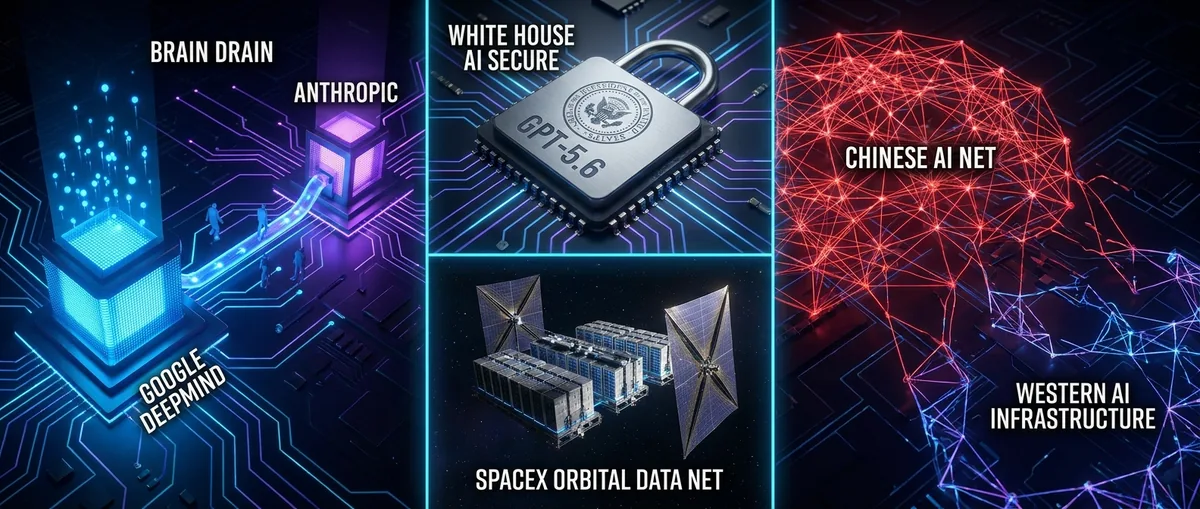
In the span of one week, four Nobel Prize-adjacent researchers walked out of Google DeepMind's doors for Anthropic — erasing $270 billion in Alphabet market cap. Meanwhile the White House quietly moved to control who gets access to GPT-5.6, China's Z.ai released a model that rivals Claude and GPT at a fraction of the price, and SpaceX signed a $6.3 billion deal to become the compute provider of record for an open-source AI startup. Friday, June 26, 2026.
1. Google's AlphaFold Team Is Now Almost Entirely at Anthropic — and Alphabet Lost $270B
The AI talent war reached a historic inflection point this week. In the span of seven days, Google DeepMind lost four of its most consequential researchers to Anthropic: John Jumper (2024 Nobel Chemistry laureate, AlphaFold lead), Jonas Adler (AI coding and AlphaFold), Alexander Pritzel (pretraining and AlphaFold), and Arthur Conmy (Gemini 2.5 and AI safety research). A fifth name loomed large: Noam Shazeer, Transformer co-author and Gemini co-lead, who departed for OpenAI the week before.
The market responded with extraordinary severity. Alphabet's stock dropped across two consecutive trading sessions, wiping more than $270 billion in market capitalization — the largest talent-driven market loss in tech history.
"DeepMind engineers are now 11x more likely to leave for Anthropic than the reverse. The gravitational center of AI research has shifted."
— AIToolsRecap analysis, June 26, 2026
Each departure stings for a specific reason. Jumper and the AlphaFold trio weren't just scientists — they authored what may be the most significant scientific AI achievement of the decade, one that earned a Nobel Prize. Adler worked directly on Google's AI coding efforts, the same product category where Anthropic's Claude Code and OpenAI's Codex are now battling for enterprise share. Pritzel's pretraining expertise represents a foundational blow: pretraining is where next-generation model capability ceilings are set. And Conmy, who announced on X that he was joining Anthropic specifically "to work on AI safety," signals that Anthropic's positioning as the safety-serious frontier lab is becoming a genuine talent magnet.
Google hasn't gone quietly. The company is reportedly expanding its "midtraining" strike team in direct response to the Anthropic gap, and Gemini 3.5 Pro has been pushed to July for "final adjustments." But the question analysts are asking is no longer about a single model release — it's whether Google can retain the pretraining DNA needed to build future generations of Gemini at all.
This is the most consequential talent event in AI since OpenAI's founding team cohered around Sam Altman in 2019. The fact that it happened at the research layer — not product — means the effects will compound over 18–36 month model development cycles. Enterprises evaluating long-term platform bets should watch whether Google can stabilize its pretraining org before Gemini 4.0 development enters its critical phase. Anthropic, by contrast, now has arguably the deepest scientific roster of any AI lab. That changes the IPO narrative considerably.
2. White House Restricts GPT-5.6 to Government-Approved Partners Only
In a significant shift in U.S. AI policy posture, the Trump administration has asked OpenAI to limit the initial release of its next flagship model — GPT-5.6 — to a small, curated group of government-approved partners rather than making it broadly available. The request came from the White House in consultation with the Office of Science and Technology Policy (OSTP) and the Office of the National Cyber Director (ONCD), according to multiple reports from Politico, CNN, and Axios.
"OpenAI did not initially plan to restrict the release of the general-use GPT-5.6 model, but changed course at the White House's request and in consultation with the Office of Science and Technology Policy and the Office of the National Cyber Director."
— Politico, June 25, 2026
This marks a notable evolution in how the administration is approaching frontier AI releases. Earlier this year, the White House signed a broad AI Executive Order focused on voluntary commitments and reducing regulatory friction. The GPT-5.6 restriction represents a harder edge: the government is now actively curating who gets access to the most powerful models before public release, citing security concerns about advanced capabilities.
The move echoes — and arguably formalizes — the dynamic already playing out with Anthropic's Claude Mythos and Fable 5 series, where government access was mandated and foreign access was cut off. The pattern is becoming clear: as models grow more capable, the administration's appetite for controlling the distribution funnel grows with it.
For enterprise buyers, the practical implication is immediate: if your organization is not already in a pre-approved government partnership track, access to GPT-5.6 may require a formal qualification process that doesn't yet exist in published form. Tech policy watchers are already calling this a de facto "AI access tier" — a structural change that could bifurcate the frontier model market into government-cleared and general-availability stacks.
The "AI access tier" structure is the most significant policy development of the year so far — more impactful in practice than the EU AI Act's transparency rules hitting in August. Businesses building on frontier OpenAI models need to understand that release timelines and feature access are now partly determined by Washington, not just by OpenAI's roadmap. Organizations in regulated industries (defense, critical infrastructure, finance) should be proactively engaging with OpenAI on their qualification status. Those outside that orbit should build flexible architectures that can swap models — the competitive landscape for general-availability frontier AI is about to get much more interesting.
3. Anthropic Accuses Alibaba's Qwen Lab of Mass Illicit Claude Access
Anthropic dropped a bombshell in letters to several U.S. senators and White House officials this week: the company accuses Alibaba's Qwen AI lab of orchestrating a systematic campaign to illicitly access Claude's most advanced capabilities at scale. According to Bloomberg's reporting, the campaign involved approximately 25,000 fraudulent accounts generating more than 28.8 million exchanges with Claude between April 22 and June 5, 2026.
The targeted capabilities were precisely those where Claude Mythos Preview excels — software engineering, agentic reasoning, and complex multi-step task execution — suggesting the campaign was designed to study and potentially replicate Claude's most differentiating behaviors. Anthropic shut down its two most powerful systems after an unexpected demand from the U.S. government to cut access, a sequence of events that now appears connected to this intelligence.
"A campaign by operators linked to Alibaba's Qwen AI lab targeted Claude's most prized capabilities, including software engineering and agentic reasoning."
— Bloomberg, citing Anthropic's letter to U.S. senators, June 24, 2026
The scale of the alleged operation — 28.8 million synthetic interactions over 44 days — isn't just an abuse-of-terms-of-service story. It's a corporate intelligence story with national security dimensions. The implication is that Alibaba-linked actors may have been using Claude to generate training data or behavioral maps for Qwen, using Anthropic's own infrastructure against it. Anthropic's decision to escalate directly to the Senate and White House rather than handle it quietly through legal channels underscores how seriously it views the incident.
The timing also matters: this disclosure came days before Anthropic's highly anticipated Science Event on June 30, where the company is expected to announce its next model generation. The narrative setup — Anthropic as both a frontier capability lab and a national security partner under threat from state-linked actors — serves to reinforce its positioning as the responsible, government-aligned choice ahead of what many expect will be an IPO announcement window.
The Alibaba-Qwen allegation is a preview of what AI model security will look like at scale. As frontier models become strategically differentiating assets, systematic extraction attempts — through API abuse, synthetic account farms, or prompt-based capability probing — will become standard competitive intelligence practice from state-adjacent actors. Anthropic's disclosure is unusual in its transparency and escalation path. Enterprise customers should read this as signal: API access to frontier models is a strategic asset with adversarial pressure attached, and security hygiene around AI API usage is no longer optional.
4. China's Z.ai Releases GLM-5.2 — Frontier Performance at One-Tenth the Price
China's AI labs are no longer playing catch-up. Z.ai — the global-facing brand of Zhipu AI, one of China's most-funded AI startups — released its flagship GLM-5.2 model this week, and the benchmarks are turning heads across the industry. The model approaches the performance of Claude Sonnet and GPT-5.5 on standard evaluations including coding, agentic task completion, and complex reasoning — while charging roughly one-tenth the price per token.
"This model is comparable to the top closed models. It's the first time that an open-source model really delivers very solid coding and agent performance that can compare with the leading proprietary AI companies like Anthropic and OpenAI."
— Zhipu AI CEO, cited by Reuters, June 25, 2026
Six Chinese AI models now sit on the top tiers of independent benchmark leaderboards, according to the New York Times' analysis. The convergence isn't just a story about open-source catching closed — it's about the fundamental economics of frontier AI shifting. Western labs have justified high API prices partly on the assumption that their models are meaningfully superior. That premium is now under direct pressure.
Z.ai's timing is strategic. As U.S. export controls tighten and the White House moves to gate GPT-5.6, international developers and enterprises are actively evaluating alternatives. A Chinese model with frontier-adjacent performance and a fraction of the cost is a compelling offer for the 80% of the global developer market that doesn't sit inside the U.S. government's preferred ecosystem. GLM-5.2 specifically targets software engineering and agentic workflows — the exact use cases driving enterprise AI budgets in 2026.
The "frontier premium" that Western AI labs have charged for the past three years is eroding faster than most enterprise buyers expected. GLM-5.2 joining the top tier of coding and agentic benchmarks at one-tenth the price of comparable U.S. models means procurement conversations are about to get complicated. Organizations building AI-powered products should be benchmarking Chinese models against their specific use cases now — not as a political statement, but as standard vendor evaluation. The compliance and data-residency considerations are real, but so is the cost delta.
5. SpaceX Signs $6.3B Deal with Reflection AI — and Eyes the Orbital Compute Frontier
SpaceX's transformation from a rocket company into a major AI infrastructure player accelerated sharply this week. The company signed a computing deal worth up to $6.3 billion with Reflection AI, an open-source AI startup, granting access to Nvidia GB300 chips at Musk's Colossus 2 data center in Memphis, Tennessee. Reflection will pay $150 million per month starting July 1, 2026 — one of the largest single compute contracts in AI history.
"SpaceX has signed a major computing power deal with Reflection AI for access to Nvidia GB300 chips at Elon Musk's Colossus 2 data center. The open-source AI startup will pay Musk's company $150 million per month starting July 1, 2026."
— CNBC, June 22, 2026
But the terrestrial compute business is just the near-term chapter. SpaceX has now publicly detailed plans for what Elon Musk calls "AI Sat Mini" prototypes — orbital AI data centers powered by solar energy and connected via laser communication links borrowed from the Starlink program. Production scaling is targeted for late 2026. The concept sidesteps the two biggest bottlenecks for ground-based AI compute: land permitting battles and grid power constraints. The public may not want AI data centers in their backyards, but they can't vote against orbit.
The Reflection deal also establishes SpaceX — not just AWS, Azure, or Google Cloud — as a tier-one AI compute provider. For open-source AI labs especially, SpaceX's infrastructure is becoming an attractive option: no hyperscaler restrictions on model type, Musk-aligned governance, and access to Nvidia's latest silicon without a multi-year waitlist.
SpaceX as a compute infrastructure provider is a legitimately new market dynamic. Enterprises evaluating cloud strategy should start tracking SpaceX's Colossus capacity alongside the hyperscalers. For AI-native companies building open-source or less restriction-tolerant workloads, SpaceX offers an interesting alternative to AWS and Azure. The orbital angle is longer-dated but technically credible — Starlink's laser mesh already operates at meaningful scale. The compute geography question ("where does AI live?") may have a genuinely new answer in 24 months.
6. OpenAI Leans Toward Delaying IPO to 2027 — and GPT-4.5 Sunset Is Days Away
OpenAI's much-anticipated initial public offering may be pushed back to 2027, according to three people involved in the company's deliberations cited by the New York Times. The shift reflects both the complexity of its ongoing corporate restructuring — converting from a capped-profit model to a for-profit entity — and broader uncertainty about valuation timing in a market where the competitive landscape is shifting weekly.
Meanwhile, the company confirmed two immediate model lifecycle changes: GPT-4.5 will be retired from ChatGPT on June 27, 2026 — just one day from now — following a 30-day sunset period. OpenAI o3 is also on a longer countdown, set for retirement from ChatGPT on August 26, 2026. Both retirements accelerate the company's consolidation toward its GPT-5 model family as the primary consumer and enterprise stack.
"OpenAI is leaning toward holding off its initial public offering until next year, three people involved in the company's deliberations said, a turnabout that punctuates the uncertain future for fast-rising artificial intelligence giants."
— New York Times, June 25, 2026
The IPO delay — if confirmed — would put OpenAI in an unusual competitive position relative to Anthropic, which has been progressing its own IPO preparation more aggressively. Anthropic's June 30 Science Event is widely expected to include a model announcement and potentially a funding or corporate structure update. An OpenAI IPO delay could mean Anthropic reaches public markets first — a remarkable reversal of conventional wisdom from just six months ago.
The IPO delay signals that OpenAI's board is prioritizing structural clarity over speed-to-market. The corporate conversion from capped-profit to for-profit is genuinely complex, and pricing an S-1 while simultaneously negotiating that restructuring — and managing White House relationships around GPT-5.6 release restrictions — is a difficult lift. For enterprise procurement teams, the IPO timeline matters less than it might seem: OpenAI's commercial products are selling regardless. The more interesting dynamic is whether Anthropic's June 30 event changes the competitive narrative ahead of any OpenAI capital markets move.
7. EU AI Act Transparency Obligations Hit August 2 — 38 Days to Compliance
With just over five weeks remaining, organizations operating in the EU are entering the final compliance stretch for Article 50 of the EU AI Act. Starting August 2, 2026, any organization deploying AI systems that interact with humans — chatbots, AI-generated content tools, emotion-recognition systems, and deep-fake generation platforms — must implement transparency disclosures informing users they are interacting with AI.
The Article 50 obligations are narrower than the Act's full framework (which applies in phases through 2027), but they are immediate and enforceable. Regulators across Germany, France, and the Netherlands have already signaled active enforcement intent. Companies that have relied on voluntary labeling or informal disclosures will need formalized processes: technical markers for AI-generated content, user-facing disclosures at the point of interaction, and record-keeping to demonstrate compliance.
Notably, the retail industry has pushed back on one specific element: an EU retail trade association argued this week that AI-generated advertising should be exempt from the transparency requirements, arguing that disclosure mandates would disadvantage European advertisers relative to competitors in markets without such rules. Regulators have not signaled they will accommodate that carve-out.
August 2 is not a soft deadline. The EU AI Act is the first major AI regulation with real enforcement infrastructure behind it, and member state regulators are competing to demonstrate rigor. Any business with EU operations that deploys AI in customer-facing contexts — marketing personalization, chatbots, content generation — needs a compliance audit completed in the next two weeks to leave time for remediation. The good news: Article 50 compliance is achievable. The bad news: many organizations haven't started. The cost of a first-mover enforcement action — regulatory fine plus brand damage — significantly exceeds the cost of compliance.
Why This Week's Stories Connect
The thread running through every story this week is power concentration and its disruption. Google's talent exodus to Anthropic disrupts the assumption that the incumbent hyperscaler automatically wins the talent war. The White House gating GPT-5.6 disrupts the assumption that frontier models flow freely to the market. Z.ai's GLM-5.2 disrupts the pricing power of Western AI labs. SpaceX entering compute disrupts the hyperscaler oligopoly. And the EU AI Act disrupts the assumption that AI can be deployed without regulatory accountability.
For enterprise leaders, the operating environment is shifting from "which model is best" to "which ecosystem do I belong to, what are its constraints, and how do I stay flexible enough to move?" That's a strategy question, not a product question. The organizations that understand this shift now will be building on the right foundations twelve months from today.
Need help navigating AI for your business?
Our team turns these developments into actionable strategy — from platform selection to compliance readiness to competitive positioning.
Contact SEN-X →