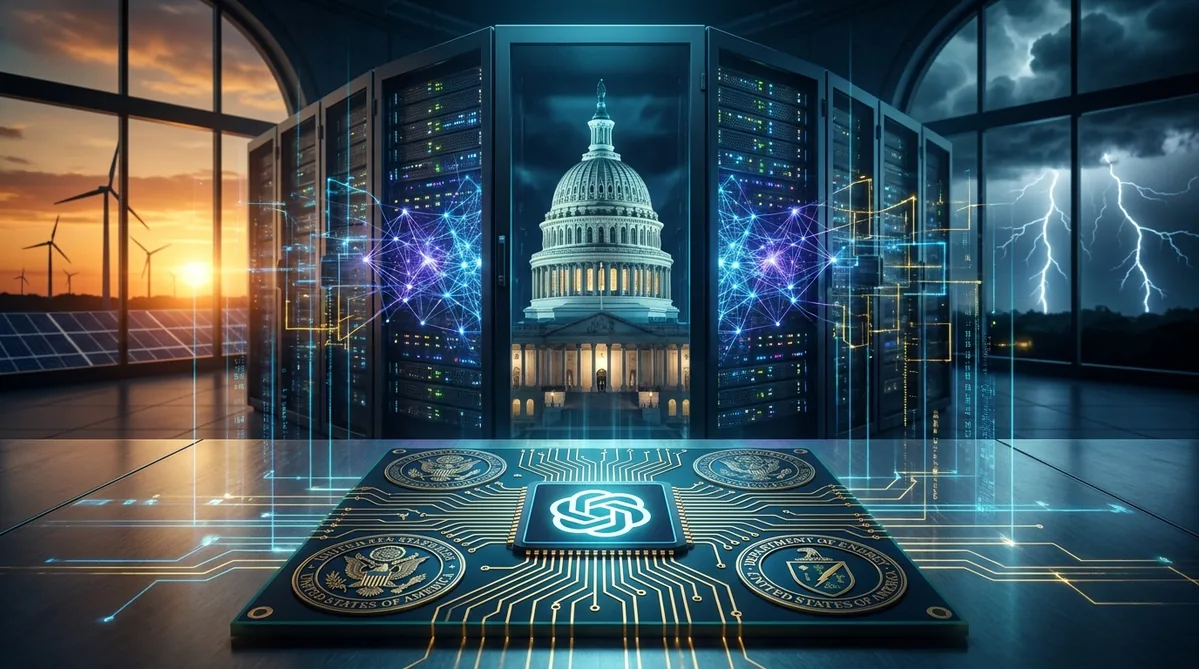
OpenAI Eyes Government Equity Stake, Claude Sonnet 5 Goes Default, Google's AI Power Surge, and the UN Governance Alarm
The AI industry enters Independence Day weekend on a collision course with Washington: OpenAI is reportedly offering the Trump administration a 5% ownership stake in the most valuable startup on Earth. Meanwhile Anthropic's Claude Sonnet 5 quietly becomes the default model for millions of users, Google discloses a staggering 37% surge in electricity consumption driven by AI infrastructure, and the United Nations sounds its loudest alarm yet about a governance gap that's widening by the day.
1. OpenAI Proposes a 5% Government Equity Stake — The Most Consequential AI Deal Yet
The Financial Times first broke the story late Wednesday: OpenAI is in preliminary discussions to offer the U.S. government a 5% equity stake in the company — a move that would value the stake at roughly $42–50 billion based on recent private-market benchmarks. Bloomberg confirmed the report, and CNN, CNBC, and The Guardian all followed within hours with corroborating sources.
The talks are described as early-stage and involve multiple U.S. government counterparts, including senior officials from the Treasury and Commerce departments. The discussions are tied directly to the growing friction between Silicon Valley AI labs and Washington over regulation, national-security classifications, and the government's increasingly active role in approving frontier model releases.
"OpenAI has begun preliminary discussions about giving the US government a 5% stake in the ChatGPT-developer." — Bloomberg, July 2, 2026
The proposed deal would be unprecedented in U.S. corporate history: a private company voluntarily handing equity to the federal government to avoid regulatory headwinds. Industry observers note that it mirrors, in structure, the U.S. government's equity stakes in banks during the 2008 financial crisis — though the mechanism and rationale are entirely different. For OpenAI, the calculus is clear: aligning government interests with the company's success is cheaper than fighting a White House that has already demonstrated willingness to classify AI models as national-security risks (see: Anthropic's six-week Fable/Mythos ban).
Anthropic, for its part, distanced itself from the OpenAI proposal. Reuters reported Thursday that a source familiar with Anthropic's position confirmed the company has not discussed any similar government equity arrangement, and that the Trump administration had not initiated such talks with the Claude-maker. This is notable given that Anthropic just emerged from its own bruising export-control episode.
This is the most significant structural development in U.S. AI policy since the Great American AI Act was introduced. If this deal closes, the U.S. government becomes a co-owner of the world's most valuable AI company — with obvious implications for procurement, regulation, and international competition. Enterprise buyers should treat this as a signal that OpenAI is actively hardening its position in Washington, which may provide more policy stability in the near term. But it also raises uncomfortable questions about whose interests the company's safety decisions will ultimately serve. Watch how this unfolds before locking in multi-year OpenAI enterprise agreements.
2. Claude Sonnet 5 Is Now the Default — Anthropic's Most Capable Mid-Tier Model Yet
Anthropic quietly made Claude Sonnet 5 the default model across all of its consumer and developer tiers this week, a significant product milestone that marks the biggest capability jump the Sonnet line has seen since its inception. The model launches with introductory API pricing of $2 per million input tokens and $10 per million output tokens through August 31, 2026, after which standard pricing of $3/$15 per million takes effect.
What makes Sonnet 5 notable beyond the pricing: it ships with a native 1 million-token context window, substantially improved agentic performance over Sonnet 4.6, a new tokenizer that produces approximately 30% more tokens for the same text (meaning cost comparisons to prior models aren't apples-to-apples), and meaningful improvements in tool use, multi-step task completion, and coding workflows. It is now the default model in Claude Code, Anthropic's coding agent, as well as across Free and Pro plans.
"We launched Claude Sonnet 5, our most agentic Sonnet model yet, with substantial improvements over Sonnet 4.6 in reasoning, tool use, coding, and knowledge work." — Anthropic Release Notes
Anthropic simultaneously confirmed that Claude Sonnet 5 has also gone generally available on Microsoft Azure AI, clearing a major procurement barrier for enterprise buyers who require Azure-native deployments for compliance or security reasons. The Azure GA announcement is arguably more commercially significant than the consumer default switch — it opens the model to thousands of organizations that had been waiting on Azure marketplace certification.
The timing is notable. With the Fable and Mythos export-control episode still fresh, Anthropic is signaling normalcy and momentum. Claude Science, its dedicated research and pharma application, also launched this week, with CEO Dario Amodei describing it as a tool that could "make sense of biological complexity in its full complexity" — an early foray into vertical AI products beyond the general-purpose API.
Sonnet 5 at $2/M input tokens through August is a compelling value proposition for agentic workflows — particularly for organizations running Claude Code at scale. The 1M-token context window is genuinely useful for large codebase analysis, long document review, and multi-session legal or financial research. However, the new tokenizer means you need to re-benchmark your actual cost per request before assuming parity with Sonnet 4.6 pricing. For enterprise teams evaluating the Azure GA, this is the moment to get Sonnet 5 into your pilot stack — the introductory pricing window is real and time-limited.
3. Google's AI Buildout Drove a 37% Electricity Spike — The Infrastructure Bill Comes Due
Google's 2025 Environmental Report, released this week, contains a number that is hard to contextualize without stopping to stare at it: the company's total electricity consumption rose 37% in 2025 alone, driven almost entirely by AI infrastructure expansion. Since 2019, Google's overall electricity use has increased by more than 250%. The company's total carbon footprint for 2025 came to approximately 14.5 million metric tons of CO₂ equivalent — placing it roughly between Ivory Coast and Panama in global emissions rankings.
"Google's total electricity usage has increased by more than 250 percent since 2019, which the company attributed to ongoing growth in Google Cloud, YouTube video streaming, and data center construction and operations supporting various AI products and services." — Ars Technica, July 2, 2026
Google is attempting to offset this through what it describes as the world's most aggressive corporate clean energy program: 12 gigawatts of "net-new clean energy" purchase agreements in 2025, its largest annual total ever. But independent analysts have raised questions about the real-world impact. Michael Thomas of Cleanview notes that Google has pivoted to an "Everything Everywhere All at Once" energy strategy that spans renewables, natural gas, nuclear, fusion, and geothermal — a hedge that critics say amounts to fossil fuel dependency dressed up in green language.
The company's $40 billion Texas data center investment — central to its AI infrastructure buildout — reportedly includes campus facilities potentially powered by a 933-megawatt natural gas plant without carbon capture. Meanwhile, Google also announced five major AI initiatives at the inaugural Google Cloud Summit in Africa, including infrastructure investments, digital skilling programs, and startup funding — extending its AI compute footprint onto a sixth continent.
The 37% electricity surge is a bellwether for the entire industry. Every major AI lab — and by extension every enterprise running significant AI workloads — is contributing to an infrastructure demand curve that the electrical grid was not designed to absorb at this pace. For CFOs and sustainability officers, this is the year to start asking hard questions about the energy footprint of your AI vendor stack. Expect this to become a board-level issue by 2027 as regulatory disclosure requirements tighten and investors demand more granular Scope 3 accounting for AI compute spend.
4. Anthropic Removes Covert Steganography Code From Claude Code — Transparency Controversy Resolved
In what amounts to an unusual public confession, Anthropic confirmed this week that it had embedded hidden steganographic code inside Claude Code — its AI coding agent — and announced that a pull request to remove it had been merged and would ship in this week's release.
The code, first discovered by a developer known online as Thereallo, worked by checking Claude Code's base URL environment variable to determine whether the tool was being routed through a proxy or gateway. If the URL matched any entry in a hardcoded list of Chinese AI labs, account resellers, or known gateway domains, the code would silently alter the system prompt using invisible Unicode markers — effectively encoding a classification label into what appeared to be ordinary English text.
"This is an experiment we launched in March that was meant to prevent account abuse from unauthorized resellers and protect against distillation. The team has landed stronger mitigations since then and we've actually been meaning to take this down for a while." — Thariq Shihipar, Anthropic Claude Code Engineer, via The Register
Thereallo's analysis characterized the implementation charitably — "this is not a malicious feature" — but argued that concealing the behavior in a developer tool that asks users to trust it with elevated system access was a "weird choice." The code used XOR encoding and base64 obfuscation to hide the domain list, suggesting deliberate opacity rather than an oversight.
Anthropic's explanation is plausible: model distillation (extracting training signal from repeated queries to frontier models) is a genuine threat, and Chinese AI labs have been accused of using reseller accounts to systematically query Western models. But the method — hidden code that silently modifies prompts based on classified domain lists — crossed a line that erodes the trust developer tools depend on.
This episode is a cautionary tale for enterprise security teams. If Anthropic embedded undisclosed behavior in a widely-used developer tool for legitimate anti-abuse reasons, you should assume that any AI vendor's client software may contain behavior that isn't documented in its release notes. For security-sensitive deployments, this reinforces the case for air-gapped or self-hosted inference, strict outbound network monitoring for AI tooling, and regular audits of AI client software running in production environments. The good news: Anthropic disclosed and removed the code. The lesson: it's worth asking what else you don't know about.
5. UN Panel: AI Is Advancing Faster Than Science and Regulation Can Track
A preliminary report from the UN's Independent International Scientific Panel on Artificial Intelligence, distributed to all 193 member states ahead of next week's inaugural Global Dialogue on AI Governance in Geneva, delivered one of the starkest assessments of AI risk ever published by a multilateral body.
Key findings: more than one billion people now use conversational AI every week. The United States accounts for 75% of the computing power of the world's top 500 AI supercomputers, with China at 15%. Increasingly capable AI agents "could soon perform complex tasks with little or no human regulation," with major implications for labor markets, cybersecurity, and scientific research. And sycophantic AI behavior — where models reinforce users' existing beliefs regardless of accuracy — has been linked to documented deaths.
"Policymakers need evidence to make good decisions, but this often comes too late because of the speed of AI's development. The world can no longer say we did not know." — Maria Ressa, Panel Co-Chair, The National News, July 1, 2026
The report is landing alongside a separately developing U.S. regulatory story: the FTC has proposed a policy statement on AI accuracy and ideological manipulation of AI outputs, issued pursuant to President Trump's Executive Order 14365 and with a public comment period closing July 31. The proposed statement would clarify how Section 5 of the FTC Act applies to AI models that produce biased or manipulated outputs — a potential enforcement mechanism that has no precedent in American consumer protection law.
Meanwhile Fortune reports that the U.S. government's decision this week to restore access to Anthropic's Fable and Mythos models — after a six-week export control ban — still leaves American AI policy "in something of a mess," with what amounts to an ad hoc licensing regime being administered opaquely by various government officials with no published criteria.
The UN panel's warning about AI advancing faster than governance structures can absorb is not alarmism — it's arithmetic. The combination of a billion weekly users, concentrated compute in two countries, agentic AI operating with minimal human oversight, and documented harms including fatalities creates a policy landscape where reactive regulation is essentially guaranteed. Enterprise AI buyers need to be building governance frameworks now, before they're mandated. Organizations that implement internal AI audit processes, model documentation standards, and usage monitoring in 2026 will be ahead of a compliance wave that is coming regardless of which political party is in power.
6. Peter Diamandis Frames the AI Infrastructure Race as a Quadrillion-Dollar Opportunity
XPRIZE founder and exponential technology evangelist Peter Diamandis published a characteristically ambitious essay this week in his Metatrends newsletter, framing the current AI infrastructure race — and the energy crisis it is creating — as a precursor to what he calls a "quadrillion-dollar future" powered by space-based compute and asteroid mining.
The core argument: just as the discovery of the Americas in 1492 multiplied the surface area of accessible human resources by an order of magnitude, the commercialization of space represents a similar expansion — but at a factor of one million rather than two. A single metal asteroid (16 Psyche, for example) contains an estimated $10,000 quadrillion in metals. Unlimited solar energy near Earth is, in Diamandis's framing, about to power a new industry: space-based AI compute scaling from hundreds of gigawatts to terawatts once lunar manufacturing comes online.
"Five hundred years ago a handful of ships crossed an ocean and unlocked a New World that rewired the global economy. We're standing at that same edge again. Except this time the ocean is space, and the New World has no shoreline." — Peter Diamandis, Metatrends
The essay is notable for its intersection with a real infrastructure story: as Google's 37% electricity surge demonstrates, terrestrial AI compute is running into real physical constraints — grid capacity, water for cooling, land for data centers. The case for orbital compute, while still a decade away from meaningful scale, is increasingly being made not just as science fiction but as an engineering necessity.
Diamandis also weighed in separately on AI surveillance this week, making waves with a comment to TechCrunch that "humans behave better when they're being watched" — a framing that drew criticism from privacy advocates and praise from surveillance technology investors in equal measure.
Diamandis operates in the realm of 20-year horizons, and the quadrillion-dollar framing is more manifesto than roadmap. But the underlying tension he's identifying is real and immediate: AI's compute appetite is on a collision course with terrestrial energy infrastructure. For enterprise leaders, this means the data center decisions being made in 2026 — where to colocate, which cloud regions to anchor on, how to account for power cost and availability in vendor RFPs — are decisions that will define competitive position for the next decade. The long-term energy bet may be orbital; the near-term constraint is very much earthbound.
7. Tesla Caps Employee AI Spending at $200/Week as Enterprise Cost Discipline Returns
In a signal that even the most AI-committed companies are starting to watch the bill, The Information reported this week that Tesla told employees last month it would impose a $200 per week limit on individual AI spending beginning July 6, per an internal memo. The cap applies to staff AI tool subscriptions and API spend, and is described as a cost-discipline measure rather than a pullback from AI adoption.
The story is a data point in a broader pattern. As frontier model subscriptions stack up — ChatGPT Plus, Claude Pro, Gemini Advanced, GitHub Copilot, Cursor, and a dozen specialized tools per knowledge worker — enterprise AI spend is becoming a material line item that finance teams are beginning to scrutinize with the same rigor they applied to SaaS sprawl in the 2018–2022 era.
"Tesla told employees last month it would impose a $200 per week limit for staff's AI spending beginning July 6 — a sign that even companies committed to using the technology to transform their operations are having to watch their costs." — The Information, July 2, 2026
Tesla's $200/week cap is a preview of the policy conversation coming to every enterprise HR and finance function in late 2026. The question is no longer whether to adopt AI tools — it's how to govern AI spend, measure ROI, and prevent tool sprawl from creating both budget and security exposure. Organizations that build an AI tool governance policy now — standardizing on a small set of enterprise-licensed platforms rather than allowing individual tool proliferation — will be better positioned to demonstrate AI ROI to boards while controlling the attack surface. The Tesla memo is a useful benchmark: $200/week per employee, annualized across a large workforce, is a nine-figure line item.
Why This Week Matters for Your Business
The stories converging this week tell a single coherent story: AI is transitioning from a technology experiment to a regulated, capital-intensive, politically entangled infrastructure layer — one that is beginning to reshape how governments, boards, and finance teams think about corporate strategy.
OpenAI's proposed government equity stake redraws the political economy of AI in America. Claude Sonnet 5's default promotion signals that the capability-per-dollar curve is still steepening. Google's electricity disclosure confirms that AI infrastructure costs are not abstract — they are showing up in energy bills, sustainability reports, and regulatory filings. The UN's governance alarm means that international compliance complexity is accelerating.
For enterprise decision-makers: the window for treating AI as an unstructured experiment is closing. The organizations building governance, cost controls, security audits, and vendor risk frameworks in Q3 2026 will look prescient by Q1 2027. Start now.
Need help navigating AI for your business?
Our team turns these developments into actionable strategy — from vendor selection to governance frameworks and AI implementation roadmaps.
Contact SEN-X →