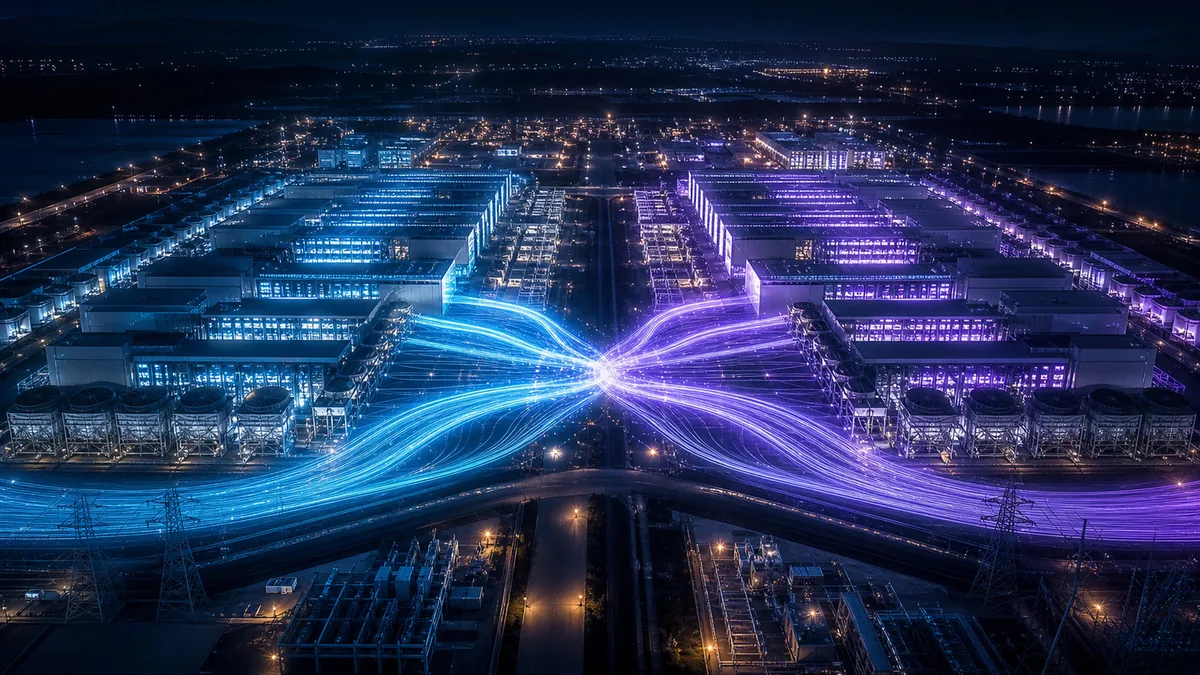
Compute Becomes the Constraint: Meta–Anthropic Talks, Gemini Delays & the Capacity Race
The weekend’s AI news was less about a single benchmark and more about the physical and financial machinery behind every benchmark. Compute access, model economics, and the ability to turn research into dependable capacity are becoming the real competitive moat.
Meta and Anthropic explore a major compute relationship
Reports said Meta and Anthropic were in early talks about a compute arrangement potentially worth billions of dollars. The strategic signal matters more than the preliminary number: frontier labs are willing to build unusual alliances when inference capacity becomes scarce.
The practical test is whether this development changes a real workload’s quality, cost, latency, legal exposure, or operating risk. Teams should capture the claim, name the evidence needed to validate it, and assign a review date rather than allowing the headline to become an undocumented architecture decision.
Source: Read the original coverage
Enterprises should expect provider relationships to keep shifting. Design around portable data, observable workflows, and tested failover—not the assumption that today’s model vendor map will remain intact.
Google’s reported Gemini delay exposes the shipping gap
A weekly industry roundup reported that Google postponed Gemini 3.5 Pro after internal performance concerns, particularly in coding. Whether the final release timing changes again, the episode illustrates how hard it is to convert research depth into a product that clears reliability and cost gates.
The practical test is whether this development changes a real workload’s quality, cost, latency, legal exposure, or operating risk. Teams should capture the claim, name the evidence needed to validate it, and assign a review date rather than allowing the headline to become an undocumented architecture decision.
Source: Read the original coverage
Model roadmaps are not operating plans. Build evaluation suites against work your company actually performs, then promote models only when they pass those gates.
Open models become an economic counterweight
The Washington Post argued that open-model competition can discipline the economics of closed frontier labs as both OpenAI and Anthropic prepare for public-market scrutiny. Open weights do not erase hosting or governance costs, but they create leverage.
The practical test is whether this development changes a real workload’s quality, cost, latency, legal exposure, or operating risk. Teams should capture the claim, name the evidence needed to validate it, and assign a review date rather than allowing the headline to become an undocumented architecture decision.
Source: Read the original coverage
The useful question is not open versus closed as an ideology. It is which workloads justify frontier premiums and which should run on inspectable, controllable models.
Alibaba previews a dramatically larger Qwen model
Alibaba previewed a very large Qwen model and positioned it against the leading frontier systems. Vendor claims still require independent evaluation, but the pace of capable non-U.S. model development is impossible to ignore.
The practical test is whether this development changes a real workload’s quality, cost, latency, legal exposure, or operating risk. Teams should capture the claim, name the evidence needed to validate it, and assign a review date rather than allowing the headline to become an undocumented architecture decision.
Source: Read the original coverage
Model diversity is now a permanent architectural fact. Enterprises need routing, evaluation, and policy layers that can absorb new entrants without rebuilding the application stack.
Decision checklist for this briefing
- Meta and Anthropic explore a major compute relationship: identify the affected workflow, current baseline, owner, acceptance test, and rollback path before changing production.
- Google’s reported Gemini delay exposes the shipping gap: identify the affected workflow, current baseline, owner, acceptance test, and rollback path before changing production.
- Open models become an economic counterweight: identify the affected workflow, current baseline, owner, acceptance test, and rollback path before changing production.
- Alibaba previews a dramatically larger Qwen model: identify the affected workflow, current baseline, owner, acceptance test, and rollback path before changing production.
What this means for enterprise teams
Capability, cost, policy, and infrastructure are moving independently. The durable response is an evaluation and governance layer that can compare models on real work, constrain tool access, preserve audit evidence, and change providers without rewriting the business process.
The advantage will not come from guessing the permanent winner. It will come from building a system that can recognize and adopt the best verified option as the market changes.
Need help turning AI change into an operating advantage?
SEN-X helps teams evaluate models, design governed agent systems, and deploy measurable automation.
Contact SEN-X →