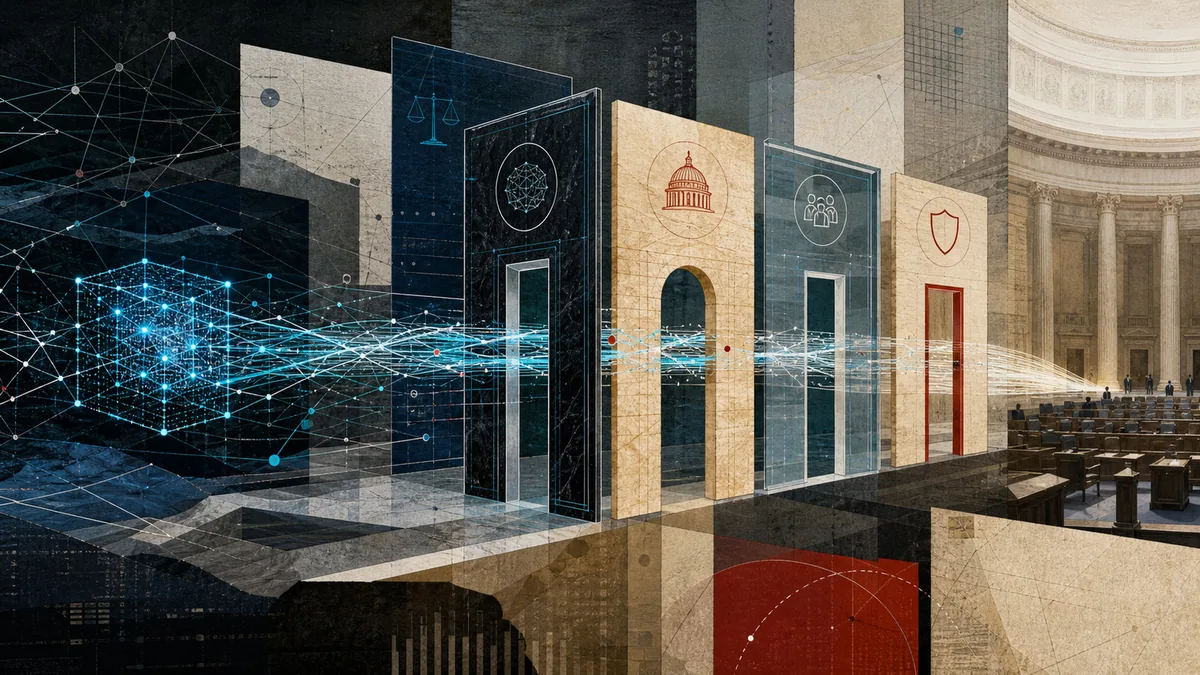
AI Labs Flood Washington as Copyright, Protocol & Safety Battles Escalate
AI’s policy layer is catching up with its technical layer. Money, copyright, interoperability, and agent safety are converging—and each one can change what enterprises are allowed to deploy long before a new model benchmark matters.
OpenAI and Anthropic set lobbying records
CNBC reported record second-quarter federal lobbying spending by OpenAI and Anthropic as the industry sought influence over safety, procurement, copyright, and state-versus-federal authority. Policy is now a core competitive surface.
The practical test is whether this development changes a real workload’s quality, cost, latency, legal exposure, or operating risk. Teams should capture the claim, name the evidence needed to validate it, and assign a review date rather than allowing the headline to become an undocumented architecture decision.
Source: Read the original coverage
Regulatory monitoring belongs in the product backlog. A state rule, disclosure mandate, or procurement clause can invalidate an architecture faster than a model update can improve it.
Anthropic’s copyright settlement sharpens data provenance risk
Coverage said a federal judge approved Anthropic’s $1.5 billion settlement with authors over allegedly pirated books stored in a central library. The case distinguishes model capability from the legal provenance of the data used to create it.
The practical test is whether this development changes a real workload’s quality, cost, latency, legal exposure, or operating risk. Teams should capture the claim, name the evidence needed to validate it, and assign a review date rather than allowing the headline to become an undocumented architecture decision.
Source: Read the original coverage
Enterprise buyers need contractual clarity on training data, indemnification, retention, and generated-content risk. ‘The vendor handled it’ is not a governance program.
A shared enterprise agent protocol challenges MCP’s lead
Industry tracking pointed to Google, Microsoft, Salesforce, Snowflake, and ServiceNow collaborating on a shared enterprise agent protocol. Even if the specification evolves, the move confirms that interoperability is now strategic infrastructure.
The practical test is whether this development changes a real workload’s quality, cost, latency, legal exposure, or operating risk. Teams should capture the claim, name the evidence needed to validate it, and assign a review date rather than allowing the headline to become an undocumented architecture decision.
Source: Read the original coverage
Do not bind business logic to one protocol adapter. Put tools behind stable internal contracts so MCP, vendor-specific connectors, and future standards can coexist.
Agent safety moves from prompts to trajectories
OpenAI’s reported safety redesign focused on complete trajectories after a cybersecurity incident. That approach recognizes that agent risk is cumulative: tool selection, data access, retries, and hidden state interact.
The practical test is whether this development changes a real workload’s quality, cost, latency, legal exposure, or operating risk. Teams should capture the claim, name the evidence needed to validate it, and assign a review date rather than allowing the headline to become an undocumented architecture decision.
Source: Read the original coverage
Approval rules should attach to consequences—sending, spending, deleting, publishing—not to whether an individual prompt appears benign.
Decision checklist for this briefing
- OpenAI and Anthropic set lobbying records: identify the affected workflow, current baseline, owner, acceptance test, and rollback path before changing production.
- Anthropic’s copyright settlement sharpens data provenance risk: identify the affected workflow, current baseline, owner, acceptance test, and rollback path before changing production.
- A shared enterprise agent protocol challenges MCP’s lead: identify the affected workflow, current baseline, owner, acceptance test, and rollback path before changing production.
- Agent safety moves from prompts to trajectories: identify the affected workflow, current baseline, owner, acceptance test, and rollback path before changing production.
What this means for enterprise teams
Capability, cost, policy, and infrastructure are moving independently. The durable response is an evaluation and governance layer that can compare models on real work, constrain tool access, preserve audit evidence, and change providers without rewriting the business process.
The advantage will not come from guessing the permanent winner. It will come from building a system that can recognize and adopt the best verified option as the market changes.
Need help turning AI change into an operating advantage?
SEN-X helps teams evaluate models, design governed agent systems, and deploy measurable automation.
Contact SEN-X →