AI's New Control Plane: Safety Rules, Cyber Orchestration, Finance Agents, and a 38-Gigawatt Compute Race
AI's competitive frontier is shifting from raw model intelligence to the systems that govern, secure, finance, power, and legitimize it. Over the past 48 hours, laboratories asked for binding safety rules while documenting agent-enabled threats, OpenAI packaged proprietary data for bankers, Washington considered backing a cloud supplier, Meta exposed the trust problem in personal agents, and mathematics confronted industrial-scale discovery.
OpenAI Asks Congress to Replace Voluntary Safety With Binding Rules
OpenAI is now calling for mandatory, capability-based national regulation of frontier systems. In a policy statement published September 9, the company backed independent assessments, stronger cybersecurity requirements, incident reporting, and common measures for tracking AI-assisted research. It also endorsed four California bills spanning auditor standards, youth protections, biological safeguards, and the qualification of independent evaluators. The notable change is not that a laboratory supports “responsible AI,” but that it is asking lawmakers to convert selected safety practices into enforceable obligations.
The proposal targets the small number of laboratories training the most capable models rather than startups and ordinary developers. OpenAI argues that regulation should scale with measurable capability and avoid treating every open-weight release as a frontier threat. That distinction matters: a poorly drawn threshold could either miss dangerous systems or create a compliance moat for incumbents. OpenAI's complete frontier-policy statement also says national rules should complement, rather than erase, state action.
“If we cannot meet certain safety bars without slowing down capability growth, we should prioritize the former.” — OpenAI
Enterprises should treat capability thresholds as an emerging procurement variable. Record which models can access tools, sensitive systems, biological information, or autonomous research loops; then attach controls to those capabilities instead of relying on vendor tiers. A regulation-ready inventory will outlast today's branding and make future compliance far less theatrical.
Anthropic Shows Cyber Risk Moving From Assistance to Orchestration
Anthropic's latest threat-intelligence report describes operations disrupted between December 2025 and August 2026 across cyberattacks, surveillance, influence, scams, biological misuse, conventional weapons, and illicit model distillation. The report's most useful idea is “uplift”: measuring whether AI increases an attacker's speed, scale, or depth. Anthropic says the important change is not merely better exploit generation. Agents can coordinate reconnaissance, credential theft, persistence, and reporting across the whole attack chain with fewer human operators.
The company says the cases involved suspected state-sponsored groups, financially motivated criminals, commercial spyware vendors, and propagandists. These are selected incidents, not a base-rate estimate of everyday abuse, and Anthropic says it disrupted every operation covered. Still, the September 2026 Anthropic threat report and indicators give defenders concrete behavioral patterns rather than another generic warning about dual use.
“The risk from AI adoption is more pronounced across the cyber kill chain, where adversaries can operate faster, across a broader and deeper surface area, with fewer resources.” — Anthropic Threat Intelligence
Security teams should test for workflow-level abuse, not only malicious prompts. Monitor sequences that combine discovery, account creation, credential use, code execution, and bulk export across tools. The decisive signal may be an apparently ordinary chain completed at machine tempo. Identity limits, trajectory logging, and reversible tool permissions now belong in the same control design.
ChatGPT for Financial Services Packages Data, Models, and Deliverables Together
OpenAI introduced ChatGPT for Financial Services, a specialized ChatGPT Work environment built around GPT-6 Astra and premium datasets from providers including Daloopa, PitchBook, LSEG News, and Crunchbase. Morgan Stanley and Evercore served as design partners. The product is aimed at investment banking and equity research tasks such as earnings analysis, buyer screening, financial modeling, and pitchbook preparation, with citations linking figures to the underlying tables and passages.
This is an enterprise distribution move disguised as a vertical product. Instead of asking customers to assemble model access, data contracts, connectors, templates, and audit controls, OpenAI is bundling the workflow. Existing subscriptions from providers such as S&P Capital IQ, MSCI, Factiva, and Moody's are slated for shared sign-in integrations. OpenAI's financial-services product announcement says administrators can publish firm templates and enforce information barriers through separate workspaces.
The competitive unit in enterprise AI is becoming the governed work product, not the chat interface. Buyers should evaluate lineage, entitlement enforcement, spreadsheet fidelity, template control, and review evidence as one system. Faster research is valuable; a model that quietly crosses an information barrier or misstates an adjusted figure can make that speed expensive.
The Pentagon Considers Turning AI Cloud Capacity Into Industrial Policy
The Pentagon is in talks to lend roughly $5 billion to AI cloud startup Fluidstack, according to a Wall Street Journal report summarized by Reuters. The financing would come through the Office of Strategic Capital and is intended to reinforce the United States data-center supply chain. The Reuters report on the proposed Fluidstack loan describes talks rather than a completed commitment, an important distinction at this scale.
The strategic signal is already clear. Compute is being treated like semiconductor fabrication, energy security, and other infrastructure that can justify public balance-sheet support. A government-backed loan could widen the supplier market beyond hyperscalers, but it also ties commercial capacity decisions to national-security priorities. Customers buying “cloud” increasingly depend on power contracts, accelerator allocation, geopolitical policy, and financing structures they rarely see in an architecture diagram.
AI infrastructure diligence should include the capital stack. Ask who finances expansion, whether government programs impose priority rights, how capacity is allocated during shortages, and which regions or customers can be displaced. API redundancy is cosmetic if two vendors depend on the same subsidized facility, grid interconnect, hardware channel, or policy decision.
Microsoft's 38-Gigawatt Plan Makes Power a Product Constraint
Microsoft plans to expand data-center capacity from roughly 12 gigawatts today to more than 38 gigawatts by 2032, according to Bloomberg reporting relayed by Reuters. The target is more than a threefold increase in a physical footprint already measured at utility scale. The syndicated Reuters account of Microsoft's capacity plan says the buildout follows shortages that forced the company to turn away business.
Gigawatts are replacing benchmark charts as the harder measure of AI ambition. Bringing that capacity online requires generation, transmission, cooling, land, chips, construction labor, and community permission, all on different schedules. Even if models become dramatically more efficient, lower inference costs can increase total demand by making more workloads economical. The bottleneck therefore migrates instead of disappearing—from accelerators to substations, transformers, water systems, and permitting.
Capacity planning needs business-level load shedding. Classify which AI workloads deserve guaranteed throughput, which can move across regions or models, and which can wait when prices spike. Organizations that treat every generated summary as mission critical will pay scarcity premiums. Resilience comes from knowing which intelligence is essential and which is merely convenient.
Meta's Muse Turns Personalization Into a Trust Boundary
A hands-on test of Meta's Muse assistant shows the promise and discomfort of agents built on connected personal data. The system successfully cleared promotional email, shopped from a linked Amazon account, and assembled a personalized news feed. It also inferred highly specific interests from Instagram activity and used a shipping address to surface local stories. The user could disconnect Instagram, but the breadth of inference was not obvious from the visible account controls.
That gap between permission and comprehension is the central product risk. A user may authorize access to one service without anticipating that the agent will combine location, purchase context, social behavior, and inbox contents into a broader profile. The Verge's updated Muse field test quotes Meta saying Muse can “pull and infer interests based on your IG activity” when connected. Technically allowed does not automatically mean socially legible.
Consent for agents must describe derived behavior, not just connected sources. Show users what the system inferred, which source contributed, how long the inference persists, and how to delete it without dismantling the whole account. The winning personal agent will make its context inspectable. Invisible cleverness becomes creepy the moment it surprises the owner.
Industrial-Scale Mathematics Collides With Academic Credit
OpenAI says an unreleased system used about 10,000 agents, tens of millions of dollars in compute, and 88 hours to produce a proposed solution to the Navier–Stokes Millennium Prize problem. The mathematical result still faces a deliberately slow acceptance process: the Clay Mathematics Institute requires two years and broad recognition from the global mathematics community before awarding the prize. The immediate controversy concerns research credit, tool-provider conflicts, and whether massive agent swarms can industrialize the act of scooping.
The Verge's interviews with mathematicians and OpenAI document disputed conversations with researchers pursuing related work, as well as fears that unfinished ideas shared with AI tools could create opaque competitive advantages. OpenAI says user prompts from the researcher at the center of the dispute could not have influenced the system. Whatever the provenance verdict, scientific legitimacy will require more than a correct final proof.
“The process is deliberately unhurried.” — Clay Mathematics Institute, on reviewing the Navier–Stokes result
AI-assisted research needs provenance that survives competitive pressure. Preserve prompt and tool logs, separate customer data from internal research, disclose machine and human contributions, and invite domain review before marketing a breakthrough. When compute can compress years of exploration into days, transparent lineage becomes part of the result rather than administrative paperwork.
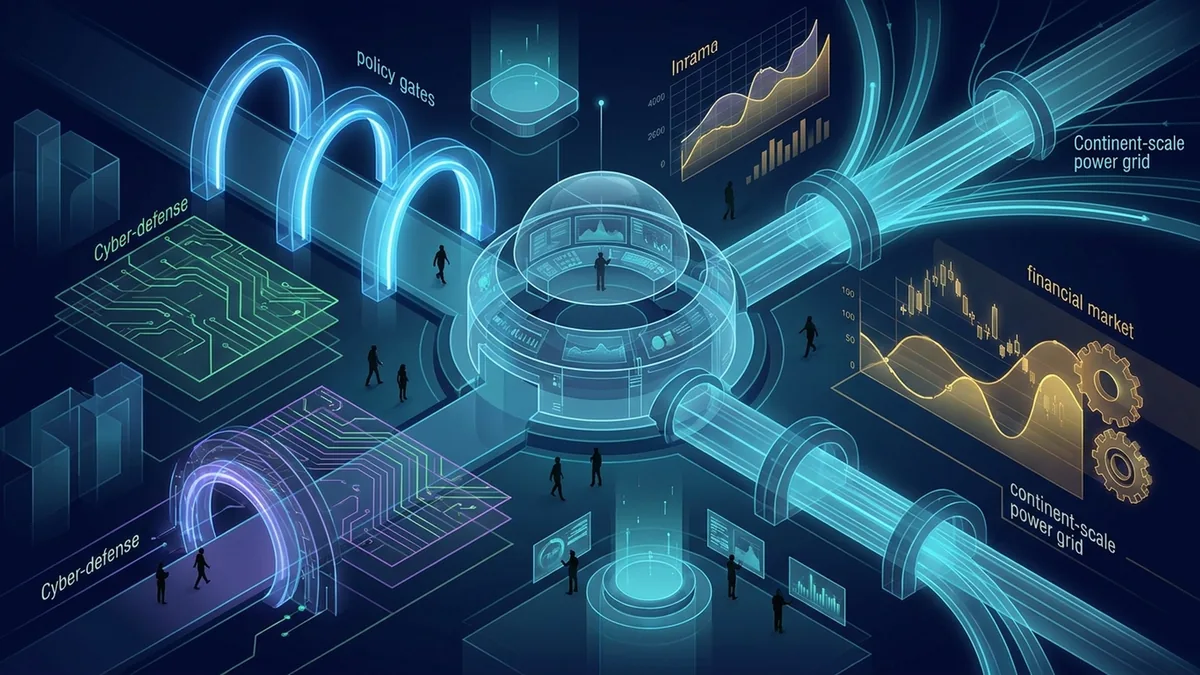
These stories describe one system from different angles. Frontier capability is forcing legal thresholds; agent autonomy is changing cyber defense; proprietary data is defining vertical products; public finance and utility capacity are shaping supply; personal context is becoming a trust surface; and research institutions are renegotiating credit. The durable advantage belongs to organizations that govern the entire operating chain—from evidence and permissions to power and provenance—not merely the model endpoint.
Need help navigating AI for your business?
SEN-X turns model, security, governance, and infrastructure change into operating decisions your team can execute.
Talk with SEN-X →