NVIDIA Unveils DSX POD to Ship AI Factories in 14 Days as OpenAI Buys Orchestra Bio and Mistral Launches Voxtral 3
AI pushed further into the physical and regulated world this week. At GTC Berlin, NVIDIA introduced DSX POD, factory-built AI factories that ship in validated containers and can be stood up at a prepared site in as little as 14 days, and it paired with Mistral on AI for engineering simulation. OpenAI acquired drug-development platform Orchestra Bio to extend its Rosalind life-sciences tools, Mistral launched its Voxtral 3 voice models and a voice agent SDK, and Anthropic reported that an autonomous research model designed protein binders against scorpion neurotoxins. OpenAI also added 12-hour prompt caching for all-day agents, and Arda launched from stealth with a $160 million round to turn product designs into assembly lines.
NVIDIA Unveils DSX POD, Factory-Built AI Factories That Ship in Containers
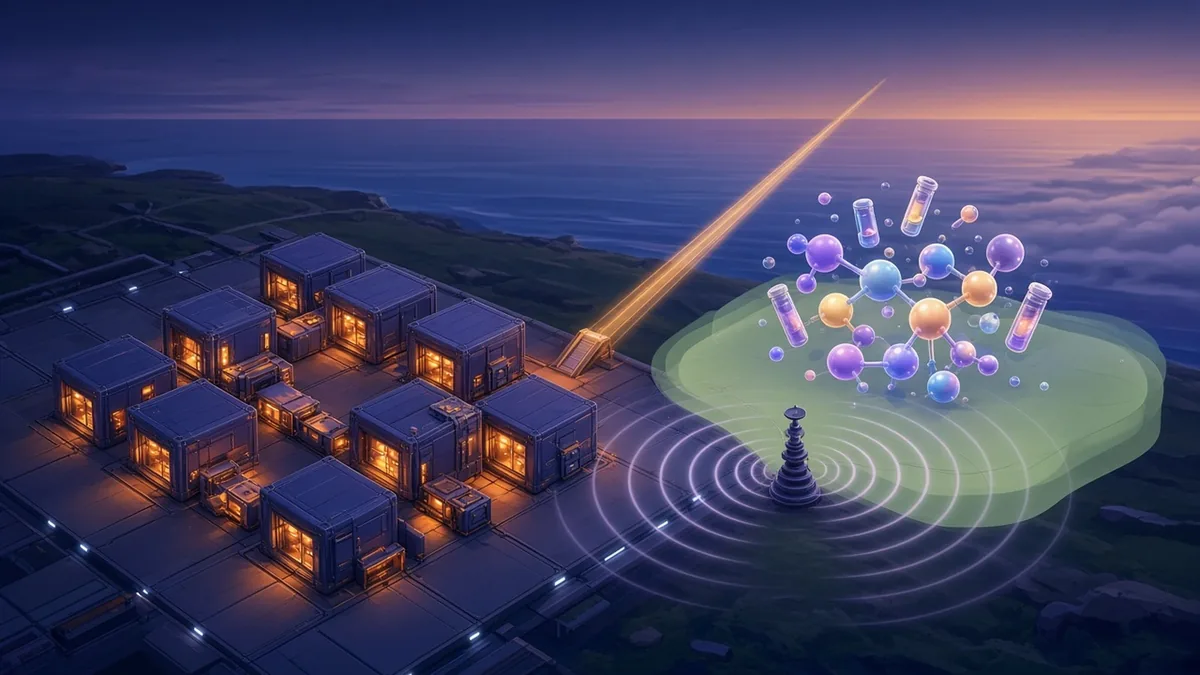
NVIDIA opened GTC Berlin with a new way to buy compute. NVIDIA’s newsroom announcement of DSX POD AI factories, dated Wednesday, October 21, describes a reference design for complete Vera Rubin AI factories that partners build inside modular containers and then integrate and validate before shipping. Computing, networking, cabling, rack-level power and liquid cooling are installed at the manufacturing plant rather than on site. Once a site has its power, cooling and network connections ready, NVIDIA says deployment time drops from six months to as little as 14 days. The company lists Anduril, Armada, Bull, Crusoe, DayOne, Dell Technologies, Delta, Eaton, Foxconn, GIGABYTE, HPE, Lenovo, Pegatron, QCT, Schneider Electric, Vertiv and Wistron as partners, with delivery worldwide planned for early 2027. NVIDIA’s official post introducing DSX POD on X, at 5:23 AM PT, repeated the 14-day figure.
"This is a complete transformation of the world supply chain." — Jensen Huang, NVIDIA
Huang made that remark on stage, according to NVIDIA’s live blog of the GTC Berlin keynote, which also says the broader DSX AI Factory Platform can cut water used for cooling by up to 100% and deliver the same AI output with up to 30% less power. The same keynote introduced an OpenShell reference architecture for agent safety, built on an open-source runtime with kernel-level sandboxing that sits between an agent and the systems it can affect. DatacenterDynamics’ report on the DSX POD efficiency claims adds that the water savings come from pairing closed-loop liquid cooling with outdoor dry coolers that avoid evaporation, that NVIDIA claims about 54 million liters a day saved at 2GW scale, and that NVIDIA itself cautions some hot climates will still need extra mechanical cooling. These efficiency figures are NVIDIA’s own claims.
DSX POD shifts the bottleneck away from construction crews and toward utilities: the 14-day clock only starts once power, cooling and fiber are ready. Organizations planning private AI capacity for 2027 should open grid and permitting conversations now, and press partners on service terms, spare parts and who owns failures inside a sealed container before signing.
Mistral and NVIDIA Team Up on AI for Simulation and Engineering Design
Europe’s leading model lab used the same event to move into heavy industry. Mistral’s announcement of its industrial engineering collaboration with NVIDIA, published October 21, says the two companies will combine Mistral Large 4 and Mistral’s physics modeling and data generation pipelines with NVIDIA CUDA-X libraries and NVIDIA Warp to speed up engineering simulation and close the loop between simulation, model development and design. Mistral models will also be connected to NVIDIA Omniverse libraries for GPU-accelerated 3D scene generation and SimReady asset creation. Mistral’s official post announcing the NVIDIA collaboration summarized the plan as faster simulation, open benchmarks and datasets for physics AI, and evaluations for agentic AI in CAE and EDA.
"For too long, the pace of engineering has been set by the pace of simulation." — Neil Ashton, Mistral
The benchmark work is the most concrete piece. Mistral says the agentic evaluations will test whether agents can operate engineering tools, finish multistep workflows and produce technically correct results, while tracking execution time and compute cost, with aerospace, automotive and semiconductors named as target sectors. The post also recaps the wider partnership: the two companies co-developed Mistral NeMo, are working through the NVIDIA Nemotron Coalition on a frontier base model, and Mistral says the weights for Mistral Large 4, its roughly one-trillion-parameter model, are planned for release at the end of October. Mistral is bringing more NVIDIA-powered capacity online toward a target of 1 GW by 2030.
Shared, public benchmarks for engineering agents are overdue, because today every vendor grades its own CAE and EDA demos. Engineering leaders should watch for the first datasets, then test candidate agents on their own meshes, solvers and design rules, measuring correctness and compute cost per task rather than trusting a headline accuracy number.
OpenAI Acquires Orchestra Bio to Pair Drug-Program Agents With Rosalind
OpenAI made a life sciences acquisition on Tuesday. OpenAI’s post on acquiring Orchestra Bio, dated October 20, says Orchestra is a platform where people and AI agents work together to coordinate drug development, and that its team and technology will join Rosalind, OpenAI’s family of models and tools for life sciences research, which includes GPT-Rosalind and the Rosalind Workbench. In Orchestra, scientists and program leaders delegate the monitoring and tracking of studies and campaigns to agents. OpenAI gives the example of a failed manufacturing batch that can delay a clinical trial: the agents help identify which activities and timelines are affected, gather the relevant information and compare ways to respond, while people decide what to do next. OpenAI notes that developing a new medicine takes roughly 10 to 15 years on average from target discovery to U.S. regulatory approval, and points to its existing partnerships with Novo Nordisk and Moderna. OpenAI’s official post announcing the Orchestra Bio deal, at 11:10 AM PT, welcomed the team. Financial terms were not disclosed.
The deal signals that OpenAI sees the opportunity in drug development as much in coordinating programs as in designing molecules. Biopharma operations teams weighing agentic tools should insist on an audit trail for every recommendation, clear boundaries around regulated data, and a human sign-off step before any agent-suggested change touches a clinical timeline.
Anthropic’s Research Claude Designs Binders Against Scorpion Neurotoxins
Anthropic published a striking autonomy experiment in biology. Anthropic’s science blog post on designing binders against scorpion toxins, dated October 20, says an internal research model working inside Claude Science spent 64 hours, largely autonomously and guided by four follow-up prompts, designing proteins meant to latch onto five neurotoxins from scorpions in Mexico, Brazil, North Africa and the Middle East. Anthropic says Claude generated 318,484 protein designs, selected 180 for testing, and the team added 31 more, for 211 designs sent to contract labs Adaptyv Bio and Twist Bioscience. Of those, 17 met the team’s criteria for a binder, each against a single toxin. The company frames this as a response to a neglected disease: it cites scorpion stings injuring about 1.2 million people a year and causing more than 3,250 deaths, mostly among children with limited access to care.
"We have not confirmed whether these binders neutralize scorpion venom in a cellular environment, so we do not claim to have produced an antivenom." — Anthropic
Anthropic’s official post summarizing the scorpion-binder research calls the work an early step toward new treatments. The blog is careful about limits: results show binding only against lab-grown recombinant toxins, and the two strongest designs, Cn2-B1 and Cn2-B2, have not been tested in cells or live animals, though competition experiments suggest they bind the same site as an antibody reported to neutralize the Cn2 toxin in mice. Outside researchers quoted by Anthropic called it a promising first step for neglected diseases that commercial incentives have long ignored.
The honest framing matters more than the headline: binding is not neutralizing, and Anthropic says so plainly. The real signal is speed and target breadth, a credible run across several hard toxins in days. For drug-discovery teams, the lesson is to treat generative design as a front-end that still feeds a full, unchanged validation pipeline.
Mistral Ships Voxtral 3 Speech Models and a Voice Agent SDK
Mistral also expanded beyond text into voice. Mistral’s launch post for Voxtral 3 introduces a family of speech-to-text and text-to-speech models plus a voice agent SDK that folds listening, reasoning, tool calling and speaking into a single real-time streaming pipeline. The transcription model, Voxtral Small Transcribe 3, supports more than 50 languages, including 24 official EU languages, and handles diarization and context biasing; Mistral says it leads Whisper, ElevenLabs’ Scribe v2 and Gemini 3.5 Transcribe on its benchmarks, which are the company’s own reported numbers. The text-to-speech model, Voxtral Mini TTS 3, offers voices that adjust emotion, pace and emphasis across 35-plus languages. Mistral’s official post introducing Voxtral 3 described it as state-of-the-art Transcribe and Speech models powering a new voice agents API.
The pricing and deployment story is the differentiator. Mistral lists batch transcription at $0.0035 a minute and voice-agent pricing from $0.04 a minute, and stresses that Voxtral 3 runs on its EU-hosted API or on a customer’s own infrastructure, letting organizations control where audio is processed and whether conversations are retained. Because each stage is a separate model, teams can swap the language model, the voice or the language without rebuilding the agent.
Self-hostable voice models matter most to contact centers and health or finance teams that cannot send call audio to a shared US cloud. Buyers should benchmark Voxtral’s accuracy on their own accents and jargon with context biasing turned on, and price the full voice-agent loop, not just per-minute transcription, before committing to a migration.
OpenAI Adds 12-Hour Prompt Caching for All-Day Agents
A quieter but practical change landed for developers. OpenAI’s API changelog entry for October 20 says the Responses API can now keep a prompt cached for 12 hours, so shared instructions, tools and context stay cached across requests that are hours apart, at the lower cached-input rate. The trade-off is the write cost: the changelog says 12-hour cache writes cost 2.5 times the input-token price, against 1.25 times for the default 30-minute lifetime documented in OpenAI’s prompt caching guide. That guide says cache reads cost 0.1 times the ordinary input rate on most recent models, and 0.05 times on GPT-6.1 Sol, regardless of the chosen lifetime, and that each request can create up to four explicit cache writes.
"You can now choose 12-hour prompt caching in the API." — OpenAI Developers
OpenAI’s official developer post on 12-hour caching pitched it at persistent agents that reuse the same context throughout the day. The guide’s own math shows why the write premium can pay off: at the 0.1x read rate, writing a prefix once and reusing it across ten requests costs about 2.15 times its ordinary input price, versus 10 times with no caching.
This is a tuning knob, not free savings: the 12-hour write costs double the 30-minute write, so it only wins when a large, stable prefix is reused many times across a long day. Teams running all-day agents should measure reuse per cache entry, and keep fast-changing context on the 30-minute default to avoid paying the higher write rate on throwaway tokens.
Arda Launches With $160 Million to Turn Designs Into Assembly Lines
Funding news rounded out the day in physical AI. CNBC’s report on Arda’s launch from stealth, dated October 20, says the company founded by former OpenAI chief research officer Bob McGrew raised a $160 million Series A at a $1.5 billion valuation, led by Altimeter, Accel and Khosla Ventures, bringing total funding to about $232 million including an earlier $72 million seed. Arda builds AI software that reads a product’s CAD files and other design artifacts, works out an assembly sequence, writes the work instructions and lays out the workstations, then updates that plan as the design changes. McGrew told CNBC the tool is like what coding assistants do for programmers, applied to manufacturing engineers.
"When a design changes, you can retrain a human in a day — but it takes three to six months in order to change the automation to reflect the new design." — Bob McGrew, Arda
Accel’s note on its investment in Arda says defense contractor Anduril already uses Arda’s technology inside its ArsenalOS manufacturing software, and claims assembly instructions that once took hours now take minutes, with some engineering workflows running more than 10 times faster; those are the company’s figures. Arda says it will spend the money on hiring, more deployments across defense, electronics and the data-center supply chain, and on robotics models to eventually program automated assembly lines, not just plan lines run by people.
Arda is chasing the gap between software-speed design changes and factory-speed retooling, and a marquee customer in Anduril gives the claim weight. Manufacturers evaluating it should pilot on one fast-changing product line, verify the generated work instructions against their own quality and safety standards, and treat the promised robotics automation as a roadmap, not a product.
Tuesday and Wednesday’s news pushed AI deeper into the physical and regulated world. NVIDIA wants to ship entire data centers in containers, Mistral is aiming models at engineering simulation and at sovereign voice, OpenAI is buying its way into drug-development operations, and Anthropic is testing how far an autonomous model can go in protein design. Arda is selling faster factories, and OpenAI’s 12-hour cache quietly lowers the cost of running agents all day. The common thread for buyers is the same: measure the claims on your own workloads, data and safety rules before you commit budget.
Need help navigating AI for your business?
Our team turns these developments into actionable strategy.
Contact SEN-X →