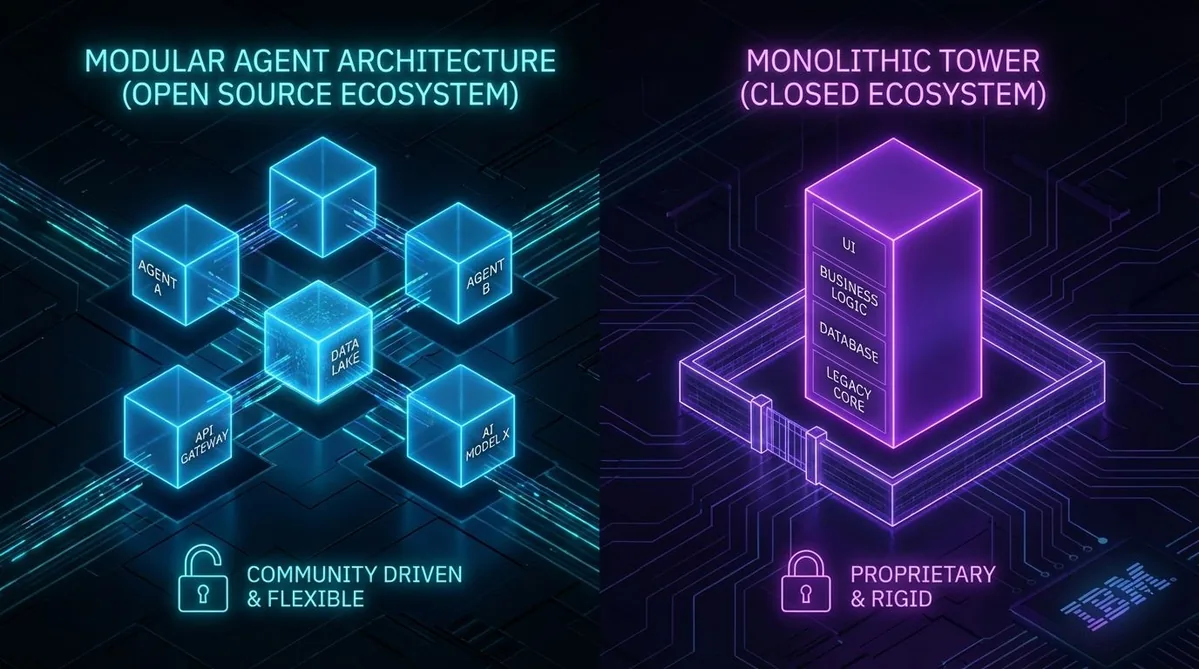
IBM Says OpenClaw Challenges the Vertical Integration Thesis
IBM Research weighs in on whether an open, modular agent architecture can compete with vertically-integrated AI assistants from big tech.
🦞 OpenClaw Updates
IBM Think: "The Rise of OpenClaw Challenges Vertical Integration"
In a notable IBM Think article, Principal Research Scientist Kaoutar El Maghraoui argues that OpenClaw's success challenges the assumption that autonomous AI agents must be vertically integrated — with providers tightly controlling models, memory, tools, interfaces, execution layers, and security stacks.
"The rise of OpenClaw challenges the hypothesis that autonomous AI agents must be vertically integrated, with the provider tightly controlling the models, memory, tools, interface, execution layer and security stack for reliability and safety."
The article examines how OpenClaw's modular approach — where users choose their own LLM, host their own data, and extend via community skills — creates a fundamentally different trust model from cloud-first agents like ChatGPT's agent mode or Google's Project Mariner.
IBM's analysis validates the architecture thesis we've been advocating: modularity beats monoliths for enterprise AI. When your agent can swap between Claude, GPT, Grok, or open-source models without rebuilding, you avoid vendor lock-in. When your data stays local, you satisfy compliance requirements. The trade-off is complexity — which is exactly why expert deployment and configuration matters.
🔒 Security Tip of the Day
Use Multi-Agent Routing for Isolation
OpenClaw's multi-agent routing lets you create isolated agents for different purposes — a work agent, a personal agent, a shared family agent. Each has its own workspace, sessions, skills, and permissions.
Why it matters: If your work agent is compromised or misconfigured, it can't access your personal data (and vice versa). Configure separate agents via agents.list in your config, each with their own tool policies and channel bindings.
⭐ Skill of the Day: linear
🔧 linear
What it does: GraphQL-based Linear project management integration. Create and update issues, manage projects, teams, and cycles directly from OpenClaw. Your agent can triage bugs, update sprint status, and keep your Linear workspace current without context-switching.
Install: npx clawhub@latest install linear
Source: Verified on ClawHub and recommended in the Reddit best-skills thread.
Why we like it: For teams using Linear, this eliminates the constant tab-switching. Tell your agent "create a bug for the login timeout issue, P1, assign to backend team" and it's done. The GraphQL integration means it's fast and can handle complex queries.
👥 Community Highlights
The IBM article sparked discussion about OpenClaw's long-term viability against well-funded competitors. Community consensus: the open-source model is the moat. As one Discord user put it, "Google can build a better agent, but they can't build a more customizable one."
🌐 Ecosystem News
O-mega Integration Guide: O-mega published a comprehensive guide to building AI agent workforces with OpenClaw, covering multi-agent orchestration strategies and the "shift from one monolithic AI to multiple specialized helpers."
Need help with OpenClaw deployment?
SEN-X provides enterprise OpenClaw consulting — architecture, security hardening, custom skill development, and ongoing support.
Contact SEN-X →