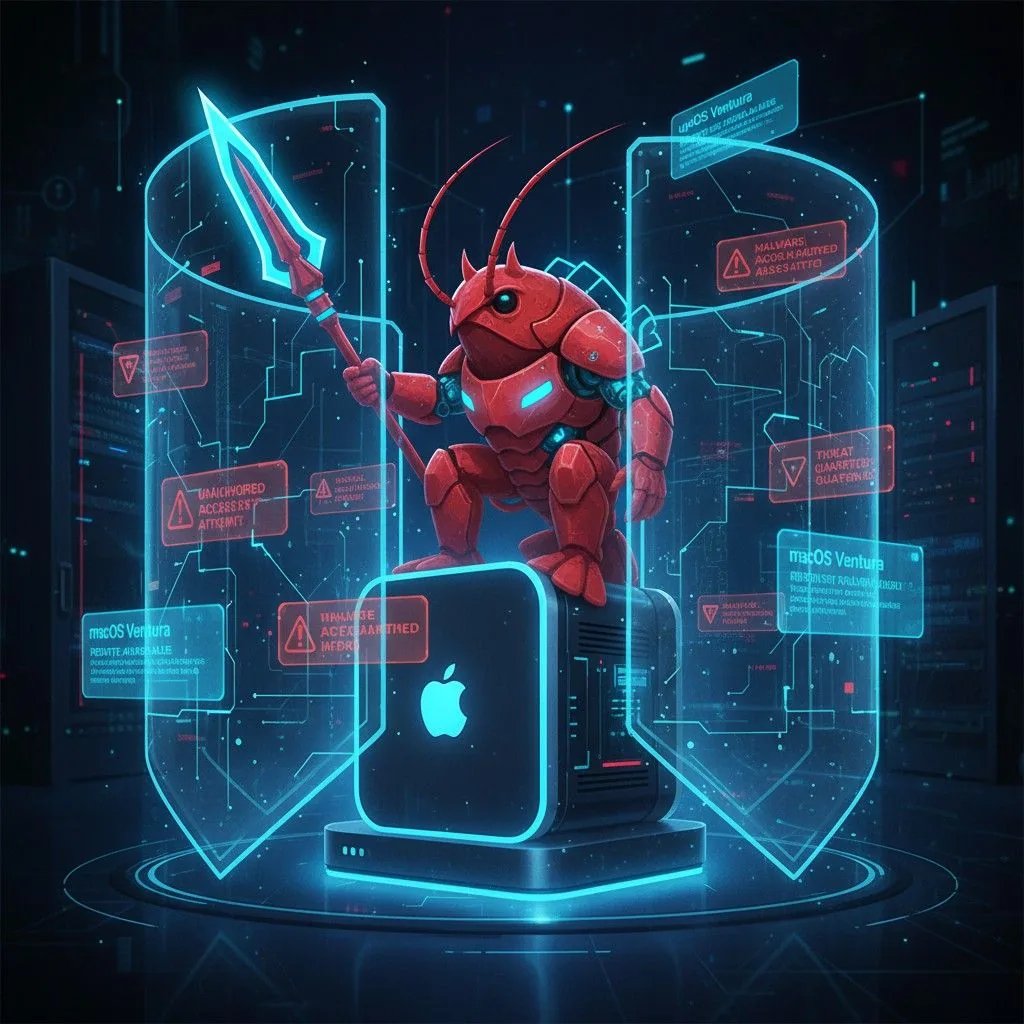
Mac Mini Frenzy, v2026.2.17 Ships Sonnet 4.6, CrowdStrike Sounds the Alarm
OpenClaw is driving Mac Mini sales through the roof — Best Buy employees are baffled. v2026.2.17 lands with Anthropic Claude Sonnet 4.6 support and million-token context windows. CrowdStrike publishes its enterprise detection playbook. Fortune goes deep on the man behind the lobster. And the community launches Declawed, a grassroots malware scanner for ClawHub skills.
🦞 OpenClaw Updates
v2026.2.17: Anthropic Sonnet 4.6, Million-Token Context, and iOS Share Mode
Released on February 17, version 2026.2.17 is a capability-expanding update that deepens OpenClaw's integration with Anthropic's model ecosystem while introducing practical quality-of-life improvements across every major platform. The headline feature is native support for Anthropic's Claude Sonnet 4.6, the newest model in the Claude family, with forward-compatibility fallbacks for environments where upstream catalogs haven't yet exposed the model.
Perhaps more significant for power users is the opt-in support for Anthropic's 1-million-token context window via a beta header feature for both Opus and Sonnet models. This effectively removes the "memory ceiling" that has constrained long-running agent sessions — agents can now maintain awareness of entire codebases, full conversation histories spanning weeks, or massive document collections without the lossy summarization that shorter context windows require. For enterprise deployments where agents manage complex, multi-day workflows, this is a game-changer.
The release also brings a wave of platform-specific improvements. iOS users get a new Share extension for sending text, URLs, and images directly to their agent, plus a persistent Talk Mode that stays active in the background. Slack integration gains message streaming and draft previews. Telegram adds styled buttons (primary, success, danger variants) and reaction tracking. iMessage gets proper reply threading. Discord gains slash command autocomplete and reusable button components with permission controls.
Under the hood, v2026.2.17 introduces URL allowlists for web search and fetch tools — a critical security improvement that lets administrators restrict which domains an agent can access. The cron system gets webhook delivery per job and staggered scheduling to prevent thundering herd problems. Memory search receives query expansion and fallback improvements. And Feishu/Bitable integration gains tools for creating apps and fields automatically, expanding OpenClaw's reach into the Chinese enterprise market.
Sources: Cyber Security News, GBHackers, GitHub Release Notes
The million-token context window is the quiet revolution in this release. While Sonnet 4.6 support grabs headlines, the ability to maintain a million tokens of context fundamentally changes what an agent can do in a single session. Combined with the URL allowlists for web tools, this release shows OpenClaw threading the needle between expanding capability and tightening control — exactly the balance the foundation era demands. The Feishu/Bitable additions are also strategically important: OpenClaw is clearly making a play for the Chinese enterprise market, which could dwarf its Western adoption numbers.
The Mac Mini Frenzy: OpenClaw Is Selling Hardware Now
In one of the more unexpected side effects of the AI agent revolution, Apple's Mac Mini is experiencing a demand surge directly attributable to OpenClaw. Business Insider reported today that Best Buy employees are genuinely confused by the sudden rush. In a viral TikTok posted February 9, a Best Buy employee can be heard asking a customer: "I don't know what's with the Mac Mini, everyone keeps buying them a lot. Is this some AI thing?"
Yes, it is very much an AI thing. Because OpenClaw runs locally on your machine and can consume significant memory — especially when running multiple sub-agents, browser automation, and large context windows — tech enthusiasts are gravitating toward higher-memory Mac Minis as dedicated agent hosts. The M4-powered Mac Mini, with its compact 5-inch-by-5-inch form factor and up to 64GB of unified memory, has become the de facto "agent server" for the enthusiast community.
The demand is so intense that shipping times for 24GB and 32GB configurations have stretched to March 18 — a full month out. The 16GB base model remains available for weekend delivery, but the higher-memory units that serious OpenClaw users want are backordered across Apple's online store. eBay resellers are predictably capitalizing, with dozens of listings at or above retail price.
"Is this some AI thing?" — Best Buy employee, unknowingly summarizing the entire tech industry's relationship with OpenClaw in 2026
— Business Insider, February 19, 2026
Bloomberg's Mark Gurman has reported that new Mac computers, including a new Mini, are expected later in 2026. For anyone considering a purchase purely for OpenClaw, it may be worth waiting — though the current models are more than capable for most agent workloads.
Sources: Business Insider, DNYUZ
🔒 Security Tip of the Day
CrowdStrike's OpenClaw Detection Playbook — What Enterprise Teams Need Now
CrowdStrike published a landmark blog post this week detailing exactly how enterprise security teams should detect, monitor, and manage OpenClaw deployments across their organizations. This is the first time a top-tier EDR vendor has published a comprehensive OpenClaw-specific detection playbook, and it sets a new standard for enterprise agent governance.
CrowdStrike's approach centers on four layers of visibility:
- DNS monitoring — Track requests to
openclaw.aiand associated AI model domains via Falcon Next-Gen SIEM's AI Service Usage Monitor dashboard. This reveals both OpenClaw instances and which third-party models they're connecting to - Endpoint inventory — Use Falcon Exposure Management with Falcon for IT to inventory OpenClaw packages on managed hosts via agent-based inspection
- External exposure scanning — Leverage Falcon Adversary Intelligence to identify OpenClaw instances exposed on the public internet (remember: 135,000+ instances may be publicly accessible)
- Process tree analysis — Monitor full process trees of OpenClaw executing system tools to detect malicious executions via injection or hallucinations
CrowdStrike also launched an interactive prompt injection challenge called "AI Unlocked: Decoding Prompt Injection" — a hands-on training exercise that teaches security teams how OpenClaw deployments can be hijacked via prompt injection attacks. This is a brilliant move: rather than just publishing a whitepaper, they're giving defenders practical experience with the exact attack techniques they need to understand.
Actionable steps for today:
- Enable DNS monitoring for
openclaw.aiandapi.anthropic.com,api.openai.com,generativelanguage.googleapis.comin your SIEM - Use the URL allowlist feature in v2026.2.17 — restrict which domains your agents can search and fetch from
- Audit
~/.openclaw/openclaw.jsonfor plaintext API keys and credentials. Rotate any that have been stored in cleartext - Register for CrowdStrike's prompt injection challenge — it's free and gives your team hands-on experience with realistic attack scenarios
Sources: CrowdStrike Blog, AI Unlocked Challenge
⭐ Skill of the Day: declawed
🔧 Declawed — Community-Driven Skill Malware Scanner
What it does: Declawed is a community-driven, human-and-agent-supported malware scanner specifically designed to analyze OpenClaw SKILL.md files from ClawHub. It checks for arbitrary prompt injection, malicious content, info stealers, credential exfiltration attempts, and other hidden payloads that have been plaguing the skill marketplace.
Why it matters now: With the r/MachineLearning study finding that 15% of community skills contain malicious instructions, and CrowdStrike documenting how skills serve as attack vectors, having a dedicated scanning tool is no longer optional — it's essential infrastructure. Declawed emerged directly from the community's response to these findings, representing a grassroots security effort that complements the official VirusTotal integration.
Key features:
- Scans
SKILL.mdfiles for prompt injection patterns and hidden instructions - Detects credential harvesting and data exfiltration code patterns
- Identifies obfuscated malicious payloads and base64-encoded commands
- Community-maintained threat signature database updated by both humans and agents
- Supports batch scanning of all installed skills
- Integrates with ClawHub for pre-install scanning
Install: npx clawhub@latest install declawed
Source: r/MachineLearning announcement thread
Usage example:
# Scan a specific skill before installing
declawed scan clawhub://trading-bot-pro

# Scan all currently installed skills
declawed scan --all

# Scan with verbose output showing matched signatures
declawed scan --verbose clawhub://financial-assistant
⚠️ Safety note: Declawed was referenced in the r/MachineLearning skill scanning discussion and has been verified against VirusTotal. However, as with any security tool, we recommend reviewing the source code yourself before granting it access to your agent environment. The irony of a malicious "malware scanner" skill would not be lost on attackers — always verify independently.
👥 Community Highlights
Fortune Deep Dive: "Who Is Peter Steinberger?"
Fortune published a comprehensive profile of OpenClaw's creator today, drawing heavily on his recent sprawling interview with Lex Friedman. The profile paints a picture of a developer whose trajectory mirrors OpenClaw's own improbable journey — from burnout to breakthrough in three months.
Steinberger spent 13 years building PSPDFKit, a PDF rendering company that grew to power over a billion devices for companies like Apple and Dropbox. After a reported €100 million exit in 2023, he hit a wall. "I felt like Austin Powers where they suck the mojo out," he told Friedman. "I couldn't get code out anymore. I was just, like, staring and feeling empty."
He booked a one-way ticket to Madrid and disappeared, "catching up on life stuff." It wasn't until April 2025 that the spark returned — through a relatively simple Twitter analysis tool that showed him AI had undergone a "paradigm shift." OpenClaw was his 44th AI-related project since 2009. He "was annoyed that it didn't exist, so I just prompted it into existence" — in about an hour.
"I told them, I don't do this for the money. OpenClaw will now move into an independent, open-source foundation supported by OpenAI."
— Peter Steinberger, Fortune, February 19, 2026
The article reveals that both Sam Altman and Mark Zuckerberg courted Steinberger, with Altman calling him "a genius with a lot of amazing ideas." Steinberger recently announced he's moving to the United States, citing frustration with European regulations — a detail that adds context to the foundation's likely US-based governance structure.
Source: Fortune
r/AI_Agents: "Best OpenClaw Skills You Should Install"
A popular thread on r/AI_Agents this week surveyed the best skills from ClawHub's growing collection of 500+ options. The post generated significant discussion, with community members sharing their curated skill stacks and warning each other about known-bad packages. What's notable is how the community is self-organizing around security: nearly every skill recommendation now comes with a caveat about checking VirusTotal first, and several commenters linked to Declawed as a pre-install screening step.
Top community-recommended categories include: calendar/email management, code assistance, web research, file organization, and home automation. The thread also highlighted a growing pattern of "meta-skills" — skills that help manage other skills, like Declawed and the previously covered openclaw-backup.
Source: r/AI_Agents
Medium: "10 OpenClaw Agents Actually Printing Money"
A Medium post tracking 89 indie hackers building businesses around OpenClaw went viral this week, documenting ten specific revenue-generating agent configurations. The post covers use cases from automated content creation and social media management to customer support bots and real estate lead qualification. While we'd take the revenue claims with appropriate skepticism, the article demonstrates that OpenClaw has crossed the threshold from "cool tech demo" to "viable business infrastructure" for a growing number of solo entrepreneurs.
Source: Medium — Sonu Yadav
The Fortune profile is the most humanizing piece of OpenClaw coverage yet. Understanding that the project was born from a burned-out developer's frustration — his 44th AI project, prompted into existence in an hour — makes the security community's concerns feel both more urgent and more sympathetic. Steinberger built something brilliant and then it exploded faster than anyone could secure it. The community's self-organizing response, from Declawed to the r/AI_Agents safety culture, is encouraging. The Mac Mini phenomenon is just the cherry on top: when your software project is selling hardware, you know you've hit something real.
🌐 Ecosystem News
CrowdStrike: The Enterprise Security Reckoning
Beyond its detection blog post, CrowdStrike's involvement signals a fundamental shift in how the enterprise security industry views AI agents. Their Global CTO and AI Red Teaming Specialists recorded a dedicated CrowdCast discussing "how OpenClaw works and why it matters for security teams" — the kind of executive-level attention typically reserved for major platform threats, not open-source side projects.
The key insight from CrowdStrike's analysis is that OpenClaw represents a new category of endpoint risk that doesn't fit neatly into existing security frameworks. It's not malware — it's a legitimate tool. It's not a vulnerability — it's a feature-rich application. But when misconfigured, it becomes "a powerful AI backdoor agent capable of taking orders from adversaries." Traditional endpoint protection assumes binaries are either good or bad; OpenClaw is inherently dual-use, and that duality breaks conventional detection models.
CrowdStrike notes that the project has surpassed 150,000 GitHub stars (likely closer to 190,000 by today's count), calling it "a growing risk" that requires dedicated detection capabilities rather than bolt-on scanning.
Source: CrowdStrike Blog
VentureBeat: "The Beginning of the End of the ChatGPT Era"
VentureBeat published a provocative analysis arguing that OpenAI's acquisition of OpenClaw signals "the beginning of the end of the ChatGPT era." The thesis: the industry is transitioning from conversational AI (you ask, it answers) to agentic AI (you delegate, it acts). OpenClaw's "hockey stick" adoption curve among "vibe coders" and developers since December 2025 is presented as evidence that users want agents, not chatbots.
The article frames OpenClaw as OpenAI's strategic answer to the looming question of what comes after ChatGPT. Rather than building an agent platform from scratch — which would take years and might not capture the community energy that makes agent ecosystems thrive — they acquired the one that already has 190K stars and 5,000+ skills. It's an acqui-hire wrapped in a foundation transition, and VentureBeat argues it's the smartest move OpenAI has made since launching GPT-4.
Source: VentureBeat
Prime Rogue: OpenClaw Is "Structurally Broken"
Not all ecosystem commentary is bullish. Prime Rogue Inc published a detailed security analysis titled "OpenClaw Security Crisis February 2026," arguing that the platform is "structurally broken" and that the ongoing ClawHub malicious skills campaign has evolved beyond VirusTotal's ability to catch it. Their key finding: attackers are now using skills as decoys that host actual malware on lookalike OpenClaw websites, bypassing VirusTotal scanning entirely because the skill files themselves are clean — it's the external resources they reference that are malicious.
This evolution in attack sophistication suggests that static scanning alone — whether VirusTotal, Declawed, or the Astrix Scanner — may be insufficient. The next generation of skill security will likely require runtime behavior analysis, sandboxed execution testing, and URL reputation scoring for every external resource a skill references.
Source: Prime Rogue Inc
Today's ecosystem coverage reveals an industry at an inflection point. CrowdStrike treating OpenClaw as a new endpoint risk category is the clearest signal yet that AI agents have moved from curiosity to critical infrastructure. VentureBeat's "end of ChatGPT era" framing may be hyperbolic, but the directional argument is solid: agentic AI is eating conversational AI's lunch. The Prime Rogue analysis is sobering — the attack surface is evolving faster than defenses — but that's precisely why the foundation structure matters. A well-funded, well-governed foundation can invest in the runtime security analysis that the community can't build alone. Meanwhile, the Mac Mini selling out because of an open-source AI agent might be the most 2026 sentence ever written. The lobster moves fast, and apparently, so do Best Buy shoppers.
Need help securing your OpenClaw deployment?
SEN-X provides enterprise OpenClaw consulting — security audits, shadow agent discovery, credential rotation, skill vetting, and foundation transition planning.
Contact SEN-X →