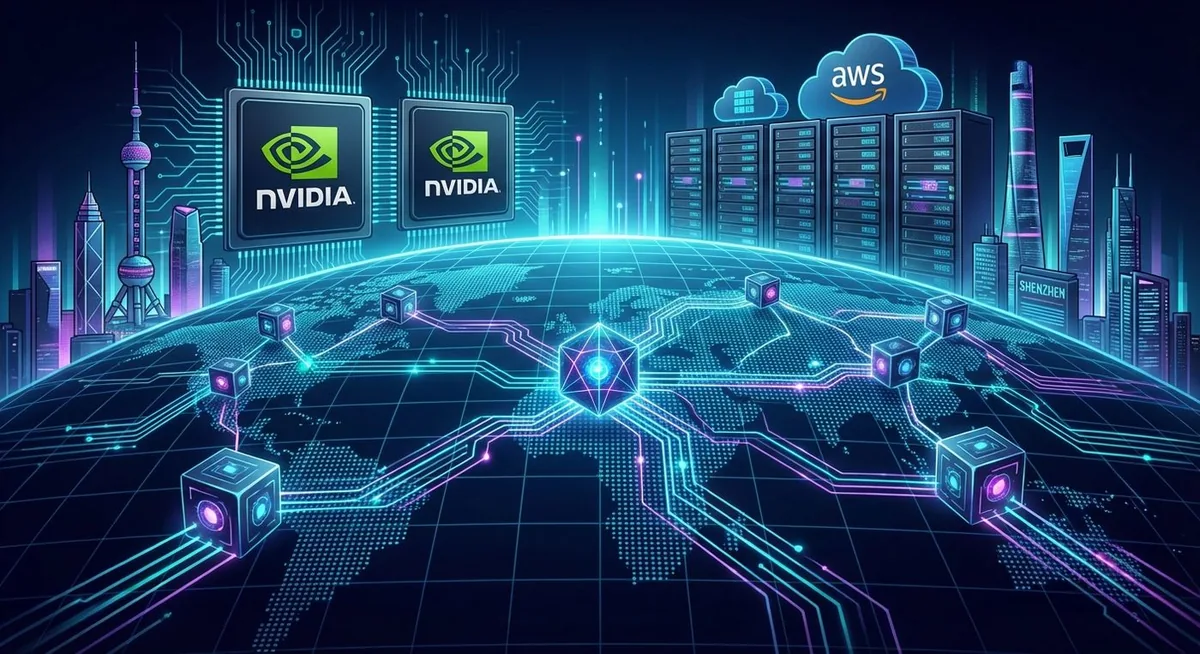
Nvidia Plans NemoClaw, AWS Launches Lightsail OpenClaw, China Backs Agent Ecosystem
Nvidia pitches enterprise NemoClaw agent platform to Salesforce, Google, and CrowdStrike. AWS ships pre-configured OpenClaw on Lightsail with Bedrock integration. Chinese cities offer subsidies to build OpenClaw "one-person company" ecosystems. Microsoft unveils Agent 365 for centralized agent governance. ClawVault structured memory skill spotlight.
🦞 OpenClaw Updates
v2026.3.2: Gateway Readiness Probes & Bug Fixes
OpenClaw v2026.3.2 continues the platform's march toward enterprise readiness. The most notable change this cycle is the addition of channel-backed readiness probes for the gateway (commit ab5fcfc), which enables Kubernetes and other orchestrators to health-check OpenClaw instances by verifying that messaging channels are actually connected — not just that the Node process is alive. For teams running OpenClaw behind load balancers or in auto-scaling groups, this is a significant operational improvement.
WhatsApp Media Upload Caps: Outbound media sends and auto-replies now honor the channels.whatsapp.mediaMaxMb setting with per-account overrides, ensuring inbound and outbound limits use the same channel config. This addresses an inconsistency where outbound media could exceed configured size limits.
Known Issues in v2026.3.2: The community has flagged several bugs this week. A tools breakage after first exec use has been reported on Linux deployments. The Control UI tools toggles don't persist on Windows — users must edit config files manually as a workaround. And a device auth signature mismatch in the Control UI is causing pairing failures for some users.
GPT-5.4 Model Tracking: Two separate GitHub issues (#36817, #37623) track the community's attempts to use OpenAI's GPT-5.4 via the openai-codex provider. The model appears in config but fails at runtime with "Unknown model / HTTP 404." The OpenClaw team has not yet confirmed whether this is a missing model mapping or an upstream API issue.
Feature Request: A community proposal for native GitHub-as-Infrastructure agent deployment is gaining traction — the idea is to use GitHub-hosted runners and git commits as persistence, enabling OpenClaw agents that live entirely inside GitHub without additional infrastructure.
Source: GitHub — openclaw/openclaw main branch
Channel-backed readiness probes are the kind of unsexy-but-essential feature that separates "running OpenClaw on a spare laptop" from "running OpenClaw in production." If you're deploying to Kubernetes, this alone justifies the upgrade. The GPT-5.4 tracking issues highlight an ongoing challenge: OpenClaw's model ecosystem moves faster than any single provider's API. The GitHub-as-Infrastructure proposal is fascinating — imagine OpenClaw agents that persist entirely in git, with no gateway or server at all. We're watching that one closely.
🔒 Security Tip of the Day
Audit Your Cloud-Hosted OpenClaw Instances
With AWS Lightsail now offering one-click OpenClaw deployment and managed hosting platforms proliferating, it's never been easier to spin up an OpenClaw instance. That's great for adoption — and dangerous for security if you don't follow through on configuration.
The Reco.ai security analysis published this week puts it bluntly: OpenClaw "can access email accounts, calendars, messaging platforms, and other sensitive services" and is "susceptible to prompt injection attacks." Cloud-hosted instances compound these risks because they're internet-facing by default. Here's our hardening checklist:
- Rotate your gateway token immediately: Default or leaked tokens are the #1 attack vector. Use
openclaw gateway token --rotateand store it in a secrets manager, not a config file. - Enable HSTS headers: If your instance is directly HTTPS-exposed (not behind a reverse proxy), enable the HSTS option added in v2026.2.23 to prevent downgrade attacks.
- Restrict exec security mode: Set exec security to
allowlistordenyunless you explicitly need unrestricted shell access. The defaultfullmode gives your agent the keys to the kingdom. - Run
openclaw doctor --fix: This catches misconfigurations including the SSRF policy default change from v2026.2.23. It takes 10 seconds and could save you from a data exfiltration incident. - Review connected channels: Every messaging channel you connect is a potential attack surface for prompt injection. Only connect what you actively use.
Bottom line: Cloud hosting removes the infrastructure burden but not the security burden. The easier it gets to deploy OpenClaw, the more critical it becomes to actually configure it properly. Don't let one-click deployment become one-click exposure.
⭐ Skill of the Day: clawvault
🔧 ClawVault — Structured Memory for OpenClaw Agents
What it does: ClawVault provides a structured memory system for OpenClaw agents that goes far beyond simple file-based memory. Key features include context death resilience (checkpoint/recover), structured storage with typed fields, Obsidian-compatible markdown output, local semantic search, and session transcript repair. When your agent crashes mid-task or context gets truncated, ClawVault can reconstruct where it left off.
Install: npx clawhub@latest install clawvault
Source: ClawHub Skills — ClawVault v1.5.1
Safety Note: ClawVault stores data locally by default. We verified the skill does not phone home or transmit data externally. As always, run a VirusTotal check before installation — the 386 malicious skills discovered on ClawHub last month by Koi Security researchers are a reminder that the ecosystem still lacks comprehensive automated vetting.
Why we like it: OpenClaw's biggest operational weakness is context death — when a long-running agent session hits token limits or crashes, everything in working memory is lost. ClawVault directly addresses this with checkpoint/recover semantics. The Obsidian-compatible output is a nice touch too: it means your agent's memory is human-readable and searchable in a knowledge management tool. Pair it with the skill-from-memory skill to automatically convert solved problems into reusable skills.
👥 Community Highlights
OpenClaw Gets Its Own Wikipedia Page
In a milestone that speaks to OpenClaw's cultural reach, the project now has a dedicated Wikipedia article. The page documents OpenClaw's history from its creation by Austrian developer Peter Steinberger through its rapid rebrand cycle (Clawdbot → Moltbot → OpenClaw) and its current status as one of GitHub's most-starred projects. The article also addresses security concerns head-on, noting that "misconfigured or exposed instances present security and privacy risks" and that the agent is "susceptible to prompt injection attacks." Having a Wikipedia page with balanced coverage — including the security critique — is a sign of maturity for the project.
CNET Deep Dive: "From Clawdbot to Moltbot to OpenClaw"
CNET published a comprehensive profile this week tracing OpenClaw's whirlwind journey: three different names in two weeks after launch, now a global phenomenon. The piece asks the central question that's captivating the tech world: "What if your AI agent assistant didn't just chat or write code but carried out real, helpful tasks — all on its own?" The article positions OpenClaw as the catalyst for a broader shift from AI chatbots to AI agents — tools that don't just answer questions but take action.
Source: CNET
India's DIY AI Agent Boom
Inc42 profiles what it calls "India's DIY AI Agent Boom," with data scientists, startup founders, and engineers across the country using OpenClaw to build personal AI "employees." The article describes OpenClaw as spawning a new category of autonomous systems that "solve daily challenges" — from managing freelance invoicing to automating customer support workflows. India's developer community has been particularly enthusiastic, with OpenClaw meetups springing up in Bangalore, Hyderabad, and Mumbai.
Source: Inc42
Every.to Tutorial: Setting Up Your First Personal AI Agent
The popular tech newsletter Every.to published a hands-on guide to setting up OpenClaw, with a practical tip that resonated across the community: "If what matters to you, use a stronger model." The guide walks through the full setup process and emphasizes that model choice is the single biggest lever for agent quality — upgrading from a mid-tier model to something like Claude Opus 4.5 dramatically improves task completion rates, especially for multi-step workflows.
Source: Every.to
All Things Open: Complex Tasks from a Simple Chat
The All Things Open community published a getting-started guide positioning OpenClaw as "an open source autonomous agent framework designed to execute advanced tasks through simple chat interfaces such as WhatsApp or Telegram." The article emphasizes what makes OpenClaw different from traditional chatbots: "Unlike traditional AI chatbots that stop at text generation, OpenClaw takes action." It's a clear, accessible introduction aimed at developers who haven't yet taken the plunge.
Source: All Things Open
🌐 Ecosystem News
Nvidia Plans Open-Source "NemoClaw" Agent Platform for Enterprises
The week's biggest ecosystem story: Nvidia is developing an open-source platform for AI agents called "NemoClaw," according to a Wired report confirmed by CNBC. Jensen Huang's company has begun pitching the product to enterprise software giants including Salesforce, Cisco, Google, Adobe, and CrowdStrike, seeking partnerships for what could become the enterprise standard for AI agent deployment.
"The platform will allow these companies to dispatch AI agents to perform tasks for their employees and is expected to include security and privacy tools." — CNBC
Key details: NemoClaw will be open source, meaning partners get free usage with early access in exchange for contributions. It will be chip-agnostic — companies can use it regardless of whether their products run on Nvidia hardware. The platform builds on Nvidia's existing NeMo platform for AI agent lifecycle management and represents the company's most significant move yet into the agentic AI space it helped enable with its GPU infrastructure.
Source: CNBC
AWS Launches Pre-Configured OpenClaw on Amazon Lightsail
Amazon Web Services announced general availability of OpenClaw on Amazon Lightsail, offering a one-click deployment path for running autonomous AI agents in the cloud. The Lightsail OpenClaw blueprint comes pre-configured with Amazon Bedrock as the default AI model provider. AWS recommends the 4 GB memory plan for optimal performance. Once launched, users can pair their browser and start chatting with their agent immediately — no additional configuration required.
"As someone who has experienced installing OpenClaw directly on my home device, I learned that this is not easy and that there are many security considerations." — AWS Blog
The launch validates OpenClaw's position as a cloud-ready platform while acknowledging the friction that has historically limited adoption. For AWS-centric teams, this is the lowest-barrier path to running OpenClaw in production. The Bedrock integration means access to Claude, Llama, Mistral, and other foundation models without additional API key management.
Source: AWS News Blog
Chinese Tech Hubs Back OpenClaw with Subsidies Despite Security Warnings
In a story that highlights the global stakes of the agent revolution, Reuters reports that local governments in several Chinese tech and manufacturing hubs have announced measures to build an industry around OpenClaw. Shenzhen's Longgang district — home to China's first AI and robotics bureau — released draft measures to build an OpenClaw-centered AI ecosystem and support "one-person companies." Tencent hosted an OpenClaw setup session in Shenzhen that drew children and retirees alongside developers.
"After appearing in November, the tool has become one of the fastest-growing projects in the history of GitHub." — Reuters
The Chinese adoption wave is happening despite regulatory warnings about security risks linked to personal data access. The tension between rapid adoption and data security mirrors the global conversation, but the scale is uniquely Chinese: entire municipal governments are now building policy frameworks around a single open-source AI agent project.
Source: Reuters
Microsoft Unveils Agent 365 for Enterprise Agent Governance
Microsoft announced Agent 365, a centralized control plane for monitoring and securing AI agents across an organization. The platform enables IT, security, and business teams to observe, govern, and secure agents — including those built with Microsoft's own AI platforms and those from ecosystem partners. ZDNET notes that Agent 365 addresses "the growing threat of unmanaged machine identities in corporate networks." Microsoft also previewed Copilot Cowork, which brings agentic multi-step task capabilities to Microsoft 365 Copilot — essentially their answer to the autonomous agent paradigm that OpenClaw pioneered in the open-source space.
Source: ZDNET · Microsoft Security Blog
ClawHub Ecosystem Update: 5,700+ Skills & Growing
The ClawHub skill registry has crossed 5,700 community-contributed skills. DataCamp published a comprehensive guide to the "Best ClawHub Skills," and the ecosystem now has multiple third-party directories (LobeHub, clawhub-skills.com, OpenClawLaunch.com) cataloging and reviewing available skills. Notable new additions include skill-from-memory, which converts completed tasks and conversation history into publishable OpenClaw skills — a meta-skill that could accelerate ecosystem growth significantly. The clawhub CLI now supports versioned installs, bulk operations, compression for CI/CD pipelines, and authenticated publishing.
Source: DataCamp · OpenClawLaunch
This week marks a phase transition for the AI agent ecosystem. When Nvidia builds an enterprise platform around agents, AWS offers one-click deployment, Chinese cities offer subsidies, and Microsoft launches a governance layer, we're no longer talking about a developer toy — we're watching the birth of critical enterprise infrastructure. The NemoClaw announcement is particularly significant: Nvidia making its platform chip-agnostic signals confidence that the agent market is big enough to justify open competition rather than lock-in. For OpenClaw specifically, the AWS Lightsail integration removes the last major adoption barrier for cloud-native teams. And the Chinese subsidy story is a bellwether: when governments start building policy around your project, you've crossed from software into geopolitics. Our advice? If you're still evaluating whether to adopt agent technology, the evaluation window is closing. The question isn't whether agents will become standard infrastructure — it's whether you'll be ready when they do.
Need help with OpenClaw deployment?
Move from agent experiments to production with SEN-X agentic AI implementation and enterprise deployment, backed by AI change management consulting, security architecture, and ongoing support.
Contact SEN-X →