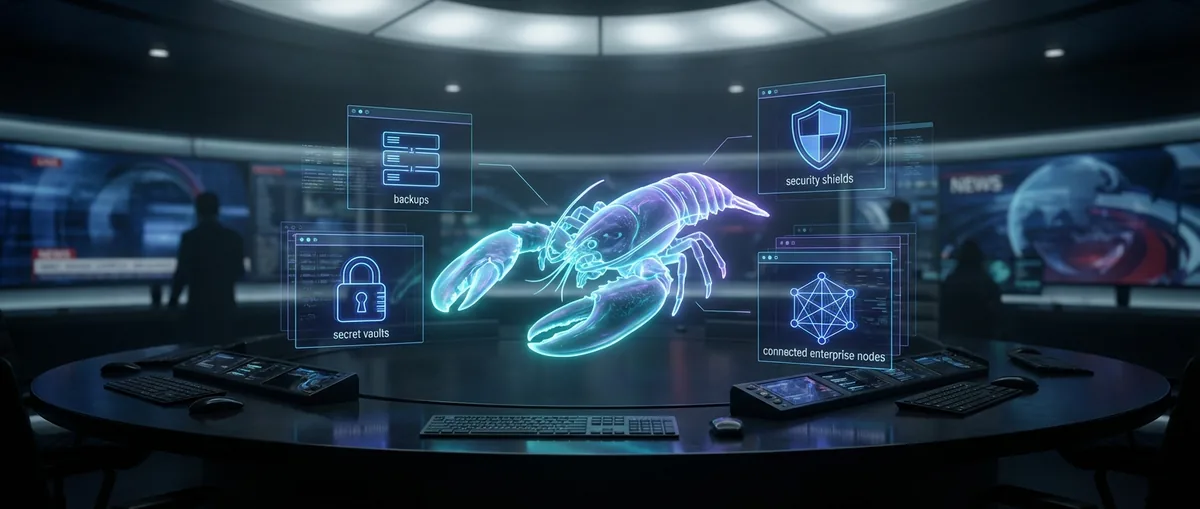
OpenClaw Daily — March 20, 2026: Recovery Discipline, Secret Hygiene, Skill Vetting, and the Enterprise Guardrail Race
OpenClaw’s March release cadence keeps tightening recovery and secret handling, skill vetting remains non-optional after ClawHub malware campaigns, and enterprise players are racing to wrap agents in governance without killing the magic.
🦞 OpenClaw Updates
Today’s OpenClaw story is not one giant flashy launch. It is something more important: the platform is visibly maturing in the unglamorous places that separate a fun personal agent from an agent you can trust with your actual life. The most relevant recent releases are v2026.3.13-1, v2026.3.8, and v2026.3.2, and together they tell a clear story: recovery, secrets, routing correctness, and safer defaults are getting real engineering attention.
Recovery is becoming a first-class feature
The quiet star of the month is backup and recovery. In v2026.3.8, OpenClaw added openclaw backup create and openclaw backup verify for local state archives, plus config-only backup mode and stronger verification logic. That matters because the worst time to discover your agent state is fragile is after an update, a bad prompt loop, or a disk incident. A backup command is not sexy, but it is exactly the kind of feature serious operators have been asking for.
“add openclaw backup create and openclaw backup verify for local state archives” — OpenClaw v2026.3.8 release notes
Just as important, the latest recovery release is explicit about being a recovery release. v2026.3.13-1 notes that “this release exists to recover the broken v2026.3.13 tag/release path.” That kind of transparency is healthy. It signals a project that is willing to clean up its own operational mistakes in public rather than bury them under hype.
Secret hygiene keeps expanding
v2026.3.2 continued one of the best trends in the project: pushing users away from loose plaintext credentials and toward more structured secret handling. The release expands SecretRef support “across the full supported user-supplied credential surface,” with fail-fast behavior on active surfaces and non-blocking diagnostics elsewhere. That is a mature design decision. If a credential reference is broken somewhere important, failing loudly is the right move.
“expand SecretRef support across the full supported user-supplied credential surface (64 targets total)” — OpenClaw v2026.3.2 release notes
That same release also added openclaw config validate, which is another deceptively important step. Agent operators do not just need more power; they need fewer ways to brick their own deployments with one sloppy config edit. In practice, validation before gateway startup reduces downtime, avoids mystery crashes, and makes self-hosting much less brittle.
The messaging-first posture is still the right default
One breaking change in v2026.3.2 deserves extra praise: onboarding now defaults tools.profile to messaging for new local installs. Translation: fresh installs do not immediately come with a broad coding and system-tools surface unless the operator explicitly chooses it. That is exactly the kind of default that keeps new users from accidentally turning an assistant into an overprivileged shell pilot on day one.
Meanwhile, v2026.3.13-1 and v2026.3.8 keep sanding down the rough edges: Discord metadata fetch handling, Telegram SSRF policy integration, cron deadlock prevention, UI continuity, and timezone support in Docker. None of those changes will dominate social media, but they are what make a cross-channel agent platform survivable in real use.
OpenClaw is moving past the “look what my lobster can do” phase and deeper into the “can I operate this safely for months?” phase. Backup verification, strict config validation, secret refs, and messaging-first defaults are exactly the right boring features. If you’re deploying OpenClaw seriously, today’s upgrade thesis is simple: prioritize releases that reduce blast radius and improve recoverability, not just releases that add new toys.
🔒 Security Tip of the Day
Treat every skill like third-party code, because it is
The security lesson of the OpenClaw ecosystem has not changed: the agent is powerful, but the real attack surface often arrives disguised as convenience. VirusTotal’s February write-up warned that “the fastest-growing personal AI agent ecosystem just became a new delivery channel for malware,” and its analysts reported “hundreds of OpenClaw skills that are actively malicious.” eSecurity Planet, citing Koi researchers, summarized the same problem as 341 malicious skills inside ClawHub, most tied to a single coordinated campaign.
That means the safest operator habit is boring and non-negotiable:
- Never trust setup steps blindly. If a skill asks you to paste shell commands, download password-protected ZIPs, or run binaries from random repos, stop there.
- Prefer skills with transparent code and minimal prerequisites. A good skill should mostly explain API configuration and expected permissions, not invent a scavenger hunt.
- Scan before install. VirusTotal now supports OpenClaw skill packages in Code Insight, which gives you at least one extra layer of scrutiny before you hand an extension to an agent with real access.
- Run least privilege everywhere. Even a “safe” skill becomes dangerous if the surrounding agent can read your secrets, mailboxes, browser sessions, and shell.
- Keep the agent boxed in. Sandboxed or ephemeral environments are still your friend, especially for testing new skills.
Bottom line: the OpenClaw ecosystem is now large enough to attract both excellent builders and opportunistic attackers. If your workflow includes installing skills casually, you are effectively doing package security whether you admit it or not.
⭐ Skill of the Day: Veryfi Skill
🔧 Veryfi Skill
What it does: Veryfi’s ClawHub skill turns receipts, invoices, and bank statements into structured data from inside an OpenClaw workflow. For operators doing expense capture, bookkeeping triage, or lightweight document extraction, that is a genuinely useful bridge between messaging-driven agents and a real business workflow.
Why it made the list: Today’s recommendation is not “safe because we feel good about it.” It made the list because the vendor’s own guidance actually includes some of the right precautions: test with non-sensitive samples first, confirm deletion and retention timelines, use limited-scope API keys when possible, and monitor usage logs.
Source: Veryfi’s ClawHub skill overview
Safety status: Recommend with caution. I did not get a direct VirusTotal report URL for this exact skill package during this run, so I am not treating it as pre-cleared. The recommendation here is conditional: only install after scanning the exact package or referenced artifacts through VirusTotal/Code Insight and only if the setup remains transparent and limited to the stated document-processing function.
Practice areas: Finance ops, expense automation, back-office workflow, document extraction, receipt intake.
👥 Community Highlights
The community conversation around OpenClaw has matured in a useful way. Less of it is “look, my agent tweeted something weird,” and more of it is “how do we run these things without becoming our own incident response team?” That is a sign of an ecosystem graduating from spectacle to operations.
OpenClaw’s documentation-and-ops layer keeps getting sharper
The recent release notes show a project obsessing over operator pain: malformed cron rows, updater restart recovery, routing duplication, launchd edge cases, config snapshot correctness, and shared auth continuity. Those are not glamorous community wins, but they are exactly the kinds of issues that generate support load and burn trust when left unresolved.
There is also an underappreciated community signal in how quickly release-note items are tied to issues and pull requests. That traceability matters. It gives operators a clearer map of what changed, why it changed, and whether a bug they care about has a real path to resolution.
Search and retrieval are becoming practical, not just aspirational
v2026.3.8 added Brave web search support for an llm-context mode that can return extracted grounding snippets with source metadata. That is a meaningful bridge between “the agent can search” and “the agent can show me why it said that.” For teams using OpenClaw for research, market scanning, or internal knowledge workflows, source-grounded retrieval is not a luxury feature. It is the minimum viable antidote to hallucinated confidence.
“web_search can call Brave's LLM Context endpoint and return extracted grounding snippets with source metadata” — OpenClaw v2026.3.8 release notes
That small feature says something larger about the community’s expectations: people no longer just want clever agent behavior. They want receipts.
🌐 Ecosystem News
Red Hat is making the strongest enterprise case for “bring your own agent”
Red Hat’s latest OpenClaw-focused post is one of the clearest summaries yet of the enterprise dilemma: agent frameworks are exploding, but the actual hard part is not getting an agent to work on a laptop. It is getting that agent to run with identity, isolation, policy, observability, and auditability once it touches production systems.
“What doesn't change is the gap between ‘it works on my laptop’ and ‘it runs in production, securely, at scale, with audit trails.’” — Red Hat
Red Hat’s pitch is not that OpenClaw needs to become an enterprise framework. It is that infrastructure should wrap the agent with the controls the agent itself does not natively provide. That is a smart framing, and it mirrors where the broader market is heading: governance around agents rather than faith inside agents.
NVIDIA’s message is similar: guardrails are now part of the stack
The other big ecosystem signal comes from NVIDIA’s Agent Toolkit push. The relevant quote from Jensen Huang is the one everyone in this space will keep recycling: “Claude Code and OpenClaw have sparked the agent inflexion point – extending AI beyond generation and reasoning into action.” That is both praise and warning. Once AI takes action, the supporting stack changes. Logging, identity, policy, partner integrations, and cost controls stop being optional accessories.
NVIDIA’s OpenShell positioning is basically an admission that enterprise buyers want agent capability without surrendering data control or operational accountability. That does not weaken OpenClaw. If anything, it confirms OpenClaw has become important enough that infrastructure vendors now want to standardize around it.
The skills market still has a trust problem
On the consumer and prosumer side, the ClawHub story is still the biggest drag on ecosystem trust. VirusTotal’s recent post explains the pattern with brutal clarity: sometimes “nothing in the file is technically malware by itself. The malware is the workflow.” That is the key line. In agent ecosystems, abuse increasingly lives in instructions, prerequisites, wrappers, and social engineering — not just in binaries that signature scanners can trivially catch.
That is why ecosystem quality will increasingly depend on trust infrastructure: reputation, signing, static analysis, setup transparency, scoped permissions, and maybe eventually stricter marketplace review. Right now, the operator still has to do too much of that job manually.
The OpenClaw ecosystem is splitting into two layers. The first layer is raw capability: better tools, better routing, better recovery, better multimodal support. The second layer is trust infrastructure: backups, validation, secrets, policy wrappers, marketplace scanning, and enterprise guardrails. The winners will be the teams that understand both. Pure capability without control becomes a headline for the wrong reasons. Pure control without capability becomes shelfware. OpenClaw’s opportunity is that it already has the energy and community; now it needs the trust layer to keep catching up.
Practice Areas
Agent Operations Security Hardening Workflow Automation Enterprise AI Skill Governance
Need help with OpenClaw deployment?
SEN-X provides enterprise OpenClaw consulting — architecture, security hardening, custom skill development, deployment reviews, and ongoing operator support.
Contact SEN-X →