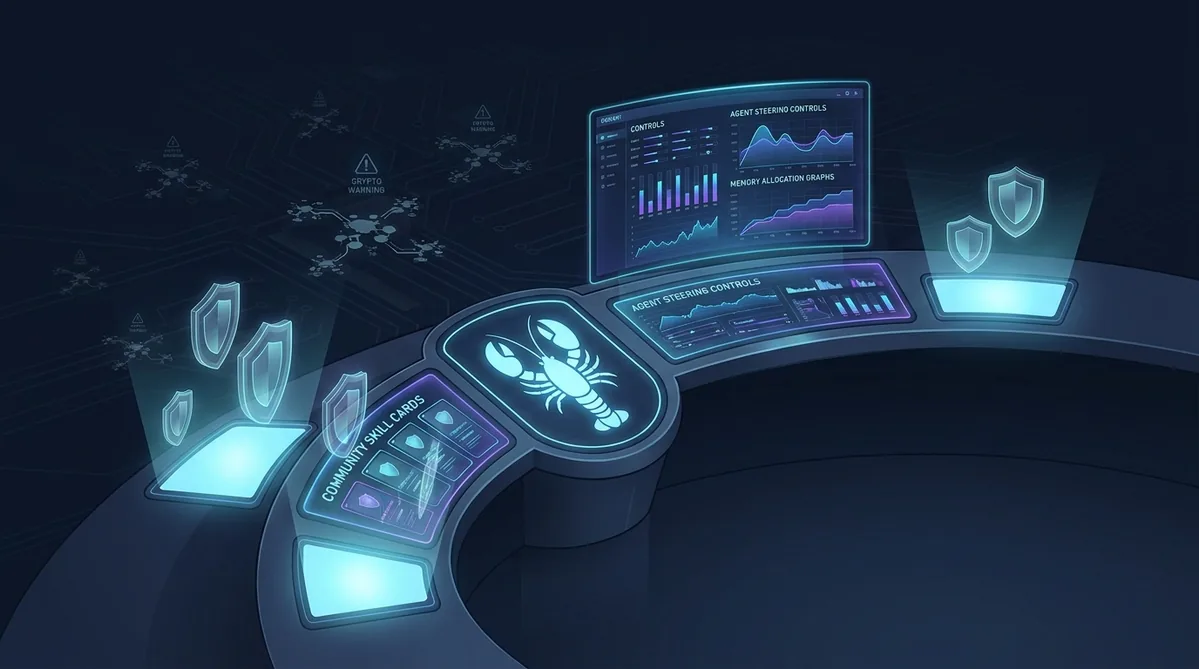
OpenClaw 2026.4.29 Sharpens Steering While ClawHub’s Crypto Swarm Forces a Security Reset
OpenClaw’s latest beta turns operator control into the headline feature: default steering for active runs, visible reply enforcement, richer memory tooling, and fresh NVIDIA model support. At the same time, a report on ClawHub’s crypto-swarm skills is a blunt reminder that the fastest-growing agent ecosystem still lives or dies on trust.
🦞 OpenClaw Updates
Today’s real OpenClaw story is not hype. It is operator ergonomics. The freshly published v2026.4.29-beta.1 release notes read like the kind of changelog you get when a project starts absorbing lessons from people running agents all day instead of just demoing them. The headline is steering. According to the release, “messaging and automation get active-run steering by default, visible-reply enforcement, spawned subagent routing metadata, and opt-in follow-up commitments for heartbeat-delivered reminders.” That’s not flashy consumer marketing, but it matters a lot in practice.
Active-run steering by default changes the social contract between an operator and an agent. Instead of waiting awkwardly for the current run to finish, users can now push guidance into the next model boundary more naturally. The companion queueing changes — including a “500ms followup fallback debounce” — suggest the team is spending serious effort on conversational feel under real load, not just raw capability. That is exactly where mature agent products start separating from toy demos.
The release also tightens message governance. OpenClaw now offers a global messages.visibleReplies control so operators can require visible output to go through explicit messaging surfaces. That may sound niche, but it’s a huge deal for companies worried about silent background action or ambiguous agent behavior in shared chats. In group and channel environments, clarity beats cleverness.
Memory is the other notable arc. The same release says memory “grows into a people-aware wiki with provenance views, per-conversation Active Memory filters, partial recall on timeout, and bounded REM preview diagnostics.” In plain English: OpenClaw is moving beyond dumb retrieval into something more structured and inspectable. Provenance matters. People cards matter. The ability to limit memory by conversation matters even more if you are mixing personal, client, and community contexts in one agent runtime.
Model support keeps broadening too. NVIDIA onboarding and model catalog work arrived alongside “safer Codex/OpenAI-compatible replay and streaming behavior.” That lines up with a broader industry move toward multimodal and multi-provider agent stacks, where the best system is rarely married to a single model vendor. For teams deploying OpenClaw seriously, this is the release pattern you want: more control, more observability, more flexibility.
“Messaging and automation get active-run steering by default, visible-reply enforcement, spawned subagent routing metadata, and opt-in follow-up commitments for heartbeat-delivered reminders.” — OpenClaw v2026.4.29-beta.1 release notes
The practical takeaway: if you run OpenClaw for support, internal ops, or personal automation, this beta looks worth studying even before stable. It is not a vanity release. It is a control-plane release.
OpenClaw is getting better in the exact places skeptical operators care about most: steering, boundaries, provenance, and safe routing. That is a healthier signal than another round of “AI that does things” slogans. The project still moves fast, but this week’s velocity feels more disciplined than chaotic.
🔒 Security Tip of the Day
Treat every external skill like software supply chain risk, not like a prompt
The sharpest security lesson today comes from The Register’s report on 30 ClawHub skills that quietly recruited agents into a crypto-linked swarm. The article says the skills “silently co-opt” AI agents, trigger registration with a third-party service, store credentials on disk, and can even generate a Hedera wallet without the human explicitly approving any of it. That is ugly, even if it sits in the gray zone between malware and “just instructions.”
“The mechanism is identical regardless of intent: an AI agent silently registering with a third party server, reporting its capabilities, generating crypto keys, and accepting remote tasks – all without the user initiating or approving any of it.” — Ax Sharma, Manifold Security, via The Register
My practical advice is simple:
- Read the SKILL.md before install. Skills are executable behavior specifications, not harmless snippets of prose.
- Check provenance and reputation. Prefer first-party or clearly maintained repositories with visible issue history and real community use.
- Run a VirusTotal or equivalent review when the package includes scripts, binaries, or fetched dependencies. This is mandatory in our shop for a reason.
- Watch for undeclared network behavior. Any skill that phones home, writes credentials, or generates wallets should be treated as high risk unless that behavior is explicit and central to the skill’s purpose.
- Limit agent permissions before skill install. If the skill turns out to be sketchy, scoped tools and network restrictions are what save you.
Bottom line: agent ecosystems are becoming app stores whether they like it or not. If you install skills with the same blind trust people used for browser extensions in 2013, you are going to have a bad time.
⭐ Skill of the Day: github
🔧 GitHub Skill
What it does: The GitHub skill gives an OpenClaw agent structured ways to inspect issues, pull requests, CI runs, releases, and repository metadata through the gh CLI. For engineering teams, it is one of the highest-leverage skills you can add because it turns “check the repo” from a vague natural-language request into a repeatable workflow.
Why it’s today’s pick: It pairs perfectly with the week’s OpenClaw release cadence. When a project like OpenClaw ships large, fast-moving release notes, being able to query releases, compare PRs, review checks, and inspect issue state cleanly is far more useful than a generic browser-scraping skill.
Safety verification: I am recommending the built-in github skill shipped with the local OpenClaw installation rather than an unknown third-party ClawHub package. Its SKILL.md points agents to the standard gh CLI, documents exact commands, and does not introduce hidden remote services. That makes it a safer recommendation than an unverified community skill — especially on a day when ClawHub trust is the story.
Good use cases: release monitoring, PR status summaries, CI failure triage, and quick repo analytics from chat.
Operator note: Safe does not mean harmless. A GitHub-capable agent can still comment, close issues, or merge PRs if you authorize those actions. Start read-only in practice, then widen permissions deliberately.
👥 Community Highlights
OpenClaw is crossing from developer subculture into mainstream curiosity, and that shift showed up clearly this week. The strongest example is John Herrman’s Intelligencer piece, which is valuable less because it flatters the ecosystem and more because it captures how the product actually feels to an intelligent outsider. Herrman describes OpenClaw as “the AI that actually does things,” then immediately collides with the reality of permissions, Node versions, security warnings, and model-provider friction.
“OpenClaw is a hobby project and still in beta… If you’re not comfortable with security hardening and access control, don’t run OpenClaw.” — quoted installer warning in New York Magazine’s Intelligencer
That tension is real. Power users hear that warning and think, fine, worth it. Mainstream users hear it and think, why on earth would I do this to myself? Both reactions are rational. If anything, the article is a useful mirror for the community: OpenClaw’s magic is obvious once it works, but setup and trust still demand too much resilience from normal people.
The community story underneath the story is that OpenClaw now has cultural gravity. When New York Magazine devotes a long reported essay to your agent framework, you are no longer just a GitHub curiosity. That visibility is good for adoption, but it also raises the bar. Users will not separate “the ecosystem” from “that one bad skill,” or “the framework” from “the terrifying setup experience.” They will treat it as one product whether maintainers like it or not.
Meanwhile, the OpenClaw repo itself keeps signaling momentum. The release notes thank a wide swath of contributors across messaging, memory, security, channels, and provider integrations. That breadth matters. Healthy open ecosystems are not just about star counts; they are about whether the work is spreading across maintainers and use cases. This week, it appears to be.
The community’s biggest win right now is attention. Its biggest risk is confusing attention for trust. OpenClaw is attracting the exact kind of audience that will not forgive rough edges forever. The next phase is less about virality and more about boring excellence.
🌐 Ecosystem News
The broader agent stack kept moving fast outside OpenClaw too. NVIDIA’s Nemotron 3 Nano Omni announcement is especially relevant because it targets one of the most annoying architectural realities in production agents: perception is fragmented. NVIDIA says the model unifies video, audio, image, and text so systems no longer have to bounce context between separate subsystems. The company claims “9x higher throughput than other open omni models with the same interactivity,” and specifically positions the model for computer use, document intelligence, and audio-video reasoning.
That matters to OpenClaw operators because the future agent stack is clearly modular. Planning, memory, perception, and action will not all live in one giant monolithic model forever. OpenClaw’s growing provider flexibility fits that world nicely; NVIDIA’s launch strengthens the case that specialized sub-agents and model routing are not a temporary hack but the long-term architecture.
Reuters also reported that Amazon introduced new agentic software for recruiting and supply chain workflows, including a product called Connect Talent that can “conduct AI-led interviews around the clock and prepare notes for recruiters, all without human intervention.” Amazon’s language around “humorphism” — making AI adapt to human workflows — feels a bit branding-heavy to me, but the enterprise signal is unmistakable. Large companies are no longer talking about agents as demos. They are attaching them to hiring, planning, and operational throughput.
“The hope is that such agents can plan, decide and act on their own, a fast-growing field that has also sparked concerns over safety and oversight.” — Reuters on Amazon’s new agentic software push
Put those threads together and the ecosystem picture is pretty clear. OpenClaw is evolving its local control plane. NVIDIA is pushing open multimodal perception. Amazon is hard-selling enterprise workflow agents. And the ClawHub scare is forcing everyone to confront governance. This market is not slowing down. It is professionalizing under pressure.
For buyers and builders, that creates a sharper set of choices than even a month ago. If you want maximum flexibility and local control, OpenClaw keeps getting more credible. If you want turnkey enterprise packaging, the cloud giants are coming hard. If you want to build on top of community skills, you now need a real supply-chain policy, not vibes.
The winning agent stacks in late 2026 will probably look less like a single magic assistant and more like disciplined systems: strong routing, constrained tools, explainable memory, multimodal perception modules, and real approval boundaries. OpenClaw is inching toward that architecture. The rest of the market is, too.
Need help with OpenClaw deployment?
SEN-X helps teams deploy OpenClaw with sane guardrails — security reviews, skill vetting, memory strategy, model routing, and production operations support.
Contact SEN-X →