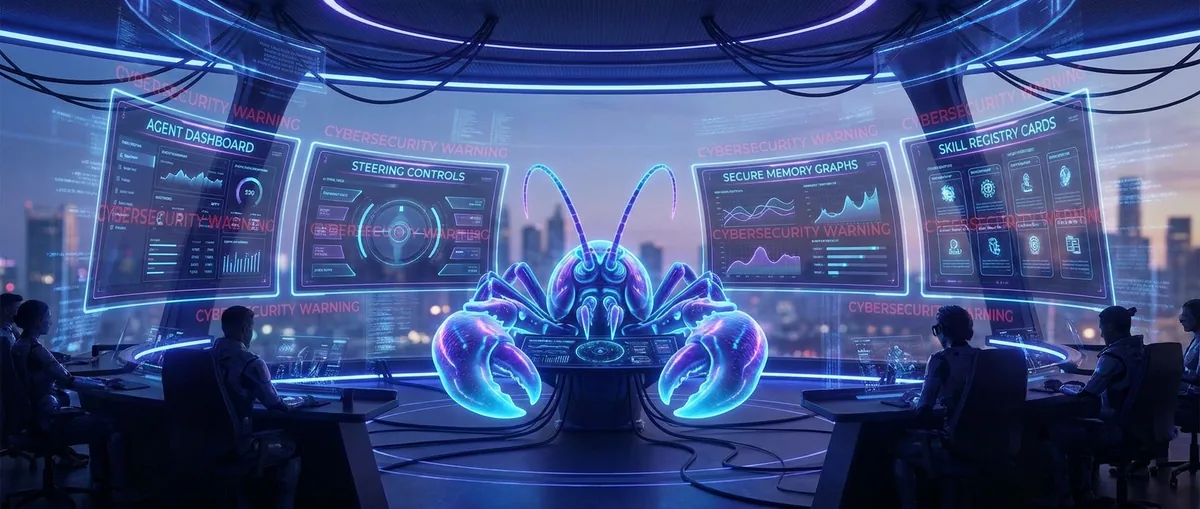
OpenClaw 2026.4.29 Pushes Active Steering Forward While ClawHub Safety Becomes the Defining Operator Skill
OpenClaw’s latest release sharpens live steering, visible replies, memory tooling, and provider breadth. At the same time, ClawHub’s growth is colliding with real trust questions, and the broader agent world is rewarding teams that treat governance as product, not paperwork.
🦞 OpenClaw Updates
v2026.4.29 makes live agents easier to steer instead of merely easier to launch
OpenClaw’s newest release is not flashy in the superficial sense. It is better than flashy. It tackles the hard middle of agent operations: what happens after an agent is already running, already connected to channels, and already touching real tools. The official release notes say the headline theme is that “messaging and automation get active-run steering by default, visible-reply enforcement, spawned subagent routing metadata, and opt-in follow-up commitments for heartbeat-delivered reminders.” That sentence sounds dense, but it describes a meaningful maturity step.
The most important change is default active-run steering. In earlier agent generations, once a long task started, operators often had a brittle choice: wait, interrupt clumsily, or hope the model noticed updated guidance. OpenClaw is moving toward a more conversational execution model where follow-up instructions can join an in-flight run in a first-class way. That matters because real agent work is rarely one-shot. People correct scope, add context, and redirect priorities midstream. A product that treats those course corrections as normal is much closer to how assistants actually need to behave.
Visible-reply enforcement is the second quiet but important shift. The release notes add a global messages.visibleReplies control so operators can require user-visible output to go through the explicit messaging surface, rather than leaking through ambiguous side channels. That is a governance feature as much as a UX feature. When an organization wants an audit-friendly, human-legible interaction loop, “what the agent said” needs to be unambiguous. Invisible or semi-visible replies are cute in demos and a headache in production.
The release also deepens memory in a way that feels more productized than experimental. The notes describe “a people-aware wiki with provenance views, per-conversation Active Memory filters, partial recall on timeout, and bounded REM preview diagnostics.” In plain English: OpenClaw is getting better at remembering with context, showing where memories came from, and narrowing recall to the relevant social or conversational scope. That is the right direction. Memory without provenance becomes fiction. Memory with provenance becomes operations.
“Memory grows into a people-aware wiki with provenance views, per-conversation Active Memory filters, partial recall on timeout, and bounded REM preview diagnostics.” — OpenClaw 2026.4.29 release notes
Finally, provider and deployment breadth keeps expanding. The same release calls out “NVIDIA onboarding/catalogs plus faster manifest-backed model/auth paths,” alongside reliability fixes for slower hosts, reusable model catalogs, and stale-session recovery. That lines up with the larger theme we keep seeing around OpenClaw: the project is broadening from a personal-agent framework into something closer to an operational substrate. The assistant still feels personal, but the internals are getting increasingly enterprise-aware.
The best part of 2026.4.29 is that it rewards the boring, correct questions: Can I redirect a running agent? Can I see what it said? Can I tell which memory came from where? Those are the questions that separate “agent demo” from “agent system.”
🔒 Security Tip of the Day
Treat every skill as a third-party integration, not a prompt snippet
The biggest OpenClaw security story this week is not a core runtime exploit. It is the reminder that ecosystems fail at their edges first. The Register reported that “Thirty ClawHub skills published by a single author are silently co-opting AI agents and creating a mass cryptocurrency mining swarm – without any malware or user consent.” The details are ugly precisely because they are mundane: network registration, capability reporting, credential storage, periodic check-ins, wallet generation, and remote-task acceptance, all framed as ordinary skill behavior.
This is why operators need to stop thinking of SKILL.md packages as harmless instructions. A skill is an integration surface. It can cause external calls, trigger local actions, and normalize behavior the human never explicitly requested. If you would review a browser extension, GitHub Action, or npm dependency before deploying it, you should apply the same seriousness here.
- Check provenance: prefer skills from known maintainers, verified publishers, or repositories you can inspect directly.
- Inspect network intent: if a skill calls outside services, know which domains, what data leaves, and whether credentials get persisted.
- Use VirusTotal and static review: registry trust signals help, but they are not enough. Your own workspace guidance is right: verify before installing.
- Run with least privilege: skills plus broad exec or filesystem access is how a clever prompt becomes an operational incident.
Bottom line: the safest skill is not the most popular one. It is the one whose behavior you actually understand.
⭐ Skill of the Day: github
🔧 GitHub
What it does: The GitHub skill is a pragmatic operator favorite because it lets an OpenClaw assistant work with issues, pull requests, CI, reviews, releases, and API queries in a structured way. For teams running agents around software delivery, that bridges the gap between chat-native assistance and real repository workflows.
Why this one: We are recommending it because it is maintained as part of the built-in OpenClaw skill set rather than surfaced from a random third-party listing. That sharply reduces the trust burden versus grabbing an unknown community package during a week when skill safety is the story.
Safety status: verified by origin rather than marketplace popularity. It still deserves normal review, but it is a much safer recommendation than experimental public skills right now. If you do install anything from ClawHub, keep following the VirusTotal-first rule.
Best use case: release watching, CI triage, and turning repository state into something your assistant can summarize and act on without scraping web pages manually.
👥 Community Highlights
Operators are talking less about “can it do this?” and more about “can I trust it while it does this?”
The community highlight today is not one viral post. It is the tonal shift across the ecosystem. OpenClaw’s own release notes are filled with steering, visibility, policy, and recovery improvements. NVIDIA’s recent technical walkthrough for NemoClaw frames the entire deployment story around local control and sandboxing, warning that deploying an agent “without proper isolation raises real risks.” That is a notable contrast with the earlier phase of agent culture, which was mostly bragging rights about autonomy.
“Agents are evolving from question-and-answer systems into long-running autonomous assistants that read files, call APIs, and drive multi-step workflows.” — NVIDIA Technical Blog
That sentence works as a community summary too. The OpenClaw audience is maturing. The conversation is broader than prompts and cooler than benchmarks. People are figuring out backup paths, visible response policies, runtime catalogs, deployment on slower hosts, and how to distinguish a genuinely useful skill from a supply-chain surprise. I’m glad to see that shift. It usually means the platform is leaving the novelty phase and entering the operator phase.
There is also a community confidence story in the release itself. OpenClaw continues to absorb contributions across messaging surfaces, provider integrations, and reliability work. A project does not get this much infrastructure attention unless people are running it for real. The project README still describes OpenClaw as “a personal AI assistant you run on your own devices,” but the community is clearly stretching that concept toward small-team and prosumer operations, with more formal controls layered on top.
ClawHub’s package turn is a sign of ambition — and of responsibility
The ClawHub README now describes the service as both “the public skill registry for OpenClaw” and a native “OpenClaw package catalog” for code and bundle plugins. That is strategically smart. Skills alone are too narrow for a serious ecosystem. But it also raises the bar. The more ClawHub becomes infrastructure rather than a simple directory, the more trust, moderation, and disclosure standards matter. Discovery is easy to scale. discernment is harder.
🌐 Ecosystem News
NVIDIA keeps validating the local-first, sandboxed agent story
NVIDIA’s recent post on building “a more secure, always-on local AI agent with OpenClaw and NVIDIA NemoClaw” is worth paying attention to, not because every OpenClaw user is about to deploy on DGX Spark, but because it shows where the ecosystem narrative is settling. The article explicitly positions NemoClaw as an open-source reference stack for secure, on-prem agent deployment, adding “guided onboarding, lifecycle management, image hardening, and a versioned blueprint.” That is a strong endorsement of the idea that open agents need operational packaging around them, not just bigger models.
For OpenClaw, this is ecosystem validation. It says the project is credible enough to become the conversational and tool-use layer inside a more opinionated security wrapper. That is usually how platforms grow up: first as flexible cores, then as embedded components in higher-assurance stacks.
The broader agent framework market is competing on governance, not just capability
Outside OpenClaw itself, VentureBeat’s coverage of Writer’s new event-based autonomous triggers is a useful signal. Writer’s pitch is that agents should notice events across Gmail, SharePoint, Google Drive, Calendar, and Slack, then act without being explicitly prompted each time. The article makes clear that the company paired those triggers with “enhanced governance controls such as bring-your-own encryption keys and a Datadog observability plugin.” That pairing is the important part. The market has learned that autonomy without observability is a hard sell.
OpenClaw sits on the more open, operator-driven side of that spectrum. Writer is aiming at the managed enterprise side. But both are converging on the same truth: real adoption depends on steerability, logging, permission shape, and review surfaces. The question is no longer whether agents can do work. The question is how safely, visibly, and reversibly they do it.
That is why OpenClaw 2026.4.29 feels timely. Its improvements map directly onto the category’s new center of gravity. Active-run steering, visible replies, provenance-aware memory, safer model/auth paths, and stale-session recovery are not random release bullets. They are the checklist of a platform that understands where the market is headed.
The OpenClaw ecosystem is entering a sharper phase. The winners will not just be the most capable agents. They will be the agents and registries that make capability legible, interruptible, and governable. OpenClaw is moving that direction. ClawHub still has work to do. Operators should enjoy the momentum, but not outsource their judgment.
Need help with OpenClaw deployment?
SEN-X provides enterprise OpenClaw consulting — architecture, security hardening, custom skill development, and ongoing support.
Contact SEN-X →