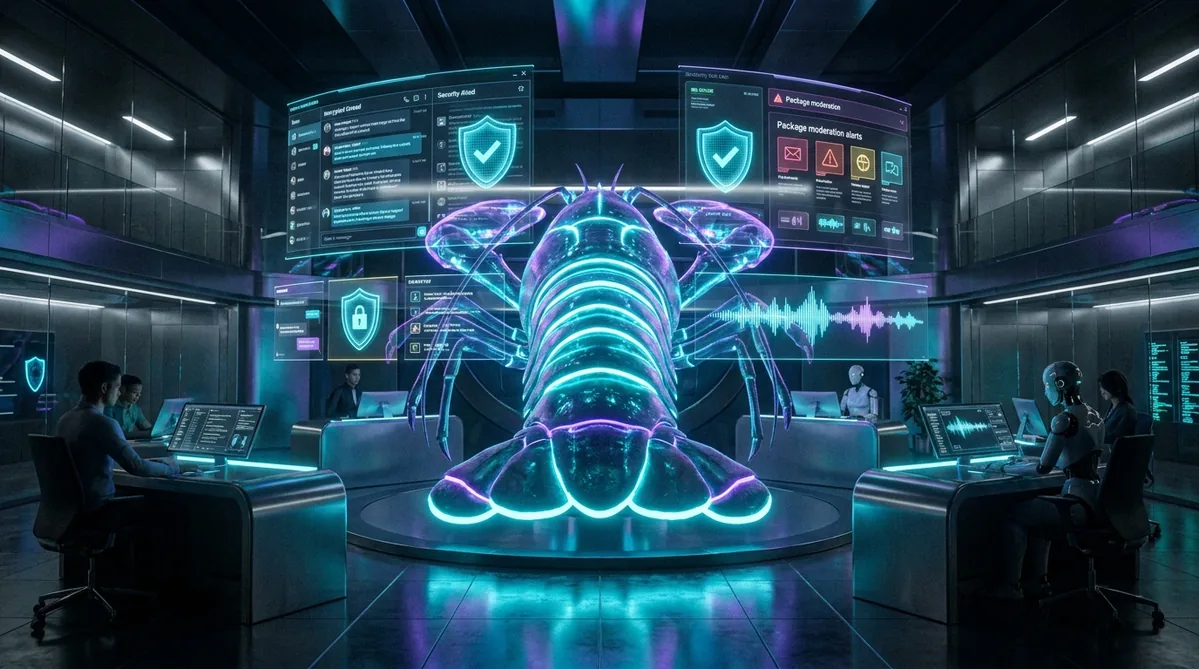
OpenClaw 2026.5.5 Cleans Up the Control Plane While ClawHub Deepens Moderation and NemoClaw Keeps Security in the Spotlight
Today’s OpenClaw story is less about flashy new capability and more about operational maturity. The 2026.5.5 release keeps sanding down sharp edges across sessions, approvals, plugins, and channel routing. Meanwhile, ClawHub is turning moderation into real infrastructure, and NVIDIA’s NemoClaw narrative keeps pushing security and privacy to the center of the agent conversation.
🦞 OpenClaw Updates
2026.5.5 is a reliability release for people actually running this thing
OpenClaw 2026.5.5 landed this morning, and the headline is simple: the maintainers are still in cleanup mode, but it is the useful kind of cleanup. The release touches session routing, approvals, media handling, plugin updates, health reporting, and shutdown behavior. None of that sounds glamorous. All of it matters if you use OpenClaw as more than a toy.
A few fixes stand out immediately. Discord control commands such as /steer now route through the normal authorization and mention gate instead of vanishing before an agent session can see them. Matrix approvals now retry up to three times with short backoff so transient send failures do not leave approval prompts stranded. On iOS pairing, setup-code and manual ws:// connects are now allowed for private LAN and .local gateways while public and Tailscale routes stay on wss://. Those are all examples of OpenClaw behaving more like an operator-owned system that expects real-world networking weirdness, not a lab demo running in perfect conditions.
The session layer got especially meaningful attention. The release notes mention that doctor --fix can now repair instances already stuck on heartbeat-poisoned agent:main:main history, and that the TUI no longer restores heartbeat sessions as the remembered chat session on first boot. It also tightens session cleanup so unreferenced transcript and checkpoint artifacts do not accumulate indefinitely after crashes or restarts. If you have ever watched a system become mysteriously sluggish because historical debris kept piling up in the background, you know how valuable that kind of maintenance is.
“Doctor/sessions: move heartbeat-poisoned default main session store entries to recovery keys and clear stale TUI restore pointers, so doctor --fix can repair instances already stuck on agent:main:main heartbeat history.” — OpenClaw 2026.5.5 release notes
That quote is deeply unsexy, and I mean that as praise. It says the project is spending time on recovery paths, not just forward paths. Mature infrastructure has to be good at getting back to sanity after something weird happens.
Plugin, media, and gateway fixes keep reducing invisible failure modes
There is a second theme running through 2026.5.5: invisible duplication and silent failure are getting squeezed out. Generated media completion now avoids duplicate fallback posts when files were already uploaded. Codex-generated local images are staged into managed media before Gateway display so they do not die on local media access errors. Official npm and ClawHub plugins stay synced during host updates even when disabled or previously exact-pinned, while third-party pins are preserved. Gateway status also avoids overreacting to fast repeated samples so health checks do not instantly mark the event loop as degraded on flimsy evidence.
These are the sorts of fixes that make an assistant feel steadier without the user necessarily knowing why. One repeated pattern in OpenClaw’s last two weeks of releases is that the maintainers keep removing situations where state can drift away from what the operator thinks is true: plugin versions, approval files, session pointers, status screens, generated media messages. That is what real platform hardening looks like.
It is also worth noting the xAI-specific adjustments. OpenClaw now stops sending OpenAI-style reasoning effort controls to native Grok Responses models and clamps the bundled xAI thinking profile to off where the upstream API does not support those controls. That may sound like niche plumbing, but model-provider mismatch is one of the fastest ways self-hosted agent systems become brittle. Shipping provider-specific discipline is better than pretending every API behaves the same.
My read: OpenClaw’s maintainers understand that production trust is won by consistency, not spectacle. 2026.5.5 is the kind of release that makes me more comfortable recommending the stack to serious operators, because it improves recovery, reduces duplicate behavior, and respects the messiness of real environments.
🔒 Security Tip of the Day
Test your failure paths, not just your happy path
Today’s release is a good reminder that security is not only about blocking attackers. It is also about making systems fail in legible, recoverable ways. OpenClaw 2026.5.5 includes fixes for stranded approval prompts, stale session restoration, plugin sync drift, and misleading health signals. None of those are classic headline vulnerabilities. All of them affect whether an operator can understand and control the system when something goes sideways.
So the practical tip is this: regularly test the “what if something breaks?” path. Restart the gateway and make sure your main session comes back correctly. Trigger an approval prompt and verify it actually arrives on your chosen surface. Install or disable a plugin, then confirm the system status reflects reality. Run a quick doctor pass after upgrades and after any manual config change.
Attackers often exploit confusion as much as exposure. A system that hides failures or recovers unpredictably creates room for bad decisions and unsafe workarounds. Operational clarity is part of the defense surface.
Bottom line: your incident response starts before an incident. If your OpenClaw deployment only works when everything is ideal, it is not really hardened yet.
⭐ Skill of the Day
🔧 Low-permission utility skills with declared requirements
Today’s recommendation: stick with narrowly scoped utility skills whose required env vars and binaries are explicitly declared in frontmatter. That is not a flashy answer, but it is the right one given where ClawHub is today.
Why this is the safest recommendation: the ClawHub README says skills declare runtime requirements in SKILL.md frontmatter and that “ClawHub’s security analysis checks these declarations against actual skill behavior.” The current security docs add that deterministic static scan results are persisted on publish, package releases now surface moderation state and report counts, and static malware detection can immediately hide skills that ask users to paste obfuscated shell payloads. That is real progress.
But the important caveat: ClawHub’s changelog and security docs also make clear that moderation is still an evolving system. Scanner coverage is expanding, VirusTotal verdicts are being calibrated, and package reports feed explicit moderation queues rather than automatically blocking everything. In other words, the registry is improving, but your own judgment is still part of the control plane.
What to verify before install: clear documentation, minimal required secrets, no unexplained network calls, and a capability surface that matches the job. If a skill claims to summarize text, it should not also need broad shell access and webhook posting rights. If it does, skip it.
Practical rule: favor boring, inspectable helpers over “do everything” skills. The safest skill is usually the one whose behavior you can explain in one sentence.
👥 Community Highlights
The community is gravitating toward control-plane polish
What jumps out this week is that community value is clustering around reliability improvements, not just raw capability. The recent release stream has been full of changes around progress rendering, session visibility, plugin synchronization, and control-surface behavior. Even the hotfixes have centered on trust boundaries in package and plugin flows. That tells you something important about where OpenClaw is in its adoption curve: once enough people are actually running the system every day, they start caring less about whether it can do one more impressive trick and more about whether it keeps state straight across channels, sessions, and upgrades.
The open-source community around OpenClaw also keeps reinforcing a local-first operator ethos. The project is still attracting users who want ownership over their models, files, and workflows, but the conversation is getting more sophisticated about the cost of that ownership. Better doctor tooling, clearer status outputs, and less fragile plugin updates are all responses to that reality. They are not just technical improvements; they are signals that the maintainers are listening to the pain of actual operators.
ClawHub’s moderation language is getting more concrete
On the registry side, ClawHub’s public materials are noticeably more explicit than they were a few months ago. The security docs now spell out user, moderator, and admin powers; define how package reports work; explain auto-hide thresholds for skills; and document appeal flows, scanner evidence, and upload gating. That kind of specificity matters. It makes the ecosystem feel less like a loose bazaar and more like a governed distribution layer.
“Package reports feed package moderation-queue and audit package.report, but do not auto-hide or block downloads. Moderators must explicitly approve, quarantine, or revoke package releases.” — ClawHub security docs
That is a healthy design choice. Automatic systems are useful, but explicit human moderation for higher-risk package actions is the kind of restraint I want to see in an agent ecosystem. The overall community takeaway today is pretty clear: power still matters, but explainability and control are becoming what earn trust.
🌐 Ecosystem News
NemoClaw keeps framing the enterprise version of the OpenClaw story
NVIDIA’s NemoClaw messaging continues to matter because it is effectively a translation layer between OpenClaw enthusiasm and enterprise risk tolerance. NVIDIA describes NemoClaw as an “open source stack that adds privacy and security controls to OpenClaw” and says it installs OpenShell to enforce “policy-based privacy and security guardrails.” That is a very deliberate pitch: keep the local-first autonomy story, but wrap it in more formal control surfaces and hardened defaults.
The companion NVIDIA blog post goes even further, positioning OpenClaw as emblematic of the broader move from prompt-driven AI toward persistent, long-running autonomous agents. It argues that these claws operate on a heartbeat, continuously checking for work, and that this shift is why organizations are rethinking privacy, authentication, and model isolation. NVIDIA’s angle is not subtle. It wants to be the infrastructure and safety layer that makes this category acceptable in serious environments.
“NVIDIA NemoClaw is an open source stack that adds privacy and security controls to OpenClaw.” — NVIDIA NemoClaw overview
I think that framing is landing because it matches the questions enterprises actually ask. They do not just want an agent that can do cool things. They want one they can reason about, constrain, and audit. OpenClaw by itself remains compelling precisely because it is open and operator-owned. NemoClaw matters because it acknowledges that openness alone does not satisfy enterprise governance needs.
Microsoft’s Agent Framework and ClawHub both point to the same broader market trend
Yesterday’s Microsoft Agent Framework 1.0 announcement is still part of the same story. Microsoft is standardizing workflows, A2A interoperability, MCP support, and middleware hooks for enterprise agent systems. ClawHub is professionalizing discovery, moderation, and package distribution. NVIDIA is adding hardened runtime and infrastructure narrative around OpenClaw. These are different layers, but they rhyme. The market is hardening around governed autonomy.
For OpenClaw watchers, that is the key macro insight. The winning stacks are not just adding more agentic behavior. They are building the surrounding scaffolding: protocol support, runtime policy, package trust signals, moderation systems, and clearer operational state. The raw model race still matters, but it is no longer the only thing that matters.
The real competition is shifting from “who has the smartest agent” to “who can make autonomy governable.” OpenClaw is improving the self-hosted control plane. ClawHub is becoming a trust layer. NVIDIA and Microsoft are wrapping the broader category in enterprise language. That is the market to watch now.
Need help with OpenClaw deployment?
SEN-X provides enterprise OpenClaw consulting — architecture, security hardening, custom skill development, and ongoing support.
Contact SEN-X →