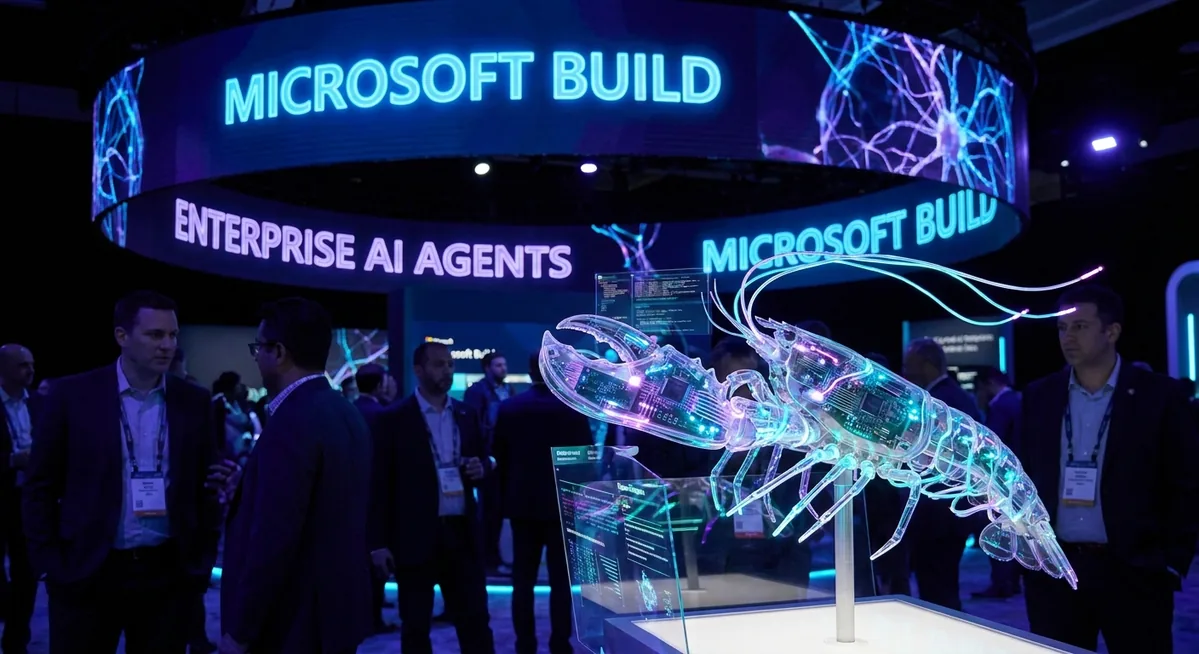
Microsoft Builds on OpenClaw, Scout Arrives, and the Runtime Gets 5× Faster
Microsoft Build 2026 turned OpenClaw's legitimacy up to eleven: Scout, a new always-on personal assistant, ships on the OpenClaw framework, Windows gains built-in agent sandboxing, and the project itself just posted its best performance numbers ever — 5× faster cold turns, 59% smaller installs, and a governance UI that finally looks like it belongs in an enterprise. Here's everything that matters from the last 24 hours.
🦞 OpenClaw Updates
The Latest Pre-Release: Stability, Recovery, and Performance That's Hard to Ignore
This morning's pre-release (June 3, 2026) lands as perhaps the most operationally robust build the project has shipped. The headline themes — cleaner recovery from interrupted tool calls, steadier multi-channel delivery, bounded timeouts across every provider and plugin path — are all unglamorous improvements that quietly make daily use far more reliable. And the performance story underneath them is extraordinary.
Per the official OpenClaw blog post "OpenClaw Is Getting Faster, Smaller, and Easier to Trust", the numbers from v2026.4.14 through v2026.5.28 are striking:
- Stable cold turn: 5.1× faster — from 9.8s to 1.9s
- Stable warm turn: 4.0× faster — from 7.5s to 1.9s
- Peak RSS: 15% lower — 686 MB → 581 MB
- Published tarball: 59% smaller — 43.3 MB → 17.9 MB
- Installed dependencies: 300 — down 53% from the high watermark
This is not just polish. It represents a fundamental shift in how the project thinks about its own architecture. As OpenClaw's founder Peter Steinberger framed it: "Growth, here, looks more like molting than adding." The core is shedding weight, pushing optional capabilities into plugins, and making ownership of the dependency tree explicit. That's the kind of discipline that separates tools from infrastructure.
What the June 3rd Pre-Release Delivers
Today's build, tagged on June 3 at 09:16, carries forward the performance and stability momentum with five clear themes:
Cleaner runtime recovery. Agents and CLI-backed runtimes now recover more gracefully from interrupted tool calls, stale session bindings, compaction handoffs, and media delivery retries. These are exactly the kinds of failures that cause silent data loss or stuck sessions in production environments. The fix list across PRs #88129, #88136, #88141, #88162, and #88182 reads like a careful audit of every way a long-running agent can get stuck — and then fixing each one.
Steadier channel delivery. Telegram, WhatsApp, iMessage, Slack, Discord, Microsoft Teams, Google Chat, Google Meet, and iOS realtime Talk all got reliability improvements. The breadth here matters: when Microsoft Scout runs on top of OpenClaw (more on that below), it needs to trust that delivery across these surfaces won't silently drop messages or misroute replies.
Bounded timeouts everywhere. Provider and plugin requests now cap timers, retries, OAuth lifetimes, media downloads, local service probes, and generated-content polling. This addresses one of the most common production pain points in agentic systems: a single hung provider call blocking an entire turn. The fix is simple in principle and notoriously difficult in practice.
Skill Workshop gets the full Control UI. Proposal lists, today actions, revision handoff, searchable file previews, review states, locale coverage, and reusable session routing are all now part of the Skill Workshop flow. This transforms skill creation from a command-line affair into a governed, reviewable process — critical as ClawHub scales past 52,700 tools and organizations start needing audit trails for what gets installed.
Chat and Control UI startup hardening. Sends stay alive through history loading, stream deltas now arrive incrementally, markdown processing is deferred during streaming, and first-output latency is now traced explicitly. These changes directly address the "frozen composer" experience that frustrated users during April's rough patch.
"Skills and plugin loading now handle stale disabled snapshots and loader failures more clearly, so channel turns avoid disabled SecretRefs and operators get better recovery guidance." — OpenClaw June 3 release notes
Provider and model coverage expands. MiniMax M3, updated Google/Vertex catalog fixes, OpenRouter SQLite model caching, Copilot Claude 1M context capabilities, Foundry reasoning alignment, and OpenAI response replay guards all land in this build. The Copilot 1M context addition is particularly notable as it unlocks very long document workflows for users already in the Copilot ecosystem.
iMessage and plugin install durability. iMessage monitor state, inbound queues, and plugin install ledgers are now moving to SQLite-backed persistence so restarts and local monitor failures can recover without duplicate filesystem scanning. For power users running OpenClaw as persistent infrastructure on Mac mini or similar always-on hardware, this is a meaningful reliability improvement.
This build is the product of a project that has learned from its rough April-May patch and is building toward the kind of operational reliability enterprise deployments demand. The 5× performance gains aren't theoretical — they're reflected in real daily use. Combined with the Skill Workshop governance UI and multi-channel hardening, OpenClaw is looking more like infrastructure and less like a well-engineered prototype. The timing, arriving the morning of Microsoft Build 2026, is not accidental.
🔒 Security Tip of the Day
When a Big Company Runs Your Agent Framework: Microsoft Scout's Security Playbook
Microsoft's announcement of Scout — an always-on personal assistant built on OpenClaw — includes a rare public explanation of how a Fortune 500 company manages the security of an open-source agent runtime in production. Omar Shahine, corporate VP of Microsoft Scout, described their approach in an interview with The Verge:
"We have a process for intake [of OpenClaw] that makes sure we're protecting ourselves from things like supply chain risk, and also just breaking changes. We operate OpenClaw in a cloud environment that's in a sandbox, and we treat OpenClaw as untrusted so it doesn't have secrets or access to any of your Microsoft 365 data."
That last sentence is the most important one for every operator running OpenClaw. Microsoft's baseline assumption is that OpenClaw itself is untrusted — it runs in a sandbox, isolated from credentials and data, with Agent 365, Purview, and Defender controlling what it can reach. They also layer in red teaming and security reviews.
Most personal deployments can't replicate Microsoft's exact stack, but the principle translates directly:
- Don't give OpenClaw standing access to your most sensitive credentials. Use short-lived tokens where possible. Rotate secrets regularly.
- Enable exec approvals on any agent that can interact with production systems. The approval gate is your human-in-the-loop circuit breaker.
- Review breaking changes before updating. OpenClaw moves fast. Pinning a version and reading release notes before upgrading is not paranoia — it's what Microsoft does.
- Audit your skill list after every update. Today's build hardens stale skill snapshot handling — a sign that the project itself knows skill state drift is a real problem.
Bottom line: if Microsoft treats OpenClaw as untrusted in their own deployment, you should be thinking the same way about the boundary between your agent and your most sensitive data.
⭐ Skill of the Day: skill-creator
🔧 skill-creator
What it does: The skill-creator skill helps you create, edit, audit, tidy, validate, and restructure AgentSkills and SKILL.md files. With the Skill Workshop now shipping a full governance UI in today's pre-release, this becomes significantly more powerful — you can draft skills in your agent, validate them against the proposal format, and push them through the new review flow directly.
Why today: The Skill Workshop governance UI that landed in today's pre-release makes skill authoring a first-class workflow for the first time. skill-creator is the natural companion — it guides you through writing skills that will actually pass the proposal/review/approval flow instead of getting rejected for missing metadata or unsafe patterns.
Safety note: This skill is part of the OpenClaw core skills repository, maintained by the OpenClaw team directly. It operates on local file content — SKILL.md files and AGENTS.md — without requiring external network access to function. It is knowledge-based and does not execute arbitrary shell commands. As always, verify the current published version on ClawHub before installing.
Install: npx clawhub@latest install skill-creator
Best use case: You have a workflow you run repeatedly — web research, inbox triage, daily briefings — and you want to formalize it as a reusable skill. skill-creator walks you through structuring it correctly and checking it against safety and format guidelines. Pairs naturally with the Skill Workshop's new proposal UI for governed publishing.
👥 Community Highlights
Microsoft Build Turns OpenClaw Into the Talk of Enterprise Tech Twitter
For the past week, OpenClaw news has lived primarily in developer circles, release note threads, and the occasional enthusiast blog. That changed overnight. Microsoft's announcement of Scout at Build 2026 brought OpenClaw into conversations at a scale the project has never seen before. The phrase "the lobster framework that Microsoft is betting on" appeared in at least three major tech outlets within hours of the keynote.
The community reaction is a mix of pride, mild shock, and a healthy dose of "wait, is this good?" Pride, because a major tech company building on open-source software is a validation signal that's hard to fake. Shock, because six months ago Satya Nadella reportedly compared OpenClaw's growth to a virus. And cautious skepticism, because enterprise adoption brings pressure to slow down, standardize, and potentially fork — none of which sit well with a project that ships multiple times a week.
The most important community signal isn't the excitement though — it's the security questions. Since The Verge's interview where Shahine described treating OpenClaw as "untrusted" in the sandbox, the question of whether individual operators are being comparably careful has gotten louder. ClawHub's VirusTotal integration, NVIDIA Skill Cards, and SkillSpector (previewed in the June 2 release) are all converging on the same answer: the ecosystem is pushing trust verification from optional to expected.
ClawHub Crosses a Quiet Milestone
ClawHub now hosts over 52,700 tools with 12 million downloads and a 4.8 average rating. Those are numbers that would get any software marketplace taken seriously. What's less visible is the infrastructure behind them: the VirusTotal partnership for automated scanning, the NVIDIA Skill Cards for hardware-specific validation, and the Skill Workshop governance flow for controlled publishing. ClawHub is becoming less a directory and more a trust platform — and the speed at which it's adding those layers suggests the team understands the stakes.
The Skill Workshop Is About More Than UX
It's easy to read today's Skill Workshop UI improvements as a developer experience upgrade. They're something more structural. A skill that goes through the proposal → review → approval flow generates an audit trail. It has a reviewer. It has a hash. It has rollback capability. That's exactly the kind of provenance chain that makes security teams comfortable approving a new tool — and that makes compliance conversations possible.
OpenClaw has been talking about "governed skill creation" for months. Today's Control UI build is where that language starts to become practice. The documentation refresh that landed alongside it (covering the full Skill Workshop guide, reviewable proposals, CLI, Gateway, agent tool behavior, approval policy, support files, and recovery) is the signal that this isn't just a UI — it's a workflow the project actually expects people to use.
🌐 Ecosystem News
Microsoft Scout Is More Than a Marketing Story
The product details of Microsoft Scout, announced yesterday at Build 2026, are worth understanding at a technical level. Scout is an always-on personal assistant that integrates into Microsoft 365 — Outlook, OneDrive, Teams — and operates continuously in the background. It monitors road traffic and calendars to recommend departure times, reads Teams threads and transcripts to surface relevant information proactively, and can be reached via phone call (not just text).
Microsoft is starting with a desktop preview for Frontier customers in the US, with a limited cloud preview to follow in coming months. Over 3,000 Microsoft employees are already using Scout internally.
Omar Shahine's framing is important: "This is a personal assistant, it's the first real personal assistant we've offered customers. I think it's important for customers to understand that you're going to get a phone call from this assistant, it's a very different type of AI than chat." That distinction — proactive, persistent, ambient versus reactive chat — is precisely what OpenClaw has been building toward for two years.
The fact that Microsoft is contributing back to OpenClaw core rather than maintaining a fork is the buried lede. It means the project's velocity doesn't slow to enterprise pace. It means security fixes flow upstream. And it means the open-source community benefits from Microsoft-scale testing on production workloads. That's a healthier arrangement than most enterprise-adopts-OSS stories end up with.
Microsoft Scout is not just a product announcement — it's a proof point. It proves that a large enterprise can take OpenClaw seriously enough to build a flagship product on it, can manage its security concerns without forking it, and can commit to contributing back rather than extracting. That's exactly the kind of adoption that matures an open-source ecosystem without killing it. Whether Scout ships broadly and succeeds is a separate question. Today, the signal matters more than the outcome.
Windows Gets Built-In Agent Sandboxing With OpenClaw Support
Separate from Scout, Microsoft also announced at Build 2026 that Windows itself is gaining built-in AI agent sandboxing — the MXC (Microsoft eXtension Container) framework — with first-party OpenClaw support. This is the infrastructure layer that makes it possible for OpenClaw to run on Windows in a properly isolated environment, with OS-level controls on what the agent can access.
Paired with NVIDIA OpenShell support also announced at the event, Windows is positioning itself as a serious local-first agent platform for the first time. For OpenClaw operators who have been running on macOS or Linux by preference, this is meaningful: the Windows path is becoming a first-class option rather than a workaround.
ClawHub Adds NVIDIA Skill Cards and SkillSpector Risk Analysis
Per the Releasebot.io summary from earlier this week, OpenClaw has added stronger ClawHub skill security with pre-publish verification, NVIDIA Skill Cards, and SkillSpector risk analysis. The NVIDIA Skill Cards are particularly interesting — they provide hardware-specific validation metadata that lets operators confirm a skill's behavior against their specific GPU configuration before installing. SkillSpector adds a risk analysis layer on top of the existing VirusTotal scans, giving publishers and operators a more nuanced view of what a skill does versus what it claims to do.
The public dataset of scan outcomes on Hugging Face (announced as part of the same update) is the ecosystem-minded move: sharing scan results benefits everyone building trust tooling, even competitors. It's the kind of infrastructure investment that says "we think security is a rising tide, not a moat."
Microsoft Build 2026's Broader Agent-First Platform Story
Scout is the most OpenClaw-specific announcement, but Build 2026 as a whole is an agent-first platform event. Microsoft announced new Foundry toolboxes that unify web and file search, MCP, OpenAPI spec, and A2A protocol access. GitHub Copilot is now billing on usage-based AI Credits. Satya Nadella declared AI has moved from "synchronous assistants to async coworkers that can execute long-running tasks." Every one of those moves validates the direction OpenClaw has been running in for two years.
The broader pattern: the enterprise AI market is not converging on chatbots. It's converging on persistent, goal-directed, multi-channel agents with human-in-the-loop controls, governed skill ecosystems, and observable state. OpenClaw has been architecting for that future since its earliest releases. Microsoft Build 2026 is the moment the Fortune 500 market publicly agreed.
The most important thing about today is not any single announcement — it's the convergence. OpenClaw's performance and governance story is stronger than it has ever been. Microsoft is betting on the framework publicly. Windows is adding OS-level sandboxing. NVIDIA is adding hardware-specific skill validation. The ecosystem is moving in the same direction at the same time, and OpenClaw is positioned at the center of it. That doesn't mean the project is finished — fast release velocity and enterprise adoption create real tension. But the question is no longer whether OpenClaw matters. It's how operators and organizations build on it responsibly.
Need help with OpenClaw deployment?
SEN-X provides enterprise OpenClaw consulting — architecture, security hardening, custom skill development, and ongoing support.
Contact SEN-X →