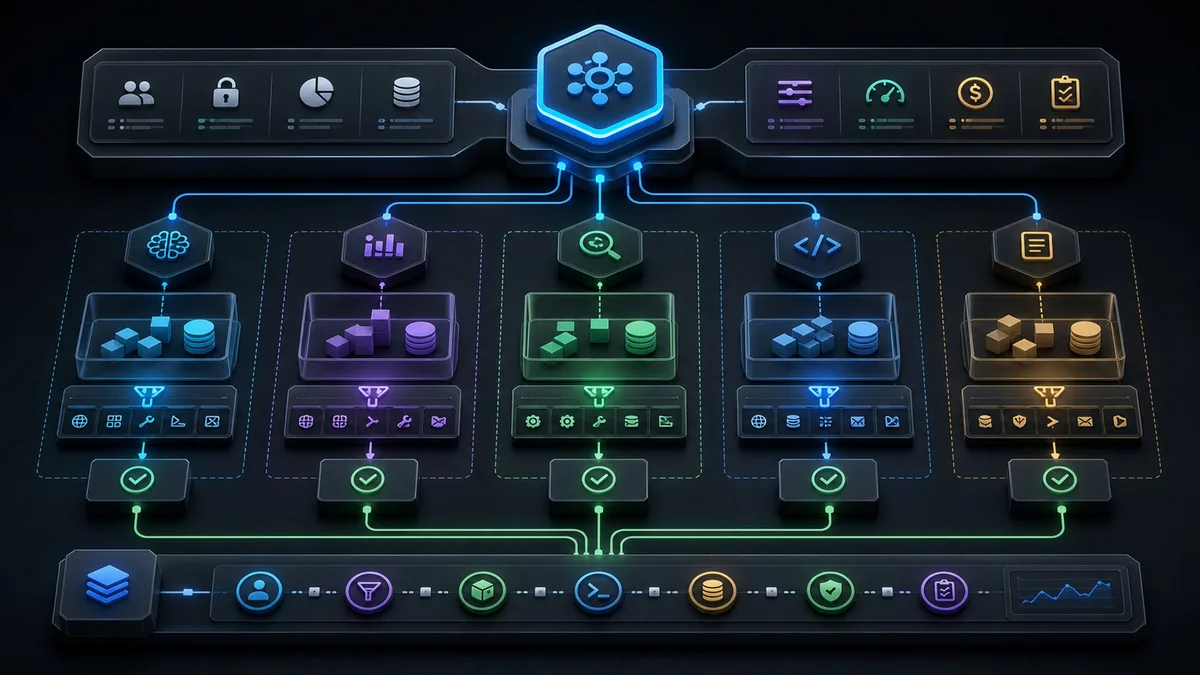
Governed Agent Fleets Arrive: ClawHub, NemoClaw & Role-Based Automation
Today’s strongest signal is governance. Discovery is scaling through ClawHub while enterprise layers add policies, sandboxes, roles, and budgets around agents that can act.
ClawHub formalizes the public skill registry
The ClawHub repository describes versioned publishing, search, moderation hooks, and a CLI-friendly API for text-based agent skills. A registry improves discovery; it does not eliminate operator review.
For operators, the important question is not whether the feature or project sounds impressive. It is whether the capability has a clear owner, bounded permissions, observable state, a failure signal, and a reversible deployment path. Those controls turn an interesting agent demo into dependable infrastructure.
Source: Inspect the source
OpenClaw’s real leverage comes from combining persistent context with explicit tools and verifiable state. Add capability only when its permissions, failure modes, and rollback path are understood.
NVIDIA positions NemoClaw as a governed deployment layer
NVIDIA describes NemoClaw as adding policy controls, lifecycle management, and sandboxing around OpenClaw agents. Enterprise adoption will depend on whether those controls remain observable and portable.
For operators, the important question is not whether the feature or project sounds impressive. It is whether the capability has a clear owner, bounded permissions, observable state, a failure signal, and a reversible deployment path. Those controls turn an interesting agent demo into dependable infrastructure.
Source: Inspect the source
OpenClaw’s real leverage comes from combining persistent context with explicit tools and verifiable state. Add capability only when its permissions, failure modes, and rollback path are understood.
CVE tracking gets a dedicated community surface
A focused tracker can help operators connect advisories to OpenClaw deployments. The operational requirement remains version inventory: you cannot assess exposure if you do not know what is running.
For operators, the important question is not whether the feature or project sounds impressive. It is whether the capability has a clear owner, bounded permissions, observable state, a failure signal, and a reversible deployment path. Those controls turn an interesting agent demo into dependable infrastructure.
Source: Inspect the source
OpenClaw’s real leverage comes from combining persistent context with explicit tools and verifiable state. Add capability only when its permissions, failure modes, and rollback path are understood.
Role-based agent management becomes a product pattern
Paperclip models agents with roles, reporting lines, permissions, and budgets across different runtimes. The broader pattern is important: fleets need accountability structures, not just more workers.
For operators, the important question is not whether the feature or project sounds impressive. It is whether the capability has a clear owner, bounded permissions, observable state, a failure signal, and a reversible deployment path. Those controls turn an interesting agent demo into dependable infrastructure.
Source: Inspect the source
OpenClaw’s real leverage comes from combining persistent context with explicit tools and verifiable state. Add capability only when its permissions, failure modes, and rollback path are understood.
Operator checklist
- ClawHub formalizes the public skill registry: verify version, provenance, required permissions, external network access, stored state, and rollback before adoption.
- NVIDIA positions NemoClaw as a governed deployment layer: verify version, provenance, required permissions, external network access, stored state, and rollback before adoption.
- CVE tracking gets a dedicated community surface: verify version, provenance, required permissions, external network access, stored state, and rollback before adoption.
- Role-based agent management becomes a product pattern: verify version, provenance, required permissions, external network access, stored state, and rollback before adoption.
Workflow / Skill Spotlight
Registry spotlight: ClawHub
Use the registry for discovery, then review the exact published files and permissions. Popularity, search rank, and a clean description are not security evidence.
Security Practice
Give every agent a named owner, bounded role, tool allowlist, budget, and revocation path. Shared unrestricted credentials erase accountability.
Need help turning AI change into an operating advantage?
SEN-X helps teams evaluate models, design governed agent systems, and deploy measurable automation.
Contact SEN-X →