OpenClaw Stable Patch Fixes Plugin Updates as Beta 7 Hardens Durable Agent Work
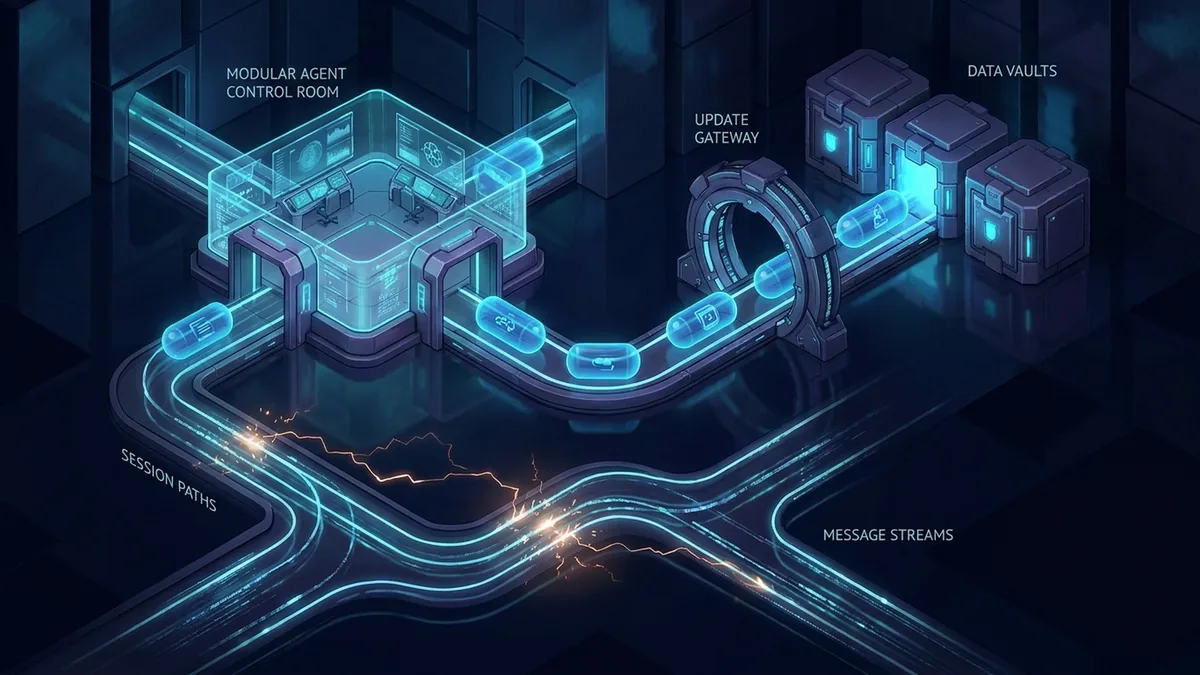
A focused stable correction repairs an important extension path, while the seventh 2026.7.2 beta tests a much larger thesis: agents should preserve accepted work, recover damaged state, branch sessions safely, and put richer interfaces behind explicit authority.
OpenClaw Updates
The Stable Channel Gets a Surgical Plugin Repair
OpenClaw published the signed v2026.7.1-2 stable release on August 4. Its public release note is admirably narrow: tracked official plugins can again install and update to correction releases when newer npm clients return metadata as a single-item array. This is not a feature bundle disguised as a patch. It fixes a compatibility seam in the package-management path that keeps OpenClaw extensions current.
The underlying official plugin metadata and configuration change explains the broader defensive work. The parser handles object and multi-version array output, flat or nested distribution fields, and missing OpenClaw metadata; it selects the highest version satisfying the requested semantic-version range rather than trusting publication order. Recognized ranges with no valid entry fail closed. Official catalog IDs also survive a bundled-to-external transition, preventing repair tools from silently deleting a valid allowlist entry before the external package arrives.
That distinction matters because an agent platform's plugin installer is both an availability mechanism and a supply-chain boundary. Flexible parsing prevents harmless client-shape changes from breaking upgrades, but range validation and explicit field errors keep flexibility from becoming “accept whatever npm returned.” Operators on the stable channel should treat 2026.7.1-2 as a targeted maintenance update, then confirm their tracked plugins still appear in configuration and load after the Gateway restarts.
Beta 7 Treats Recovery as a Full Data Path
The much larger v2026.7.2-beta.7 prerelease notes describe quarantine storage that can survive primary-database damage, crash-recoverable SQLite snapshots, durable filesystem publication, rejection of lossy schema upgrades, and snapshot recovery for rollback writers. It also routes accepted inbound messages through shared durable ingress and dead-letter recovery across Telegram, Signal, Slack, QQBot, Twitch, Synology Chat, Tlon, IRC, and Zalo User.
Those two changes belong together. Protecting the database is insufficient if a message disappears between channel acceptance and the agent turn; durable ingress is incomplete if restored work points at corrupted state. Beta 7 is trying to close the circuit from “the Gateway accepted this” to “the operator can recover or explain its outcome.” Because it remains a prerelease, the right move is a canary with induced restarts and corrupt-state drills—not an assumption that a long changelog equals production proof.
Sessions Branch While Approvals Become a Shared Interface
The same beta adds message-level rewind and conversation forks across web and native apps, including upstream Codex session forks, branch-safe queued sends, stale-pane write rejection, and prompt-image restoration. Structured question cards and approvals now span web, channels, macOS, and native applications, with approval history, fair queuing, headless resolution, push notifications, and relay support for Claude tool requests. The practical gain is not merely nicer chat: reviewers can redirect work without destroying the original transcript and answer consequential questions where they already operate.
Stable and beta are doing different jobs here, and operators should preserve that separation. The stable patch repairs one extension failure with a small blast radius. Beta 7 experiments with end-to-end durability and control-plane behavior. Install the patch through normal maintenance; test the beta against written recovery objectives, including accepted-message survival, branch isolation, stale-client rejection, and approval delivery when the primary interface is unavailable.
Tool Spotlight
Interactive MCP Apps: Tools That Can Show Their Work
Beta 7's interactive MCP Apps can bind tools and resources to ticketed interfaces, open from channel replies, and remain pinned as dashboards. The ticketed MCP App host implementation adds a standalone host and conformance work, while the Control UI MCP App bridge gates reconstructed messaging and uses the public message schema.
Why it matters: an agent can present an inspectable incident panel, form, or comparison instead of flattening every result into prose. The security requirement grows with the interface: tickets must be narrow and short-lived, context updates bounded, tools explicitly bound, and app messages unable to acquire authority merely because a user opened a dashboard.
Security Practice
Split Trust Boundaries Before Expanding Channels
OpenClaw's official Gateway security guidance states that one Gateway is a trusted personal-assistant control plane, not a hostile multi-tenant boundary. If mutually untrusted users can reach one tool-enabled agent, they share its delegated authority. Separate those users into distinct Gateways and preferably separate OS users or hosts; do not try to repair mixed trust with a longer system prompt.
The official Buzz channel documentation provides a concrete example: use a dedicated bot identity, never a human owner's private key, restrict configured rooms, and remember that sender access only decides who may start a run—it does not constrain what the routed agent can do afterward. Run openclaw security audit after configuration changes and before exposing a new network surface.
Community and Ecosystem
Buzz Shows the Difference Between Reachability and Authority
Buzz now has detailed official setup guidance for hosted or self-hosted team rooms, including relay approval, room-scoped Bot roles, mention requirements, sender allowlists, authenticated room discovery, duplicate-message avoidance, and stable public-key identities. It supports Markdown, structured diffs, threading, typing state, and room-member mentions, while direct messages, files, reactions, and automatic admin approval remain explicitly unsupported. That limitations list is useful: mature integrations say what they cannot do.
The channel's identity model is also a design signal for community builders. Human administrators grant room membership, OpenClaw retains only the dedicated bot key, and configured UUIDs remain the canonical automation targets. Profile names improve usability, but relay-signed membership and public keys determine authorization. As agents enter team rooms, friendly labels should never replace stable machine identities in policy or logs.
Discovery Standards and Migration Tools Make Agent Systems More Portable
Google's Agentic Resource Discovery specification announcement proposes catalogs hosted under provider domains and federated registries that return verification metadata before a direct connection. Catalogs can describe MCP servers, A2A agents, OpenAPI tools, and nested catalogs. This is adjacent to OpenClaw rather than an OpenClaw release, but it addresses the same emerging problem as ClawHub and plugin catalogs: finding capabilities is easy; proving publisher identity, pinning policy, and limiting egress are the hard parts.
Portability is moving at the user-data layer too. The Nous Research Hermes Agent repository documents an OpenClaw migration command that can preview changes with --dry-run and use a user-data preset that excludes secrets. Its importer covers persona and memory files, user-created skills, allowlist patterns, messaging settings, selected API keys, audio assets, and workspace instructions. That is competitive ecosystem context, not an endorsement: any migration touching memory and credentials deserves a reviewed manifest, a dry run, and a recoverable backup.
The agent ecosystem is standardizing around three portable objects: capabilities, identity, and accumulated context. ARD tackles capability discovery, Buzz makes channel identity explicit, and Hermes demonstrates that memory plus skills can move between runtimes. OpenClaw's opportunity is to make those transfers inspectable without pretending they are harmless. Every import, catalog resolution, and room invitation should produce evidence an operator can review before credentials or authority cross the boundary.
What Operators Should Do Today
Promote v2026.7.1-2 through the normal stable maintenance path and verify official tracked plugins after restart. Keep Beta 7 in a representative canary until restart, dead-letter, damaged-state, forked-session, and approval tests pass. For every new channel or interactive app, document the authenticated identity, tool policy, credential scope, and recovery owner. The release story is no longer “agents gained more features.” It is whether accepted work and delegated authority remain understandable when the happy path breaks.
Need an OpenClaw deployment built for recovery?
SEN-X helps teams design secure agent architecture, channel boundaries, plugin governance, release canaries, and operational evidence that survives production.
Talk with SEN-X →