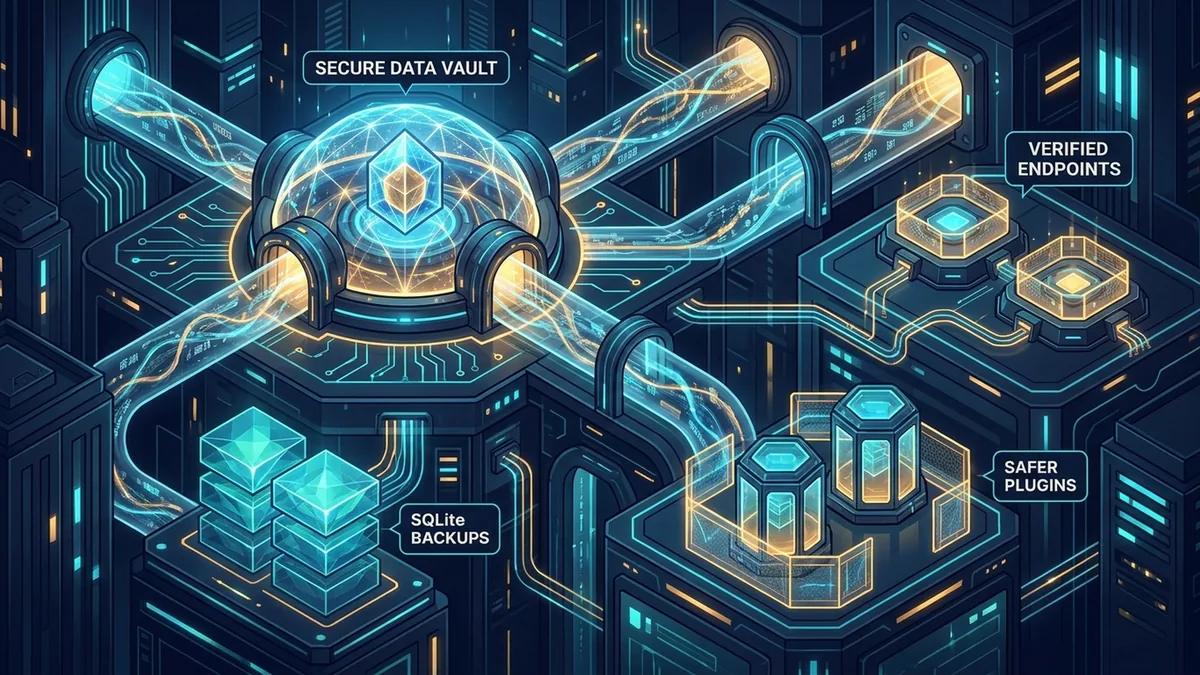
OpenClaw 2026.8.1 Beta 2 Adds Secret Host Binding, SQLite Backups, and Safer Plugins
The latest beta puts operational trust ahead of novelty: secrets gain destination boundaries, database recovery becomes a first-class workflow, plugin provenance gets sharper controls, and local-agent infrastructure continues moving toward production use.
OpenClaw Updates
Secret Egress Gets an Explicit Destination Boundary
The official OpenClaw 2026.8.1-beta.2 release notes, published August 15, lead with secret egress host binding. Shared-store secrets can now be associated with exact HTTPS destination hosts across the CLI, Gateway RPC, and Control UI. If a substitution has no valid binding, OpenClaw is designed to fail before plaintext leaves the system.
This changes the secret model from “the agent may retrieve this value” to “the agent may use this value only on an approved network route.” That distinction matters when web content, tool output, and inbound messages can all influence a tool-capable model. It narrows the damage from a manipulated request without pretending prompt filtering can make hostile content harmless.
SQLite Snapshots Turn Recovery into an Operator Workflow
The same beta adds openclaw backup sqlite create|list|verify|restore for global and per-agent databases. The artifacts are compact and verifiable, while restore is limited to a fresh target. The fresh-target rule is deliberately conservative: it avoids quietly merging a backup over live state and turning disaster recovery into an undocumented data migration.
OpenClaw also introduces named macOS app profiles that isolate state, preferences, Keychain material, Gateway services, and instance ownership. Together, profiles and database snapshots make testing less reckless. An operator can separate an experimental instance from the daily driver, verify a backup, and practice restoration without treating the production state directory as a lab bench.
Secret host binding and fresh-target restores solve different versions of the same problem: authority should be narrow, explicit, and testable. The useful release metric is not how many capabilities an agent gains. It is how many irreversible mistakes the surrounding system prevents when the model, operator, or upstream content gets something wrong.
Plugin Provenance Becomes Harder to Ignore
Arbitrary executable plugin sources now require an explicit --force acknowledgement, while bundled, official-catalog, trusted ClawHub, and tracked-update paths remain smoother. That is a sensible friction gradient: unfamiliar executable code should demand a conscious decision, but routine updates from a recorded source should not train operators to dismiss warnings automatically.
The project’s official skills documentation complements that release change. It explains owner-qualified ClawHub references, trust-envelope verification, publisher ambiguity, allowlists, load precedence, and the need to treat third-party skills as untrusted code. Crucially, the docs say a skills allowlist is not a shell authorization boundary; exec permissions, sandboxing, OS isolation, and credentials still require their own controls.
Security Practice
Audit After Every Exposure or Authority Change
The OpenClaw Gateway security guide recommends running openclaw security audit after configuration changes or before exposing network surfaces, with --deep available for a live Gateway probe. Its priority order is practical: close open messaging access with tools enabled, fix public network exposure, constrain browser control, tighten credential-file permissions, and load only explicitly trusted plugins.
Pair that audit with a single-operator trust boundary. OpenClaw’s documented model is one trusted operator per Gateway, not adversarial multi-tenancy. If two users should not share credentials or delegated tool power, separate them with distinct Gateways and preferably separate OS users or hosts. Identity first, scope second, model defenses last.
Tool Spotlight
ClawHub Verification Before Installation
What it does: openclaw skills verify @owner/slug asks ClawHub for a versioned trust envelope and can print a generated Skill Card before installation. Installed skills are checked against the version and registry recorded in their origin metadata.
Why it matters: Verification makes provenance inspectable, but it does not make behavior safe by magic. Read the skill, use an owner-qualified reference, check what binaries and environment it requires, then constrain the agent that will run it. A clean registry signal is an input to trust—not a substitute for policy.
Local Agent Infrastructure Moves Up the Stack
NVIDIA’s August 14 briefing, “NVIDIA and Local AI Community Fuel Open Source Models and Intelligent Agents”, places OpenClaw beside NemoClaw, Hermes Agent, and OpenShell in DGX Spark playbooks. The post also describes an open-source stack around Nemotron models, local inference, sandboxing, and agent runtimes rather than presenting model weights as a complete agent system.
The NVIDIA NemoClaw repository makes the security direction concrete: it runs agents including OpenClaw inside OpenShell with managed inference and an isolated execution environment. Operators should evaluate it as a separate deployment architecture, not as proof that any configuration is automatically secure. Isolation only helps when network, filesystem, credentials, and host escape paths match the intended threat model.
Local inference is graduating from a privacy checkbox into an operations stack. The important competition is shifting toward placement, isolation, observability, and recoverability around the model. OpenClaw’s host-bound secrets and snapshots fit that shift well because they define what local control actually means when an agent can still reach external services.
Community and Ecosystem Context
Adjacent projects are also treating agents as workers that need management rather than chat windows that need prettier interfaces. The Paperclip open-source repository describes org charts, roles, budgets, execution locks, audit trails, approvals, recurring routines, and adapters for OpenClaw and coding agents. Its README explicitly positions Paperclip as an orchestration layer that uses agents rather than replacing their runtimes.
Meanwhile, the Nous Research Hermes Agent repository documents a gateway, scheduled automations, isolated subagents, multiple execution backends, procedural skills, and an OpenClaw migration path with dry-run support. The competitive signal is not that every platform should copy every feature. It is that durable memory, portable skills, controlled execution, and cross-channel continuity are becoming expected parts of a serious personal-agent stack.
OpenClaw 2026.8.1-beta.2 remains a prerelease, so production operators should canary it and verify their own integrations. But its center of gravity is clear: safer secret movement, recoverable state, provenance-aware extensions, and better boundaries around distributed agent work. That is less glamorous than another autonomous demo—and much closer to what dependable automation actually requires.
Need help with OpenClaw deployment?
SEN-X provides enterprise OpenClaw consulting — architecture, security hardening, custom skill development, and ongoing support.
Contact SEN-X →