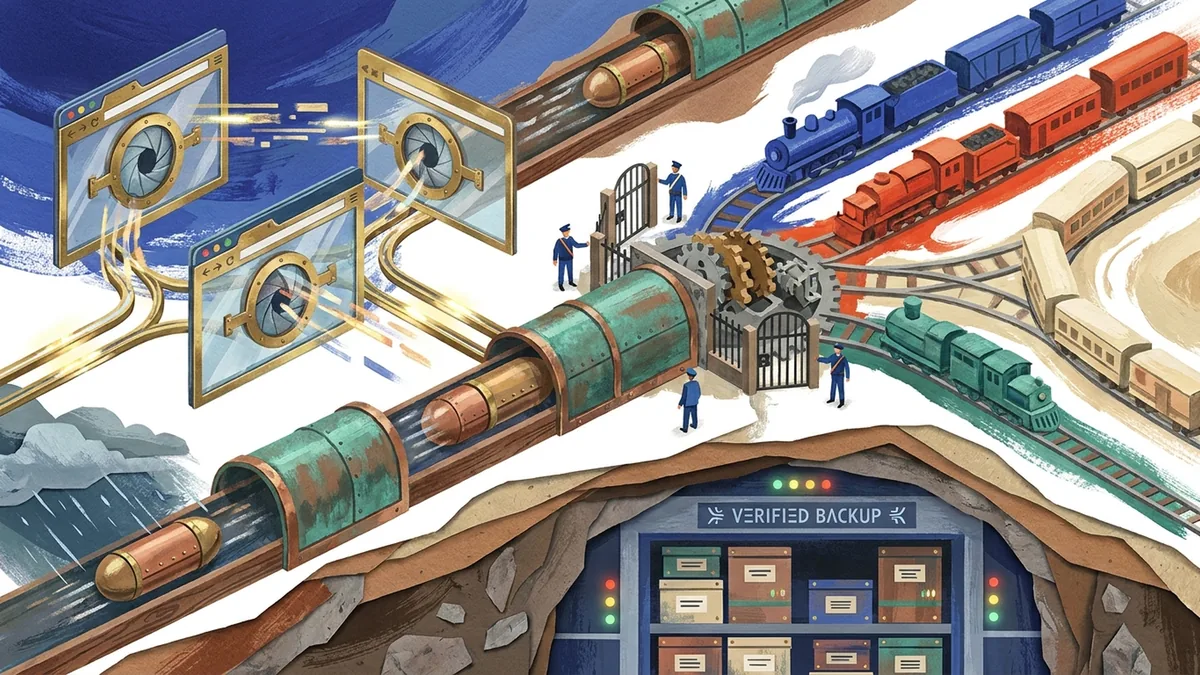
OpenClaw 2026.8.1 Beta 3 Connects Models, Browsers, and Durable Channels
The latest prerelease makes model selection more coherent, opens paired Chrome to standard automation clients, hardens channel recovery, and clarifies how specialized agent tools can share one operating layer.
OpenClaw Updates
Beta 3 publishes a verifiable runtime bundle
The official OpenClaw 2026.8.1-beta.3 release record lists GPT-5.6 Sol, Terra, Luna, and Ultra reasoning support across both OpenClaw and its Codex runtime. More important than adding four names, model, runtime, and thinking choices are treated as one selection through the model command and fallback path. That reduces a subtle failure mode in which the interface reports one configuration while execution quietly inherits another.
The publication evidence is unusually useful. The release page links the npm package, registry tarball, integrity digest, preflight and publication workflows, and official-plugin reconciliation. It also states that 89 official plugins were read back at the beta selector with complete tarball integrity metadata, while the matching Codex plugin carries the exact managed Codex 0.149.1 runtime. This remains a prerelease, but operators can verify what was shipped instead of trusting a decorative badge.
Paired Chrome becomes a standard automation endpoint
Beta 3 adds a Puppeteer-compatible Chrome DevTools Protocol relay for paired Chrome sessions. The change supplies browser-context responses, DevTools-style target descriptors, and a command that prints the relay endpoint plus its authentication header. In practical terms, tools such as Puppeteer and chrome-devtools-mcp can drive an already paired session without asking the person at the desk to approve Chrome’s remote-debugging prompt.
The OpenClaw managed-browser operating guide makes the safety choice explicit: use the isolated openclaw profile by default, the extension-backed chrome profile when a signed-in session is necessary and nobody is at the computer, and the user attachment path when a person can approve it locally. Existing authentication is powerful context, so profile selection belongs in policy rather than being left to convenience.
Beta 3’s real theme is negotiated ownership. The interface chooses a model and runtime together; the Gateway mediates a browser already owned by a user; plugins share one ingress lifecycle; and an external supervisor receives a bounded restart handoff. Teams should document the owner of each state transition, then test what happens when that owner disappears halfway through the operation.
Durable ingress moves from channel code to shared infrastructure
A shared plugin SDK monitor now covers admission, polling, pruning, claim identity validation, adoption handoff, and shutdown for channel ingress. IRC, Synology Chat, and Google Chat are the first named migrations. Consolidating those mechanics matters because duplicate delivery, missed messages, and abandoned claims usually appear during restarts—the exact moment separate channel implementations are least likely to fail in the same obvious way.
External Gateway supervision gains a similarly explicit contract. With external supervision enabled, a lifecycle owner can perform a verified, versioned restart handoff without receiving native service mutation or self-update authority. Verified SQLite snapshots and fresh-target-only restore commands complete the recovery picture. The release is not promising that long-running systems never fail; it is adding narrower ownership and evidence around how they recover.
Security Practice
Treat a signed-in browser as a privileged credential
Browser automation can act through active sessions even when no API key is visible. Separate the everyday browser from the agent-controlled profile, and attach to a personal session only for tasks that genuinely require its cookies. The browser guide notes that the managed profile has its own data directory and can copy selected cookies on macOS without importing local storage or IndexedDB.
- Default automation to a dedicated profile with the smallest useful login set.
- Disable arbitrary page evaluation when a workflow needs clicks and extraction but not injected JavaScript.
- Require manual confirmation before purchases, account changes, publishing, or destructive actions.
- Keep private-network access denied unless a specific internal hostname has been reviewed and allowlisted.
Operating rule: possession of a tab is not permission to use every authority embedded in that tab. Scope the profile, task, and final action independently.
Tool Spotlight: acpx
One structured client for several coding agents
The official acpx project documentation describes a headless client for Agent Client Protocol sessions across Codex, Claude Code, Gemini CLI, OpenClaw, and custom ACP servers. It supports explicit persistent sessions, stateless runs, queued follow-ups, machine-readable NDJSON events, permission modes, named workstreams, and TypeScript flows that combine agent turns with deterministic checkpoints.
Where it fits: use acpx when an orchestrator needs one automation shape across several compatible coding agents without flattening their structured tool calls, diffs, or completion events into terminal escape sequences. The project is candidly pre-1.0, so pin versions, expect interfaces to evolve, and keep downstream parsers tolerant of additive events.
Why it matters: interoperability is most valuable at the session and event boundary. A portable prompt wrapper is easy; durable identity, cancellation, permission decisions, queue ownership, and explicit terminal states are the machinery that lets another system supervise real work.
Community and Ecosystem
ClawHub adds change control to discovery
The ClawHub registry repository now presents one catalog for readable skills, native code plugins, bundles, and experimental whole-agent packages. Vector search and community discovery sit beside moderation hooks, capability metadata, inspection without installation, versioned publishing, rename redirects, soft-delete recovery, and local pinning. The design acknowledges that a useful marketplace needs reversible operations and provenance, not just a better search box.
The new OpenClaw beta reinforces that boundary by requiring explicit force acknowledgement for arbitrary executable plugin sources while preserving lower-friction updates for trusted ClawHub, bundled, official-catalog, and tracked sources. The lesson is not that registries make extensions safe. They make identity, declared requirements, review findings, accepted versions, and later changes visible enough for an operator to make a defensible decision.
ClickClack and Paperclip occupy different control layers
The ClickClack self-hosted team-chat repository combines a Go server, Svelte client, CLI, TypeScript SDK, durable event log, and reconnect cursors for people, bots, and agents. Beta 3 adds guided OpenClaw setup, native command-menu publication, and opt-in bot-authored dispatch with sender authorization, mention gates, retry-safe loop protection, and independent thread budgets. Bot traffic remains denied by default.
Above the conversation layer, Paperclip’s official product and deployment overview frames mixed agents as an organization with goals, tickets, budgets, approvals, heartbeats, and an append-only audit trail. It explicitly supports OpenClaw as one runtime among others and says an agent hitting its budget is paused. That makes Paperclip ecosystem context rather than an OpenClaw replacement: one coordinates portfolios of workers, while the other operates an assistant across channels, tools, memory, and devices.
The ecosystem is converging on a layered stack: ClickClack carries durable human-and-agent conversation, OpenClaw owns assistant execution and channel reach, acpx standardizes coding-session control, ClawHub distributes capabilities, and Paperclip organizes work above individual agents. The winning architecture will not use every layer. It will choose only the layers with a clear authority boundary and preserve one audit chain across them.
What to validate before adopting beta 3
Run the prerelease on a noncritical profile first. Confirm the selected GPT-5.6 variant, runtime, and reasoning mode survive fallback; exercise browser automation with both an isolated profile and a paired session; restart during channel delivery; verify a SQLite snapshot; and test the external supervisor handoff. Then inspect and pin any extension used in the trial. A release is ready when recovery, denial, and provenance are observable—not when the happy-path demo looks smooth.
Need help operating OpenClaw as infrastructure?
SEN-X helps teams design runtime boundaries, harden browser and channel access, validate recovery, and integrate agent tools without losing operational control.
Contact SEN-X →