OpenClaw Codex Harness Clarifies the Agent Control Plane
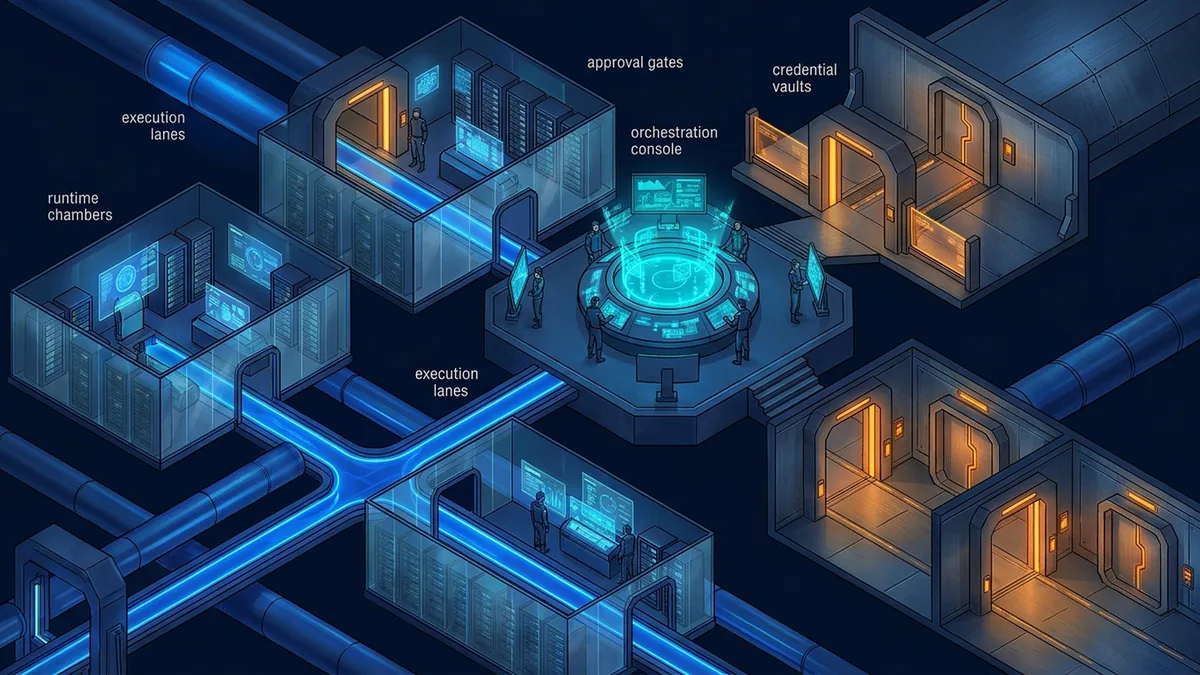
A new official guide makes the architecture legible: Codex owns the low-level agent session, while OpenClaw retains channels, approvals, policy, placement, delivery, and the visible operational record.
🧭 OpenClaw Updates
The Codex Harness Finally Names Every Owner
The newly expanded official OpenClaw Codex harness guide does something more valuable than announce another integration: it states who owns what. Codex app-server owns native thread resume, tool continuation, compaction, and execution. OpenClaw remains responsible for chat channels, session files, model selection, dynamic tools, approvals, media delivery, and the transcript users actually inspect.
That division removes a common ambiguity in agent stacks. A model runtime can execute a turn without becoming the policy plane, and a messaging gateway can govern a session without pretending to implement every provider-native capability. OpenClaw’s model reference, runtime choice, and communication surface are separate decisions. The documentation even warns that an openai/* model prefix alone does not select Codex.
Remote placement follows the same principle. A Codex app-server may run on another machine, while OpenClaw validates attachment paths and transfers authoritative bytes through a bounded, no-shell reader that rejects symlinks and applies size limits before allocation. For paired devices, execution travels over the authenticated node channel without copying provider, cloud, or GitHub credentials to the device.
This is the architectural sentence OpenClaw needed: the harness executes; the control plane authorizes, places, records, and delivers. Teams evaluating agent platforms should turn that sentence into an acceptance test. If a worker disappears, a credential is unavailable, or a node rejects approval, the failure must remain visible at the control plane instead of being blurred into a generic model error.
Beta 3 Publishes a Reproducible Plugin Set
The OpenClaw 2026.8.1-beta.3 publication record pairs its feature highlights with unusually concrete release evidence. It links the npm package and registry tarball, names the integrity digest, identifies the preflight and publication workflows, and states that all 89 official npm plugins were read back at the beta selector with complete tarball integrity metadata.
The same release pins the official Codex plugin to the managed @openai/[email protected] runtime. That matters because “supports Codex” is not a reproducible deployment statement; a specific managed runtime plus a published integrity trail is. Beta status still calls for canary testing, but operators can now distinguish an application defect from an accidental dependency mismatch.
Secret Host Binding Moves Toward Fail-Closed Egress
OpenClaw’s current unreleased changelog describes secret egress host binding across the CLI, Gateway RPC, and Control UI. Each shared-store secret is bound to exact HTTPS destination hosts, and an unbound sentinel substitution fails before plaintext can leave the system. Because the item is explicitly unreleased, operators should treat it as direction, not an available stable guarantee.
The design is still important. Secret stores usually answer “which process may read this value?” Host binding adds “where may that value be sent?” Those are different controls. An agent that legitimately needs a deployment token should not automatically be able to present it to an arbitrary endpoint selected by fetched content, a poisoned skill, or a mistaken tool argument.
🔒 Security Practice
Separate Every Trust Boundary That Can Disagree
The OpenClaw Gateway security model is blunt: one gateway is a trusted personal-assistant boundary, not a hostile multi-tenant security boundary. If users or organizations are mutually untrusted, give them separate gateways and preferably separate operating-system accounts or hosts.
Before exposing a gateway, run openclaw security audit --deep, lock down open channel policies, keep browser control off public interfaces, and load only explicitly trusted plugins. Treat a session key as routing metadata, never authentication. For remote Codex placement, pair only devices you control and run the node under a least-privilege account; workspace placement does not sandbox everything that account can access.
Practical rule: if two people can disagree about who should see a credential or authorize a tool, they should not share one gateway trust cell.
🧰 Tool Spotlight: Official Codex Plugin
@openclaw/codex
What it does: Runs embedded OpenAI agent turns through the official Codex app-server harness while preserving OpenClaw’s channel, approval, media, policy, and transcript layers.
Verified requirements: The official guide specifies the plugin, a managed Codex app-server, OpenAI authentication, and explicit allowlisting when plugins.allow is used. It also documents paired-device and cloud-worker placement rather than implying that remote execution is automatic.
Install path: openclaw plugins install @openclaw/codex, then authenticate with openclaw models auth login --provider openai. Restart the gateway after enabling the plugin and begin a fresh session so runtime policy is resolved again.
Why it matters: The plugin is compelling because it does not collapse provider runtime and gateway authority into one opaque box. Its remote paths explicitly limit credential movement, attachment reads, and node execution, giving operators concrete boundaries to review.
📦 ClawHub Becomes a Broader Package Registry
The ClawHub registry repository now documents a unified catalog spanning text skills, native code plugins, bundle plugins, and experimental whole-agent packages. Its CLI supports inspection before installation, package capability and trust metadata, exact artifact resolution, local pinning, and owner-managed rename or merge flows that preserve old links.
That is a meaningful shift from “download a prompt file.” Executable extensions need provenance, compatibility declarations, upgrade control, and a reversible local lifecycle. ClawHub’s own documentation says its analysis compares declared runtime requirements with observed skill behavior and keeps medium review findings visible. Pinning gives operators a useful brake: an installed skill can remain frozen while a newer version is investigated.
🌐 Community and Ecosystem
AgentTeams Treats OpenClaw as One Worker Runtime
The open-source AgentTeams multi-agent runtime repository places OpenClaw, QwenPaw, and Hermes workers in Matrix rooms under a manager-worker architecture. Its README describes a shared MinIO filesystem, a Higress gateway that keeps real credentials away from workers, and human visibility inside every collaboration room. The project’s recent releases add skill delivery validation and improve worker lifecycle management.
This is notable because it treats agent interoperability as orchestration rather than winner-take-all replacement. OpenClaw can be the deterministic leader in one room while a different runtime handles autonomous coding. Whether the stack fits production depends on its deployment and threat model, but the pattern is useful: assign runtimes by role and centralize secrets somewhere workers cannot read them directly.
Persistent Memory and Managed Hosting Move Up the Stack
Garry Tan’s new GBrain project for OpenClaw and coding agents presents memory as a synthesis and graph problem, not only retrieval. The repository describes local ownership, cited answers, gap analysis, entity relationships, a persistent “dream” cycle, and separate installation paths for coding agents versus always-on OpenClaw or Hermes deployments. Its published benchmarks and scale claims remain the author’s own evidence, so independent evaluation is still warranted.
At the infrastructure layer, Open Source For You’s report on Cloudways Managed AI Agents says the DigitalOcean subsidiary has made OpenClaw and Hermes generally available as managed runtimes. The offering promises isolated environments, tested runtime updates, and one-click MCP integration with existing Cloudways servers and applications.
The ecosystem is separating into three layers: runtime execution, control-plane governance, and managed operational services. Codex, OpenClaw, AgentTeams, GBrain, and Cloudways overlap, but they are not interchangeable. Buyers should map each product to the authority it actually owns, then reject any architecture where credentials, policy, memory, and execution all sit behind one vaguely defined “agent” box.
Need help with OpenClaw deployment?
SEN-X provides enterprise OpenClaw consulting — architecture, security hardening, custom skill development, and ongoing support.
Contact SEN-X →