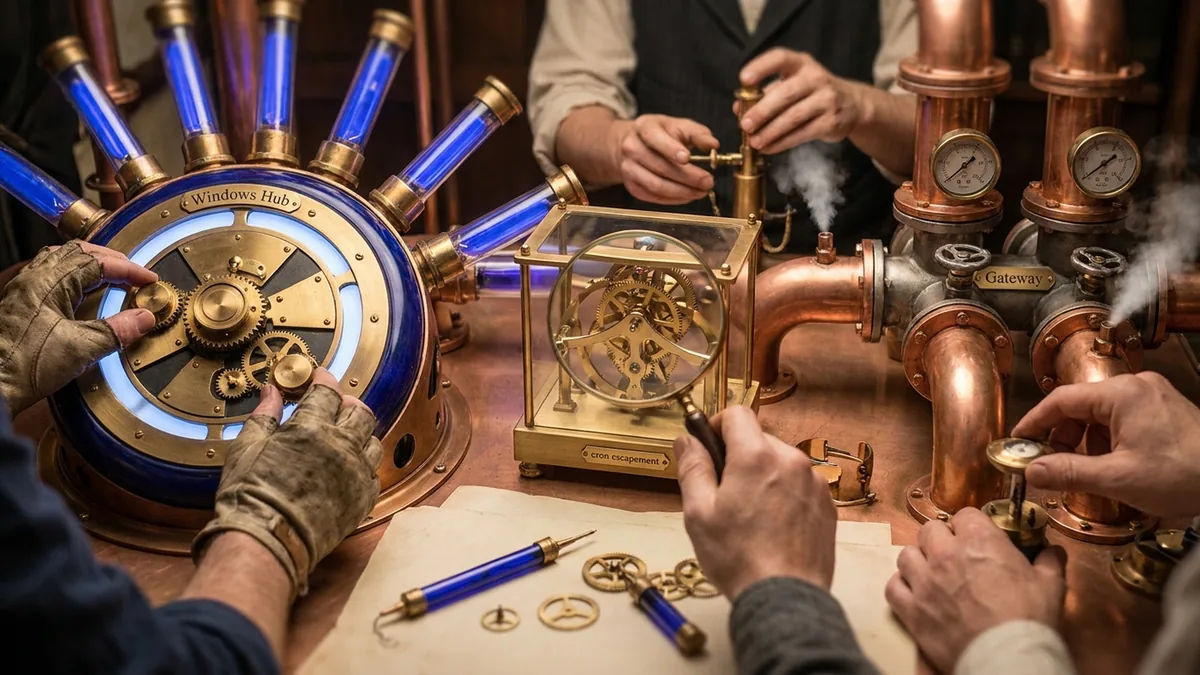
OpenClaw’s Reliability Week Brings Windows Hub, Faster Cron, and Gateway Pressure
The latest OpenClaw work is less about spectacle than operational truth: startup fixes backed by reproductions, narrower cron invalidation, a native Windows control surface, an expanding package registry, and concrete evidence that large deployments need a different definition of “ready.”
🦞 OpenClaw Updates
Main Repairs a Bun-Specific Gateway Startup Failure
The official release page still identifies OpenClaw 2026.9.4 as the latest stable release. Development on main is already attacking failures found after that qualification. A September 18 merged change, PR #151269’s Bun SQLite startup repair, ends released snapshot transactions before closing their connections. The report says Bun 1.4.0 could retain prepared statements until garbage collection, leaving a read lock alive and blocking snapshot retirement with SQLITE_BUSY.
The fix is tiny—four production lines according to the pull request—but the proof is not. Maintainers reproduced the regression against its introducing revision, exercised real SQLite locks, ran 53 tests across snapshot ownership and cleanup suites, and passed a packaged Bun smoke test covering installation, CLI, Gateway startup, health, and an agent turn. That is the right shape for infrastructure maintenance: locate the ownership error, preserve deletion ordering and cleanup guarantees, then prove the actual packaged path.
Cron Stops Rebuilding Unrelated Session Rows
Another September 18 merge, PR #151279’s targeted automation invalidation, changes how cron events affect the session list. Previously, an automation event could rebuild every resident session row even when no enabled job changed its binding. The new index compares effective binding membership and refreshes only the affected logical rows.
The submitted evidence used 760 synthetic sessions across 15 cron mutations. Unrelated row materializations reportedly fell from 758 per operation to zero, while eight unchanged-binding updates showed median session-list latency moving from 269.269 milliseconds to 31.109 milliseconds on the same-host harness. Those are observational timings, not universal benchmarks, but the design win is broader: change propagation now follows the identity that changed instead of invalidating the room.
Both fixes reward the same engineering discipline: make ownership explicit and narrow the blast radius. The Bun repair settles a transaction at its owner; the cron repair invalidates only bound sessions. Agent platforms become dependable when background work has precise lifetimes, identities, and evidence—not when operators are told to restart and hope.
Large-Fleet Evidence Challenges a Superficial “Ready” Signal
An open, P0-labeled Gateway starvation report for a 632-agent fleet provides a useful caution against extrapolating from ordinary installations. On the reporter’s copied production state, a main revision bound its listener and logged readiness, yet none of 504 five-second health probes completed across two boots. The report also recorded rising memory and a 68-second event-loop block during chat-metadata work. It explicitly distinguishes this failure from an earlier, separately documented slow-start problem.
This is one deployment report, not proof that every 2026.9.4 system is unstable. It is still valuable because the author supplies environment, revision, phase timings, probe counts, and a repeatable harness. For operators with hundreds of agents, “process exists” and “listener bound” are weak readiness criteria. A useful gate must exercise a health request after initialization, impose a response deadline, and keep sampling beyond the first nominal-ready event.
🔒 Security Practice: Keep One Trust Boundary per Gateway
Split Mixed-Trust Users Before Adding More Policy
The official OpenClaw security guide states that one Gateway is designed for one trusted operator or a team whose members trust one another. It is not a hostile multi-tenant boundary for mutually adversarial users. If customers, contractors, or separate organizations should not share credentials or agent authority, use separate Gateways—ideally under separate OS users or hosts.
- Keep the Gateway on loopback unless remote exposure is deliberate and authenticated.
- Retain DM pairing and explicit group allowlists instead of opening broad ingress.
- Run
openclaw security auditafter changing channels, network exposure, plugins, or tool permissions. - Restrict cross-provider messaging when an agent should not send outside its current provider or conversation.
Operational rule: when the people do not share trust, separate the runtime and credentials. More allowlist entries cannot manufacture a security boundary the architecture does not claim to provide.
🪟 Tool Spotlight: OpenClaw Windows Hub
Native Companion with Local Capability Gates
The official OpenClaw Windows Hub repository describes a native companion for Windows 10 20H2 or later and Windows 11. It can install a dedicated local Gateway in WSL or connect to an existing Gateway, then expose only the capabilities enabled by the user: system tools, Chromium control, camera, canvas, screen capture, location, text-to-speech, and local speech transcription.
Its most important feature is layered denial. A permission switch controls what the PC advertises; Gateway policy can still block it; Windows consent applies to sensitive devices; and system commands remain subject to exec approvals and sandbox policy. Camera, screen, microphone, spoken output, and command execution stay off unless deliberately enabled. The repository also documents locked-down, recommended, unprotected, and custom sandbox profiles instead of pretending every Windows workflow needs host-wide access.
Why it matters: Windows support is becoming a first-class control surface, not merely a shell compatibility story. The app combines native chat and status with capability diagnostics, reapproval warnings, local isolation, and explicit privacy controls. That makes it useful precisely because it exposes boundaries rather than hiding them.
📦 ClawHub Becomes More Than a Skill Shelf
The ClawHub registry documentation now describes one catalog spanning text-based skills, native code plugins, bundle plugins, and experimental whole-agent packages. Operators can inspect packages without installing them, pin local skill copies against updates, search by embeddings, and review trust and capability metadata. Skill metadata can declare required environment variables and binaries, which ClawHub’s security analysis compares with observed behavior.
That broader catalog creates a clearer supply-chain job for the registry. Search quality is only the beginning; durable value comes from exact artifact resolution, provenance, visible review findings, moderation, and local pinning. Whole-agent packages raise the stakes again because they package more authority than a procedural Markdown skill. The useful default is inspection first, exact version selection second, installation last.
🌐 Ecosystem Context: Learning Loops Are Becoming Table Stakes
Adjacent projects are converging on similar ideas. The Hermes Agent repository from Nous Research documents agent-curated memory, skill creation after complex work, skill improvement during use, session search, scheduled automations, multiple terminal backends, and messaging through a single Gateway process. It also offers an OpenClaw migration flow that can preview imports and move selected settings, memories, skills, and workspace instructions.
This does not make the systems interchangeable. It shows where user expectations are moving: agents should remember, package successful procedures, run away from a laptop, expose multiple channels, and migrate without trapping data. The differentiator shifts to governance—how clearly each platform shows authority, placement, approval, provenance, and failure recovery when those features interact.
OpenClaw’s competitive advantage will not come from having one more connector than its peers. Windows Hub, ClawHub packages, cron projections, and Gateway diagnostics become a coherent system only when operators can answer five questions quickly: who authorized this, where did it run, what could it access, what survived failure, and how do we prove the result?
Need help operating OpenClaw reliably?
SEN-X provides enterprise OpenClaw consulting—architecture, security hardening, custom skill development, deployment validation, and ongoing support.
Contact SEN-X →